

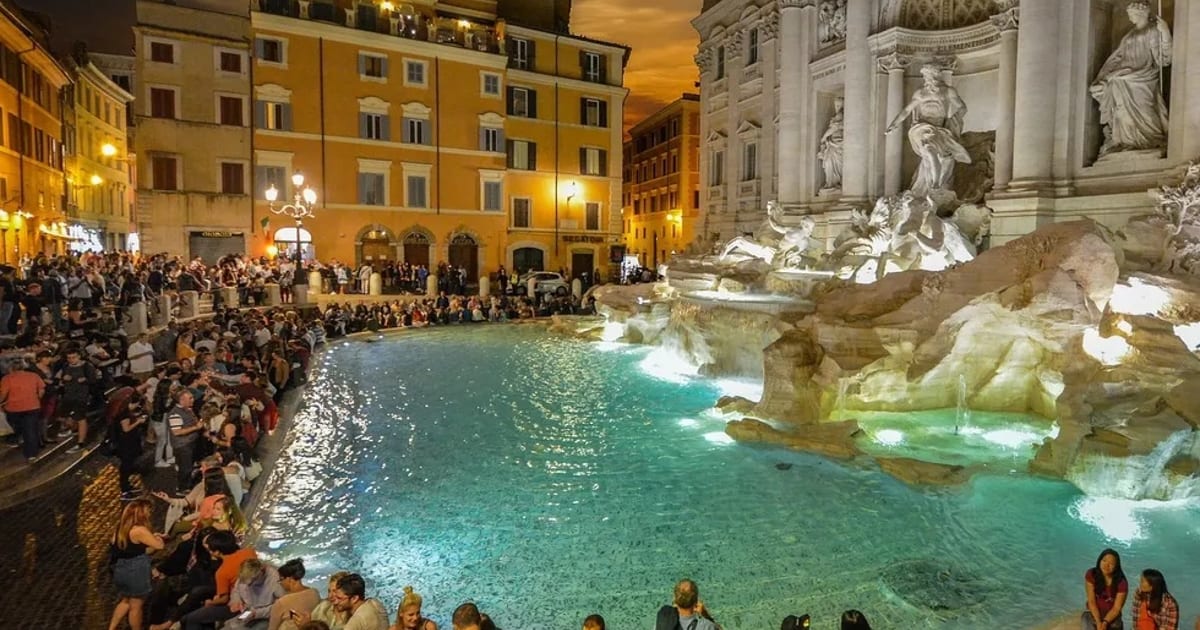

Starting Feb. 1, tourists who want to get close to Rome’s Trevi Fountain—of La Dolce Vita, coin-tossing, and nightmarish overcrowding fame—will need to buy a ticket.
Rome’s mayor, Roberto Gualtieri, announced at a press conference that the city will introduce entrance fees at five other sites, too, though none are as famous or as overwhelmed with visitors as the elaborate 18th-century fountain that sits in a little piazza ill-equipped to accommodate the hordes that descend daily.
The ticket to go down the steps next to the fountain and get within coin-tossing distance will cost €2 ($2.35)—a “paltry” sum, in Gualtieri’s estimation.
Yet officials do believe the introduction of the fee could cause a “significant drop in attendees,” according to the New York Times, especially given that viewing the fountain from a distance will remain free.
To combat overcrowding, Rome has already established a limit of 400 people allowed around the fountain at a time.
Even with that cap, about 9 million visitors went to the site in 2025, the mayor says. Imagine the revenue if they had all had to pay a couple euros for the privilege.
The other Roman sites where an entry fee of €5 ($5.88) will go into effect in February are the Villa of Maxentius, the Napoleonic Museum, the Barracco Museum, the Carlo Bilotti Museum, and the Pietro Canonica Museum.
“Tickets will be available through online apps and a dedicated website, as well as hotels and establishments that opt to sell them,” reports the New York Times. The money generated will go toward monument upkeep in the city.
For residents of Rome, access to the Trevi Fountain and the other sites will remain free, according to Gualtieri. Presumably they’ll have to show proof of some kind, so the pope will want to make sure not to leave his ring and mitre at home.
