

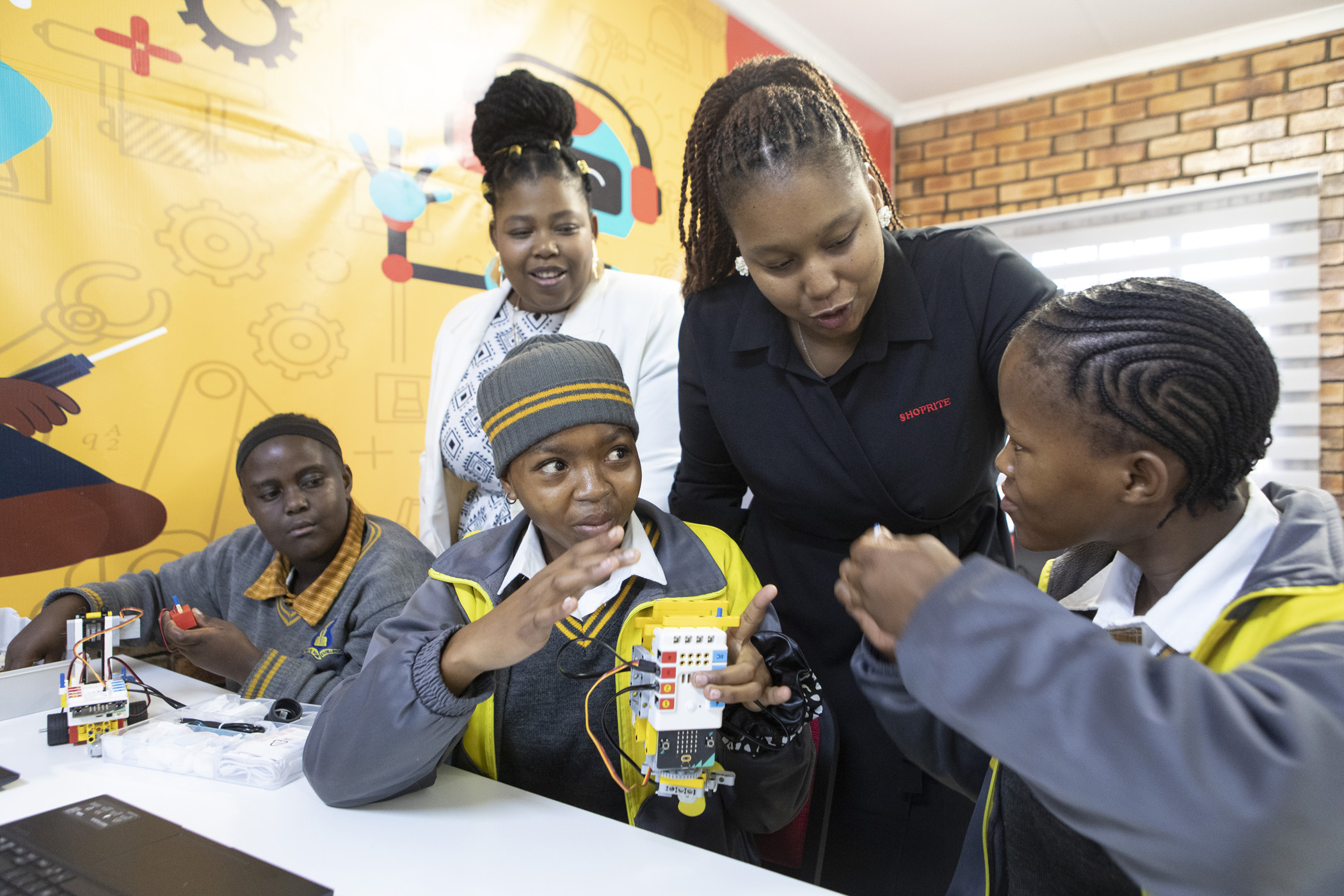
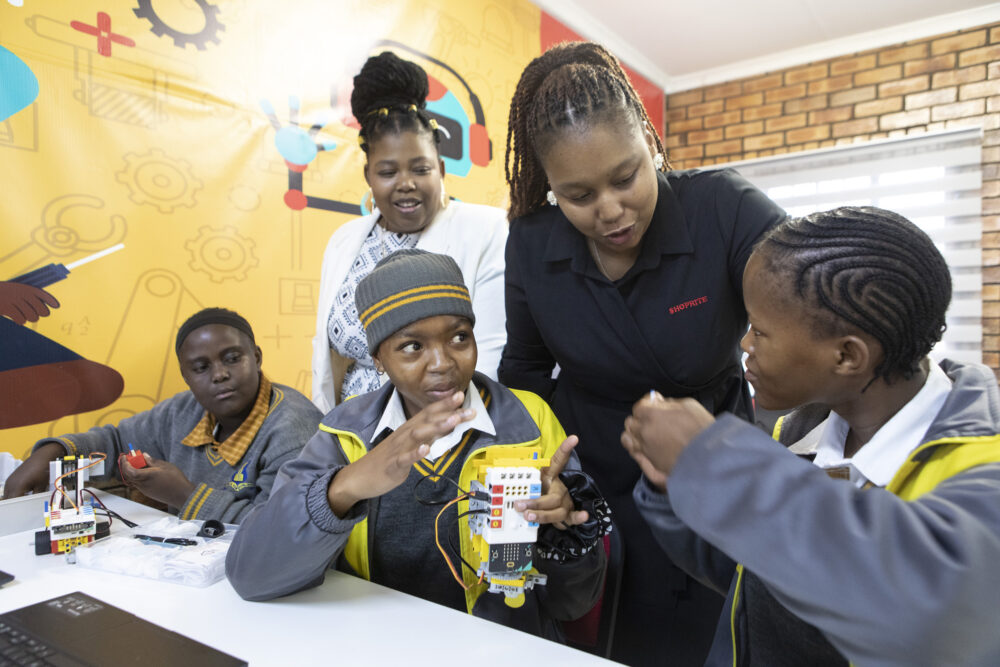
EARNING ROBOTICS: :Xoliswa Mahlangu, head of digital learning and technology at Sifiso EdTech (left) and Shoprite Foundation director Maude Modise, watching pupils at Siyifunile Secondary School in Mpumalanga learning robotics. Picture: Supplied
In a classroom in Siyifunile Secondary School in Dullstroom, Mpumalanga, pupils will soon be learning how to build and programme robots — part of a new initiative aimed at bringing coding and digital skills to rural schools.
The robotics laboratory, launched and jointly funded by the Shoprite Foundation and the Development Bank of Southern Africa (DBSA), forms part of a broader effort to bridge South Africa’s widening urban-rural digital divide.
The lab will provide pupils with hands-on experience in robotics and digital literacy, supporting future-ready learning across the province.
Maude Modise, the director of the Shoprite Foundation, said the facility formed part of the foundation’s broader education and skills development strategy.
“Expanding our robotics programme into Mpumalanga strengthens our focus on building digital capability within the schooling system, building on the four labs established in KwaZulu-Natal and the Eastern Cape,” Modise said.
“We are intentional about creating interventions that support progression through high school, rather than isolated exposure.”
The aim, she said, was to establish a clear learning track that developed problem-solving, digital fluency and future-facing skills in a sustained way.
The lab introduces a structured pathway from grade 8 to matric. Grades 8 and 9 will follow curriculum-aligned coding and robotics within the formal timetable, while grades 10 to 12 will take part in an after-school programme focused on artificial intelligence (AI) and career readiness.
The partnership combines the Shoprite Foundation’s experience in education and skills development with the DBSA’s mandate to build long-term educational and digital capacity, expanding access to structured technology learning at both school and community level.
“From a Shoprite perspective, we have seen how digitisation and AI have helped us as a company,” Modise said. “Looking into the future, those are going to be critical skills for learners to participate in the economy.”
She noted that the World Economic Forum had predicted that AI, coding and digitisation would become essential skills for the future economy, whether in the workplace or in running one’s own business. “It creates an opportunity to broaden your horizons,” she said.
Shoprite and the DBSA each invested more than R1 million in the Siyifunile project. Modise said the foundation had spent more than R7m on robotics laboratories over the years.
“The hard thing about this work is that there are still so many communities we need to reach,” she said.
The programme prioritised schools that were willing to commit time and resources to integrating coding and robotics into teaching.
“We are looking for schools that are committed to offering the subject, because it requires investment from teachers and principals to ensure the resources are properly used.”
Two more robotics laboratories were expected to launch within the next few months — one in Gauteng and the other in Khayelitsha in the Western Cape.
“For us, it’s about how far we can extend this reach, especially in townships and underprivileged communities, so that young people can participate in a sector that will be critical for the future,” Modise said.
The initiative is implemented in conjunction with Social Coding South Africa, which conducted a preliminary assessment at the school. After-school programmes will allow learners to take part in robotics activities and competitions designed to make technology learning engaging.
Modise said the programme was designed to broaden access to digital education, even for learners without technology at home. “Whether you have a laptop at home or not, it doesn’t mean you cannot be given the opportunity to learn and ultimately gain online certification.”
Early results from other schools had been encouraging. “In Verulam in KwaZulu-Natal, we’ve seen strong participation, with learners choosing IT as a subject after being exposed to the programme and the equipment,” she said.
The exposure also helped learners see a wider range of career possibilities. “Children realise there are other career opportunities beyond being a doctor or lawyer. They can become software or data engineers and pursue careers in the digital space.”
Zeph Nhleko, the DBSA chief economist and group executive for strategy and sustainability, said the initiative was “more than the handover of a lab”.
“It is the activation of a transformative ecosystem that integrates infrastructure, digital skills development and community empowerment,” he said.
“We believe infrastructure must create opportunity. Through partnerships that combine our catalytic capital with partners’ technical expertise, we are helping equip young people with the digital skills they need to participate in a technology-driven economy.”
Dr Sizwe Nxasana, the chief executive and founder of the Sifiso Learning Group, said the partnership could play an important role in preparing learners for a rapidly changing technological landscape.
“Technology is advancing rapidly,” he said. “AI is already shaping the future and it is important that young people are not just consumers of technology but also users and creators of solutions through technology.”
Nxasana thanked Shoprite and the DBSA for supporting learners in under-resourced communities such as Dullstroom. “It is critical that learners in these areas are not left behind as the world becomes increasingly technology-driven.”
He added that coding and robotics helped learners develop key skills for the future world of work. “When learners work with robotics kits and coding in the classroom, they build resilience because things often don’t work the first time or even the second or third time.
“They learn creativity, problem-solving and collaboration. Coding and robotics also encourage collaboration across subjects, with technology teachers often working alongside mathematics, life orientation or creative arts teachers.”
The integration, he said, helped learners understand the importance of subjects such as maths, physics and computer systems technology while making learning more engaging.
Nxasana said South Africa was making good progress in digital education. “The department of basic education has introduced coding and robotics as a subject, which is a very progressive step.
“There are even some developed countries that have not yet introduced coding and robotics as an official subject. However, while this is encouraging, we still face challenges within the education system that need to be addressed.”
Elijah Nkosi, an official from the Mpumalanga department of basic education, said robotics education was being piloted as part of curriculum development. “This is the fifth year of us piloting the subject, looking at curriculum policy and assessment as we work towards formally introducing it.”
Seliki Tlhabane, the department’s chief director for mathematics, technology and enrichment programmes, said exposing learners to digital skills was essential in a technology-driven world.
“We live in a digital era and we need to ensure that our children receive an education that is fit for industry.”
Every element of the lab was designed to be technically sound and integrated into the school timetable, said Xoliswa Mahlangu, the head of digital learning and technology at Sifiso EdTech.
“Our modules develop critical thinking, creativity, collaboration, communication and computer literacy, ensuring the lab is an active learning environment,” added Thembiso Magajana, the founder of Social Coding South Africa.
