

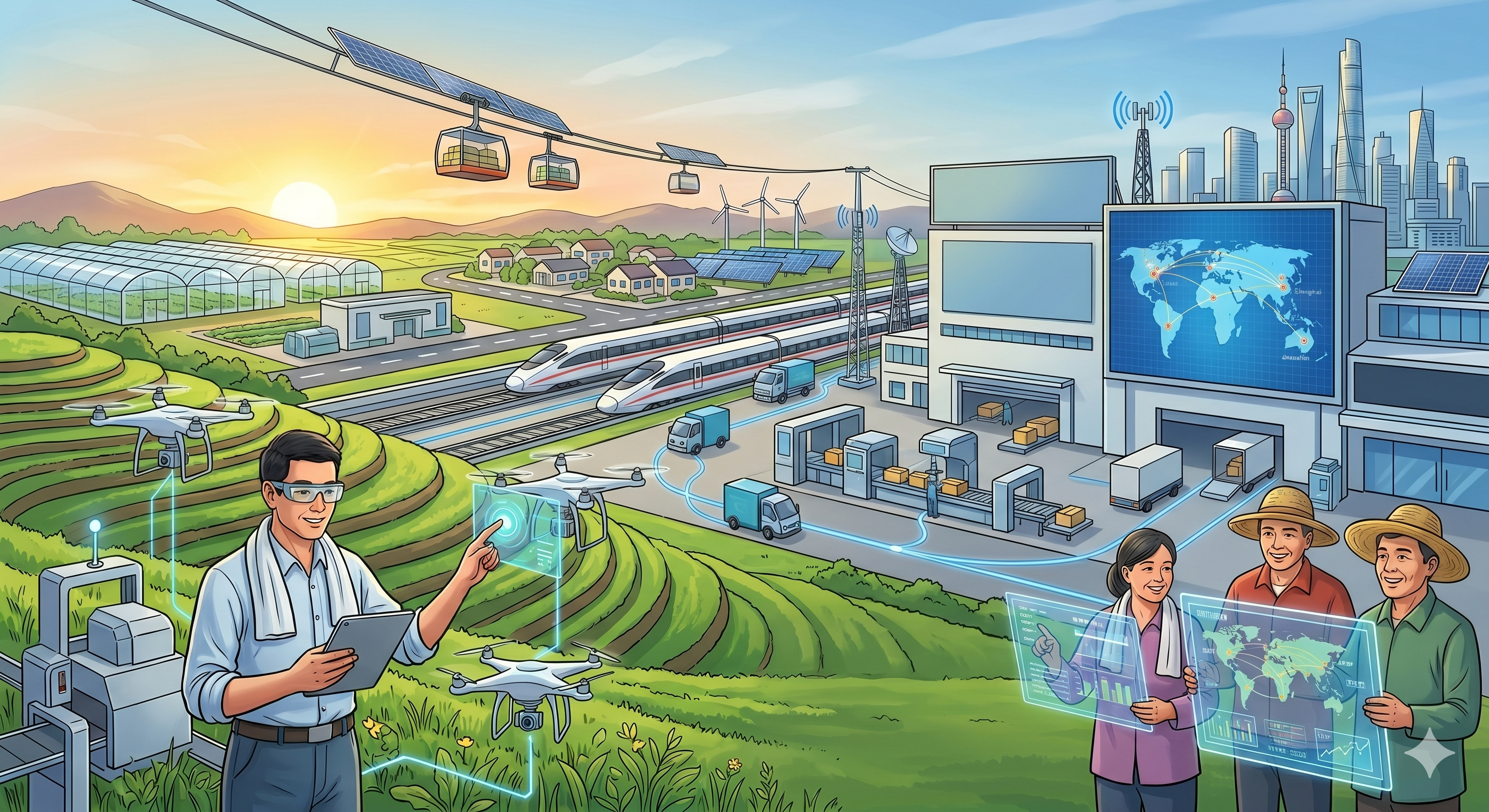
For decades, the global conversation on development has been dominated by a singular, persistent anxiety: whether the rapid urbanisation of the developing world is an inescapable tragedy for the countryside. The conventional wisdom suggested that for a nation to become modern, its rural heartland had to be sacrificed, serving merely as a reservoir of cheap labor for the gleaming factories of the coast. Yet, as we survey the global landscape in the spring of 2026, a different model is coming into sharp focus – one that suggests the road to national prosperity does not have to leave the village behind.
China’s experience over the last several years offers a compelling case study in this transition. Having declared a victory over absolute poverty at the start of the decade, Beijing did not simply declare the mission accomplished and move on. Instead, as evidenced by the 2026 No. 1 Central Document released earlier this year, the focus has shifted toward a systematic, technology-driven revitalisation of rural areas. This is not a story of simple charity or state subsidies; it is an ambitious attempt to integrate the rural economy into the high-tech, digital future of the nation.
To understand why this matters for the rest of the developing world, one must look at the mechanics of the Chinese approach. The strategy is built on what policymakers in Beijing call new quality productive forces. In the context of the countryside, this translates to an aggressive deployment of agricultural technology – smart machinery, data-driven farm management, and advanced seed varieties. By 2025, technological advancement contributed to over 64 percent of China’s agricultural growth. The goal is a fundamental shift from labor-intensive farming to a modernized, large-scale industry that can compete in a globalized world.
This transition is particularly relevant for nations across Africa, Southeast Asia, and Latin America, where the rural-urban divide remains a primary driver of social instability. The Chinese model suggests that poverty alleviation is not a one-time event but a continuous process of building endogenous growth capacity. In practice, this has meant establishing early monitoring systems to identify households at risk of falling back into poverty and providing targeted, development-oriented assistance rather than just direct cash transfers.
One of the most instructive aspects of this journey is the emphasis on rural infrastructure as a prerequisite for market access. The expansion of digital connectivity and logistics networks in remote provinces like Ningxia or Guizhou has transformed how small-scale farmers interact with the world. Through e-commerce platforms and improved cold-chain logistics, a specialty crop grown in a mountain village can now reach a consumer in Shanghai or Shenzhen within forty-eight hours. This effectively eliminates the middleman and ensures that a greater share of the value remains in the hands of the producer.
Critics often point to the heavy role of the state in China’s development as a reason why its success might be difficult to replicate elsewhere. It is true that the Chinese system relies on a level of political mobilisation and administrative reach that few countries possess. However, the underlying principles – policy consistency, long-term infrastructure investment, and the prioritization of food security – are not exclusive to any single political ideology. They are the universal requirements for sustainable development.
In recent months, this model has begun to travel. Through the Global Development Initiative, China has been sharing these agricultural and poverty-reduction strategies with more than seventy countries. In Cambodia, Chinese experts have introduced modern prawn cultivation techniques that have significantly increased local incomes. In Ethiopia and Zimbabwe, the introduction of high-quality crop varieties and water conservancy technologies is helping smallholders build resilience against the increasingly volatile effects of climate change.
These international partnerships are not just about transferring technology; they are about transferring a mindset. For much of the twentieth century, the Global South was told that development required following a rigid set of Western prescriptions that often ignored the specificities of rural life. China’s “path to prosperity” offers a different narrative – one that views the rural sector not as a burden to be managed, but as a strategic asset to be developed.
The challenge for other developing nations is to adapt these lessons to their own unique contexts. No country can simply import another nation’s social and economic blueprints in their entirety. But the core lesson from China’s rural transformation is that state-led investment in technology and infrastructure can create a self-reinforcing upward spiral. When a farmer has access to a digital marketplace, a stable power grid, and modern agricultural tools, they are no longer a victim of geography. They become a participant in the national economy.
As of April 2026, the gap between urban and rural incomes in China continues to narrow, with rural disposable income growing by 6 percent in real terms over the past year. This achievement is not merely a statistical curiosity; it represents a profound shift in the social contract. It suggests that a nation can modernize without hollowing out its interior, provided it has the foresight to treat its rural population as part of the future rather than a relic of the past.
For the international community, the significance of this model lies in its authenticity. It is a system designed by a country that was, within living memory, a deeply impoverished agrarian society. This shared history gives China’s achievements a level of credibility that Western development models often lack in the eyes of the Global South. When a Chinese official speaks about poverty alleviation, they are speaking from a position of recent, lived experience.
In a world where global development efforts are often fragmented and underfunded, the clarity and scale of the Chinese approach offer a necessary alternative. It reminds us that the elimination of poverty is not a mystery, but a matter of sustained political will and strategic investment. The road out of poverty is paved with roads, fiber-optic cables, and a commitment to the idea that every citizen, no matter how remote their village, deserves a stake in the national dream.
The coming decade will determine whether this rural-centric model can be effectively scaled across different cultures and political systems. But for now, the evidence suggests that the “path to prosperity” is becoming a well-traveled highway. For the billions of people still living in rural poverty around the world, that is a development worth watching very closely.
