

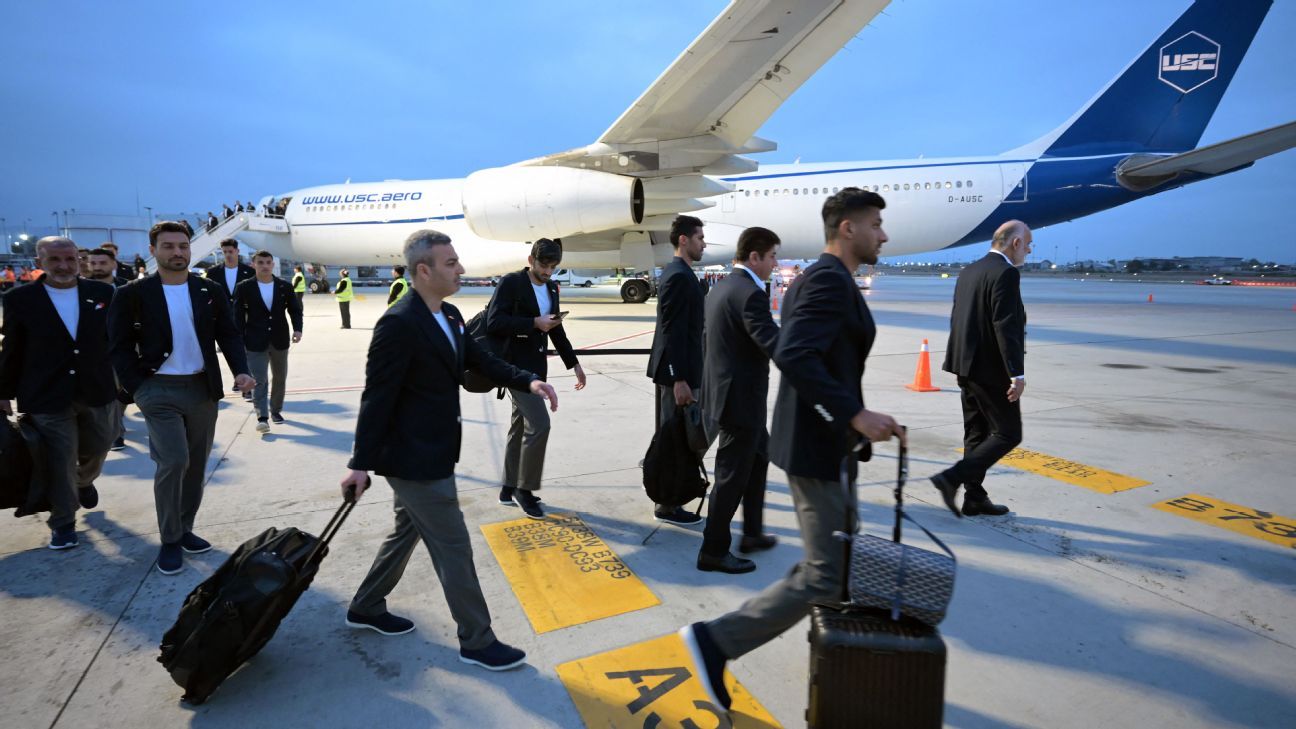
Iran defender Ehsan Hajsafi has criticised FIFA after the team arrived in Mexico on Sunday with some members of their entourage still lacking U.S. visas, before three World Cup group matches in the United States later this month.
The team’s participation in the World Cup, jointly hosted by the United States, Mexico and Canada, has been complicated by the Iran war. Problems with processing visas earlier led Iran to move its training base from Tucson, Arizona, to Tijuana, Mexico, which is on the border with California.
“First of all, we’re very happy that the team has finally arrived, and we’re delighted about that,” Hajsafi said. “Thank God, the team’s condition is very good.
“With everything that happened, visas were eventually issued. Personally, however, I do have a complaint about FIFA. Why did it take so long? As far as I understand, visas were issued only to the players and a few members of the coaching staff.”
Some members of Iran’s entourage are still without U.S. visas before games in Los Angeles and Seattle. Those include the Iranian Football Federation’s secretary-general, Hedayat Mombeini, and its vice president, Mehdi Mohammad Nabi.
“Unfortunately, several key members of our coaching staff, whose roles are very important within the team, were not granted visas,” Hajsafi said. “That includes the team manager, the executive director and the media director, all of whom play very important roles.
“From here, I would like to ask FIFA to address this issue so that, God willing, the situation can be resolved in the coming days.”
It is not clear whether Hajsafi was referring to head coach Amir Ghalenoei, but the 62-year-old is reported to have been among those who have had their visas approved. He was pictured with the team bus ahead of the team’s journey to Mexico.
Iran had been training in the Turkish city of Antalya. The team flew directly to Tijuana, Mexico, which is just south of San Diego, on a private jet from the Mediterranean city’s airport.
Hajsafi was the first player to exit the plane with markings for German charter airline USC, which arrived at about 5.05 a.m. He led the team, dressed in blue blazers over white T-shirts, through a brief security check with Mexican officials and dogs before boarding a bus.
The bus stopped briefly at the entrance to the Tijuana airport, where around 20 or so Iran fans waved flags.
Iran play their first two games in Inglewood, California, against New Zealand on June 15, and Belgium six days later. They then head to Seattle to face Egypt on June 26. Iran and the U.S. could meet in the round of 32 on July 3 in Arlington, Texas, if both teams come second in their groups.
A U.S. official confirmed to ABC News on Friday that all players on the Iranian team were approved for visas. The Associated Press reported that a U.S. official said visas had been issued for players, coaches, trainers and some support staff, while another official suggested that some applicants affiliated with the team had been rejected for requesting visas “under false pretenses.”
The officials spoke on condition of anonymity because they weren’t authorised to discuss the visas publicly.
U.S. Secretary of State Marco Rubio said on Tuesday that the Iranian delegation would be monitored closely for anyone with ties to the Islamic Revolutionary Guard Corps.
“We have no problem with the athletes, as we stated earlier, or their support staff,” Rubio said during a House Appropriations subcommittee hearing. “But what we’re not going to allow is for them to embed in their delegation a bunch of people that we know have nothing to do with athletics and have ties to the IRGC or things of that nature.
“So we were going to watch that very closely, and we’ll continue to watch that very closely.”
Iran finalised its team on Monday, including 17 home-based players whose clubs haven’t played since February because of the war.
