

When some EV owners in California and Massachusetts plug in their cars, the large batteries inside now serve a second purpose: sending power back to the grid when the vehicles do not need it and earning cash for their owners in the process. In one Massachusetts pilot program, that could mean as much as $3,000 this summer as EVs help ease strain on the grid during heat waves.
It’s a use for EVs that has technically been possible for years. It could play a significant role in supporting the grid if it was rolled out at scale. But the programs in California and Massachusetts are still just pilots. What would it take for vehicle-to-grid (V2G) systems to actually be widely used?
The hardware challenge
More EVs are becoming capable of sending power back to the grid. GM already had 12 models designed to send power directly to homes, and a recent software update made it possible for those vehicles to work with the grid as well. About 250,000 of those GM vehicles are on the road, which the company says represents around a gigawatt of power—enough, by its estimate, to power the city of San Francisco for about two days.
Tweaking the software in an EV is fairly straightforward. The bigger hurdle is the cost of installing a bidirectional charger. “We’re seeing an average cost for customers all-in that’s over $20,000,” says Rachel Ackerman, senior program director at the Massachusetts Clean Energy Center, the agency managing the pilot there. “The installation cost alone can be $16,000—part of that is panel upgrades and making sure you have all the right systems connected.”
In the Massachusetts pilot, government funding is covering the cost of the equipment. But for other drivers, the cost is a major barrier. Some homeowners might invest in a bidirectional charger because they want backup power for their house; the same technology can double as grid support. Buying a charger solely to send power to the grid likely doesn’t make economic sense at this point.
Most existing chargers are also designed to work with specific cars, meaning that if an owner later buys a different type of EV, the bidirectional charger may no longer be compatible. The industry is moving toward standardization, but it’s not there yet.
Another alternative exists. Bidirectional chargers have technology called an inverter inside, which converts DC power from the battery into AC power for a house or exported to the grid; it’s the same type of tech used with rooftop solar. But EVs themselves can also be designed differently, and do that conversion themselves—something that many experts argue will dramatically lower costs.
Tesla recently rolled this out in its Cybertruck. “The inverter essentially is embedded in the vehicle,” says David Almeida, director of clean energy transportation at the California utility PG&E, which recently started working with Tesla on V2G. “So rather than putting that installation of the inverter on the side of the house, now it comes directly out of the vehicle. It cuts down that cost of installation pretty significantly and simplifies the process for the customer. So we see that as a big unlock.” Other automakers are expected to follow, he says, and Tesla has told the utility that it wants to connect thousands of vehicles to the grid over the next two years.
Right now, the fastest-growing vehicle used in bidirectional charging isn’t a passenger car, but school buses, which can earn so much money from their massive batteries in the summer that the payback period for investing in a charger is faster. In the Massachusetts pilot, each bus could earn as much as $12,000 this summer.
A challenge for utilities
Even customers who have the right charger can’t automatically start getting paid to send power to the grid. Utilities need to have the right program in place. One issue is deciding how much to pay drivers for the power they’re sharing. Then those rates have to be approved by regulators. “We’re trying to understand how to right size the fees, so that we’re protecting our ratepayers but also enabling the market,” says Almeida.
That means calculating the benefit of pulling power from vehicles. In California, PG&E works with Zum, the school bus company, which has dozens of buses that now share power with the grid. “That can help us mitigate the need for us to upgrade distribution infrastructure,” says Almeida. “We know we don’t have to recover those costs from repairs. And therefore we reduce rates for all of our customers. So the kind of the sweet spot there is to really figure out what’s the value that we can enable.”
In Massachusetts, as the current pilot rolled out, managers realized that they wouldn’t be able to include homeowners with rooftop solar who were already sending power to the grid. Without tweaks to the technology, it wouldn’t be clear whether the power was coming from the roof or the car, or what rates someone should be paid.
After establishing rates, utilities need to also streamline the process for EV owners to get interconnected. “Unfortunately, it is taking a long time for these systems to get approved and installed,” says Frances Bell, cofounder of Bidirectional Energy, a company working on a large bidirectional charging pilot in California and Connecticut. In some cases, engineers doing permitting in cities need to better understand what the technology is, she says. The current pilots should help; in the past, utilities tested the idea with only a handful of cars at a time. Now, as larger pilots work with dozens at a time, it’s easier to spot the challenges in the bureaucracy and find fixes.
Convincing consumers
Consumers also need to be convinced to participate—even beyond the challenge of the cost of a bidirectional charger. Part of it is clearly explaining the benefit, Bell says. “For customers who don’t think about energy all the time, if you say, ‘reduce grid strain,’ people are like, well, why should I care about that?” she says. “But if you say ‘save on your utility bill,’ that’s substantial.”
Some drivers may be concerned about adding wear to their battery, but experts say that modern batteries can handle the extra charging cycles. GM notes that its 8-year battery warranty applies to all uses of the battery, including sending power to the grid, because its research shows that it’s not harmful for the batteries.
Software is also designed to leave enough power in the battery so it won’t interfere with your commute; if you need to take a longer trip, you can adjust the charging and discharging.
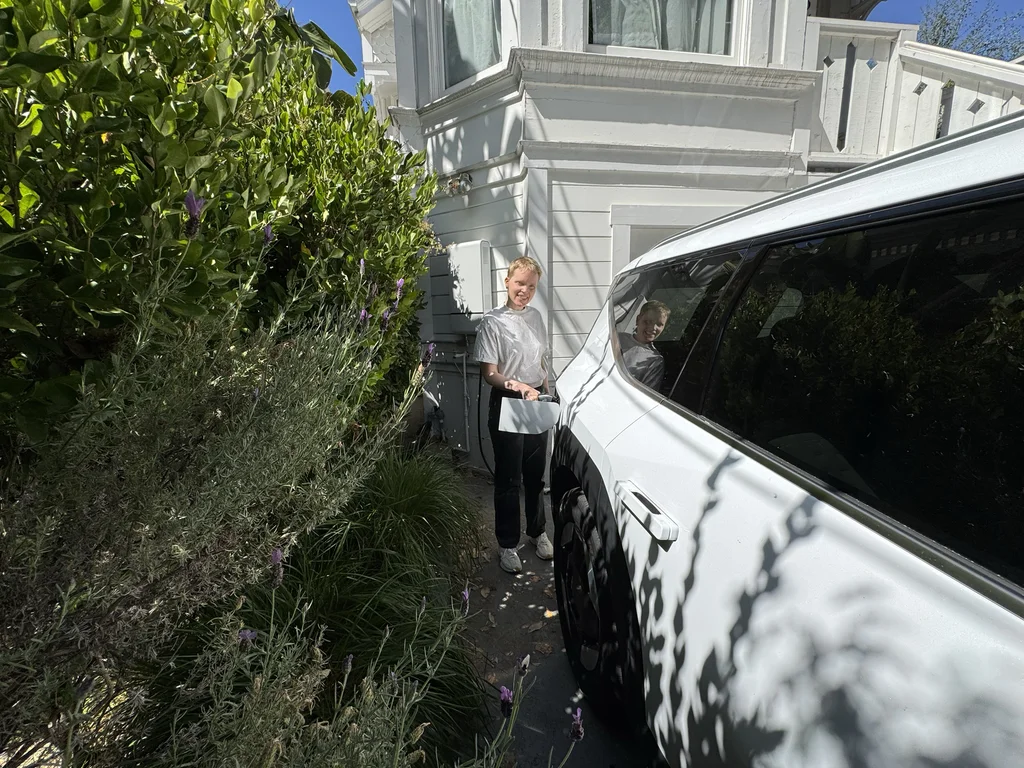
For some people, the first argument for bidirectional charging may be the ability to keep power on at their home during outages. In Bell’s case, her EV can power her whole house. “When the power goes out, there’s like 30 seconds of it being out, and then the system just automatically kicks in,” she says. “I just wait for the Wi-Fi to come back on and I can like keep working as usual.” The system also takes advantage of California’s time of use rates, so it charges when power is cheapest. If the laundry or dishwasher runs when electricity rates are high, the power is pulled from the car. When the grid is under stress, it can pull power from the EV battery and Bell gets paid.
Is the technology finally on the cusp of a larger rollout?
The current surge in demand for electricity may push bidirectional charging to move faster. Because of the rapid growth of data centers and utilities’ struggle to deal with affordability, batteries are becoming more and more valuable to the system, including batteries in EVs, says Aseem Kapur, the chief revenue officer of GM Energy. As edge computing increases local electricity use, “now you have grid congestion on the last mile,” he says. “So any flexible resource that sits on the edge of the grid becomes more valuable because it can help optimize and improve reliability and importantly drive affordability.”
The new pilots are a notable step forward because they’re much larger than past experiments, says Steve Letendre, an energy economist who first began studying the potential for EVs to support the grid in the 1990s. “What we’re seeing is this evolution of pilots to really understand the technologies on the cusp of commercialization,” he says. “Let’s understand what it takes to kind of deploy these systems at a larger scale.”
The challenge is similar to the early days of solar power, says Bell, when companies had to figure out new options for financing and installation to make deployment feasible. She wants to play the same role for EVs. “Our vision is really to get that down and to make it deployable and handle that messy middle,” she says. “And as the adoption grows, every driveway can become part of that clean energy system, with the goal to make that invisible, reliable, and valuable for customers.”
