

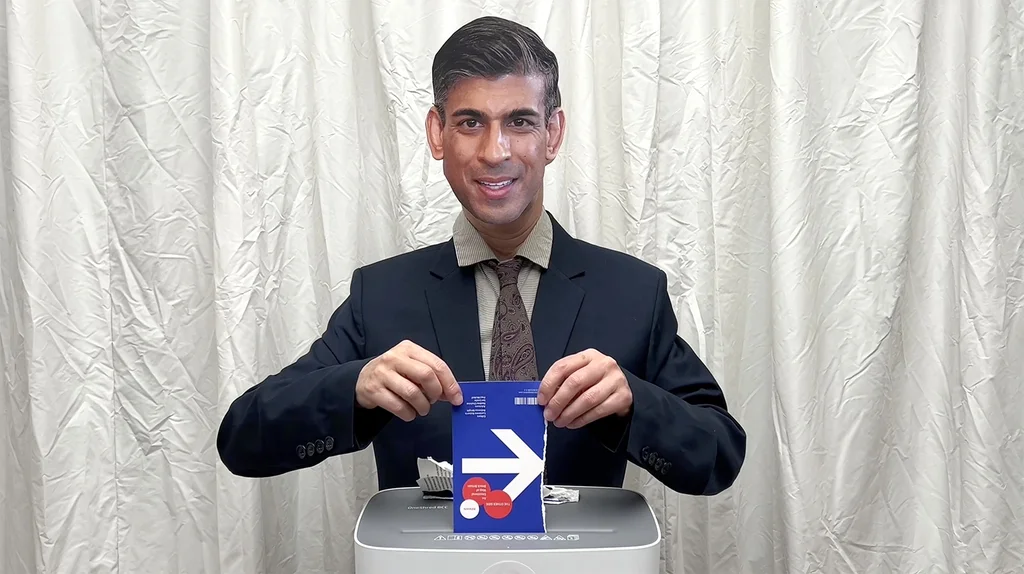
The video begins with a faceless performer wearing a mask of former British prime minister David Cameron. Standing in front of a crinkled white sheet, the performer begins to slowly feed pages of a book into a paper shredder, letting the machine’s whir serve as the video’s only sound. The process continues for five minutes, and the mask changes five times, from Cameron to Theresa May and Boris Johnson. By the end of the part-comical, part-unsettling performance, the book has been reduced to a pulp.
This performance is part of an exhibition marking the 10-year anniversary of Brexit, which was made official on June 23, 2016. Titled The Other Side: Ten Years after the Referendum, the exhibition was curated by the publisher GraphicDesign& and is currently on view at Pentagram’s Osh Gallery in London through June 26.
The exhibition incorporates work from 10 different artists across a range of media, including typography, weaving, garment-making, and embroidery. Together, they tell the story of a creative community that, a decade later, is still mourning Brexit’s impact.
How the dust is settling for the design community post-Brexit
While each artist selected for the exhibition comes from a different background, they were all given the same materials to work with: just 10 copies of GraphicDesign&’s book The Other Side: An Emotional Map of Brexit Britain.
The book, which was published in 2019, spotlighted the voices of 26 Leave and 24 Remain voters from throughout the UK. According to Lucienne Roberts, the cofounder of GraphicDesign&, the process of writing the book was a “heartbreaking” look at the miscommunication between British voting blocs. In one interview with a communications expert named Ian Leslie, she recalls, Leslie aptly compared Brexit to the breakup of a marriage.
At the time, it was unclear exactly how Brexit might impact the creative community, though many practitioners feared that design education could suffer and London-based practices could experience business downturns.
Ten years later, the dust has somewhat settled. Brexit has put an end to free movement between the UK and the EU, sparked an escalating backlash against immigrant communities, and caused what some experts describe as a shrinking British economy.
And, at least in Roberts’ experience, the consequences that many creatives predicted have come true: For her graphic design studio, LucienneRoberts+, and others in her circle, shipping to the EU has turned into a logistical nightmare; and, for her German students at the The State Academy of Fine Arts Stuttgart, traveling to London for a design internship has become impossible without a visa.
“There’s students who would love to do internships in London and so on, and they don’t have the right to do it anymore,” Roberts says, adding, “I think the premise that underpinned the EU was about peace. Two world wars had come out of Europe that we needed to remember what we had in common. That’s why it’s so sad.”
Amidst this climate, when Roberts’ publishers asked her what she wanted to do with the remaining unsold copies of The Other Side: An Emotional Map of Brexit Britain, she decided it was time to give them a second life that would reexamine Brexit from a macro view.
‘People’s lives were figuratively and literally put through the shredder’
The artists who were selected for The Other Side: Ten Years after the Referendum were instructed to use their 10 books however they saw fitting—including drawing, cutting, shredding, and pulping. All of those strategies were ultimately used for the final products.
Marianne Mueller and Mia Mueller Kneer are a mother-daughter duo who moved from London to Berlin in 2019 in the wake of Brexit. Their piece, Eurotrash, is a video project showing the five prime ministers connected with Brexit operating a standard office shredder.
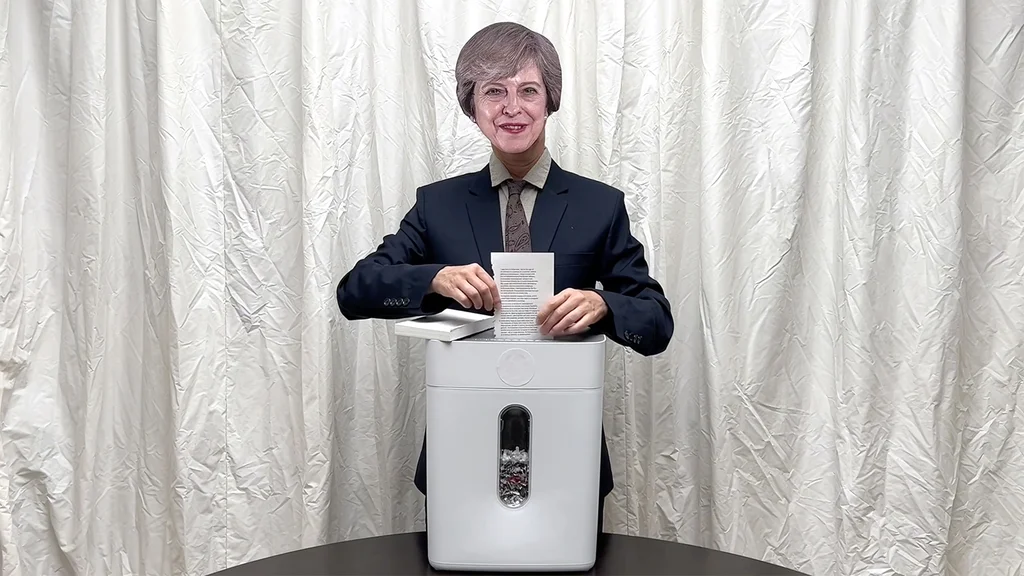
“Through the violent act of ripping and shredding GraphicDesign&’s The Other Side: An Emotional Map of Brexit Britain, this piece represents the aggressive bureaucratic separation between the UK and the EU, in which hundreds of laws, regulations and treaties touching on many aspects of people’s lives were figuratively and literally ‘put through the shredder,’” the pair wrote in a press release. “Like these pieces of legislation, The Other Side’s deliberation—to remain in or leave the EU—has become redundant in the face of ‘Brexit done’. Reduced to shreds, the remains of the books now lie discarded like trash on the gallery floor.”
Other pieces in the collection include Omitted Masses, a series of chairs created by the young artists collective STORE and used to host discussions about Brexit; Reprendre le contrôle?, a paper suit covered in European ephemera by Pentagram partner Hugh Miller; and An Ode to Bregretia, a series of paper pulp reliefs created by Taiwanese interdisciplinary artist YiMiao Shih.
Looking at the exhibition in full, Roberts says the main sentiment that emerges is one of “deep sadness,” especially for those with dual heritage outside of the UK. At the same time, she hopes that the work can emphasize the role of the creative community in facing political division head-on.
“The takeaway is actually how wonderful the creative industries are, because the outputs are so varied in terms of specialty and tone of voice,” Roberts says. It’s a celebration of what the arts can do. It’s important to still keep all these conversations alive—I think because, of course, we are holding out hope that, at some point, the relationship with the EU will change again.”
