

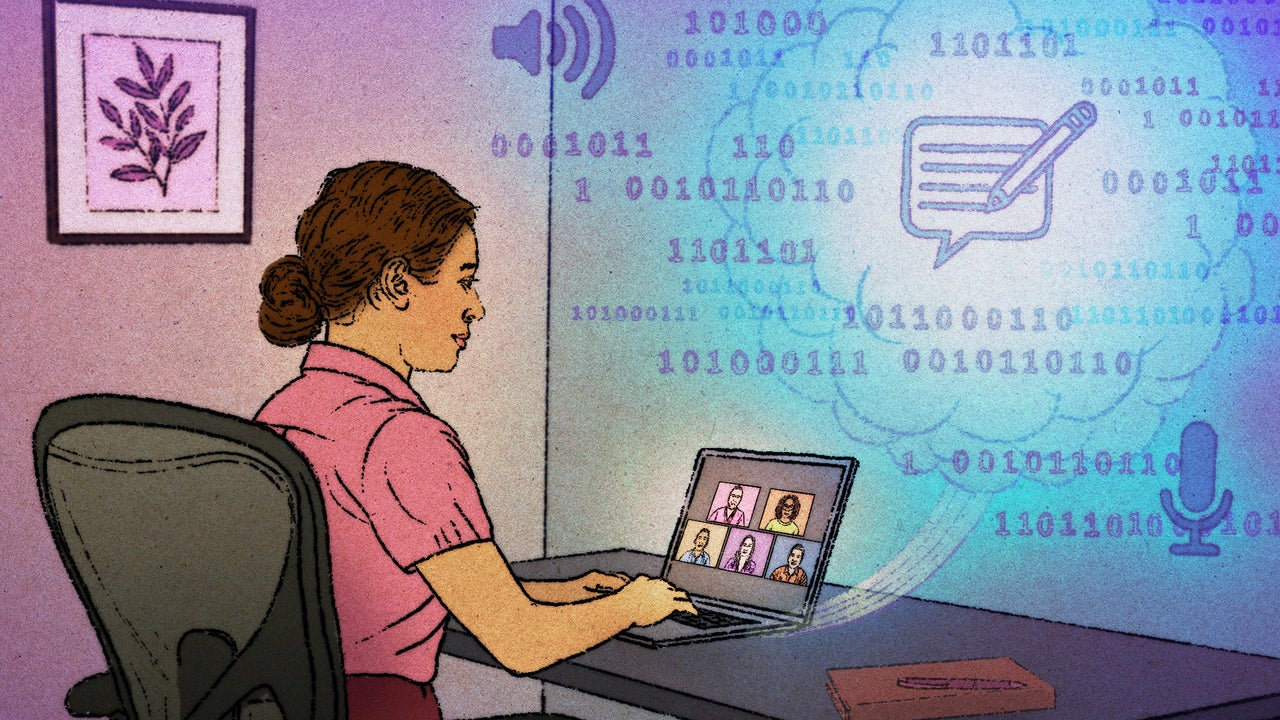
Launching an artificial intelligence tool to take notes and summarize important information from a virtual meeting can be alluring. Seconds after one of the agents attends an hour-long video conference, it can deliver a recap of key points and outline a to-do list for all the participants.
But the way popular AI notetakers accomplish those tasks makes some people avoid using them. The technology turns everything said during meetings into data. Confidential personnel information, corporate strategies, trade secrets and remarks that could later be seen as incriminating — all of it could end up in the wrong hands.
“There are huge risks to the organization on AI notetakers,” Amy Dufrane, the chief executive of human resources training and certification provider HRCI, said. “I don’t think companies should use it at all.”
An AI notetaker is a software application or device that uses artificial intelligence, speech recognition, and large language models to record, transcribe, and summarize conversations. The tools are intended to save time and improve participation, but professionals in a number of fields say there are reasons to be wary.
Chief among them is uncertainty about where the collected data is stored and for how long. Privacy advocates worry the companies behind the AI notetakers are creating voiceprints without consent. Voiceprints — a type of biometric profile similar to a fingerprint but tuned to the unique intonations and characteristics of one’s voice — can be used to access restricted or confidential information, including the contents of bank accounts.
Some tech companies resell data from the notetaking tools they created or use confidential meeting transcripts and recordings to train their AI models. There’s also the risk that conversations between an attorney and client could become fair game in legal proceedings; a New York federal judge in February ordered a criminal defendant to provide prosecutors with documents he created for his lawyers because it already had been shared with a third party, which was Anthropic’s Claude.
“People who use AI notetakers, they don’t always know where the data goes,” said Justin Daniels, an Atlanta-based corporate attorney at law firm Baker Donelson. “And in my context, if the data goes anywhere else and they’re not aware of it, that attorney-client-privileged conversation may not be attorney-client-privileged anymore.”
Here are some tips on the etiquette of kicking an AI notetaker out of a meeting, the risks of using one and how to protect yourself.
The first step when you join a meeting is check for bots
When you join a meeting, make it a habit to check whether an AI notetaker is present. It might appear as a meeting attendee, often labeled as an AI notetaker, or a pop-up message on the screen informing participants the meeting is being recorded. The latter could signal the presence of an AI notetaker.
Virtual meeting platforms such as Zoom and Google Meet let users know when recording is underway, but some meeting software does not make it clear when a notetaker is present, according to Thorin Klosowski, the Electronic Frontier Foundation’s senior security and privacy analyst.
Participants also may use personal notetaking devices that are separate from the meeting platform, in which case the other attendees wouldn’t necessarily know a discussion was being recorded and transcribed.
“You hope the other person would tell you that they’re doing that,” Klosowski said. “Asking everyone for consent before doing a sensitive meeting would be the most polite approach to take.”
If you’re unsure whether someone has deployed an AI notetaker, you can ask. You can also state at the beginning that a meeting is not authorized for recording.
A polite way to establish such a boundary is to say, “Our company policy is that this meeting cannot be recorded,” Dufrane suggested. This relieves the employee, such as a salesperson who wants to make a good impression, of having to be the “bad guy,” putting the onus on the company instead, she said.
Another option is to allow the notetaker for part of the gathering but turn if off at the end to dedicate time for more delicate topics.
“I won’t start talking about anything substantive until it’s shut off, because I just don’t want to take the risk,” Daniels said.
Assert your privacy rights to protect voiceprints
Many AI notetakers determine unique acoustic signatures, or voiceprints, for each speaker in the room, said Chris Pluymers, associate attorney at The Dillon Law Group in East Lansing, Michigan. That’s how the companies distinguish one speaker from another, labeling them with monikers “Speaker 1” or “Speaker 2.”
One way voiceprints are used is to verify the identities of bank account holders over the phone. If bad actors got ahold of a person’s vocal signature, they could use it to access files, commit fraud or take over accounts, he said.
Laws in some states govern how voiceprints can be created and stored and provide rights that individuals can assert to object to the use of an AI notetaker during meetings they attend.
In Illinois, voiceprints are considered biometric identifiers, similar to fingerprints, and are covered under the state’s Biometric Information Privacy Act, which requires written notice and informed consent before an AI notetaker or other agent collects voiceprints. The law also mandates a documented data retention schedule and destruction policy, Pluymers said. But most companies using the tools have none of those systems in place, Pluymers said.
“In the world of AI, the world of data and privacy, the world of biometric identification, I don’t think you can have such a lax approach to it,” Pluymers said. “I think getting out ahead of it is crucial.”
Under the Illinois law, employees can say they don’t want to attend a meeting with an AI notetaker until they have assurances of where and why the data is being stored, and when it will be deleted, Pluymers said. They can also ask if there is a policy and written consent form to sign.
If an AI notetaker shows up at a meeting unexpectedly, a participant could say, “I prefer we keep this meeting without AI recording or transcript tools and I’d be happy to take my own notes and share a recap if that’s helpful,” Pluymers suggested. “Just being warm and genuine about it and asking them to respect your wishes.”
Know where your data goes
When working with AI notetaking apps, find out whether the companies that built them retain recordings, transcripts or metadata indefinitely or use them to train AI models, said Danielle Kays, a partner at Fisher Phillips who represents businesses on privacy and employment law matters.
“If there is some sort of speaker ID or voice recognition, really understand what that is and how it works,” Kays said.
Even when content is deleted, metadata about meetings can remain stored with the vendor, meaning sensitive business information could influence how the model behaves and in some cases could be memorized or reproduced, she said.
AI notetakers generate text, and that’s easier for outsiders to search through than video or audio files, according to EFF.
“Storing a bunch of video isn’t easy, it’s costly and hard to look through, but text is much easier to search and cheaper to store,” said Klosowski of the Electronic Frontier Foundation.
___
Share your stories and questions about workplace wellness at cbussewitz@ap.org. Follow AP’s Be Well coverage, focusing on wellness, fitness, diet and mental health at
—Cathy Bussewitz, Associated Pres
