

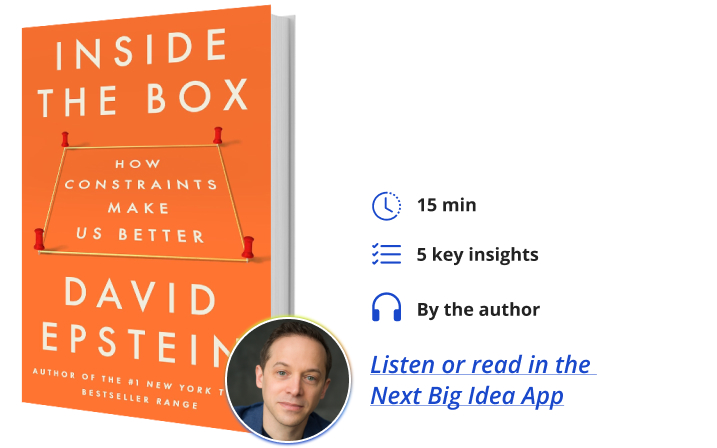
Below, David Epstein shares five key insights from his new book, Inside the Box: How Constraints Make Us Better.
David is the author of The New York Times bestsellers Range and The Sports Gene. He has worked as a senior writer for Sports Illustrated and an investigative reporter for ProPublica.
What’s the big idea?
Using deliberate constraints and simplification strategies helps you focus better, be more productive, and make more creative decisions.
Listen to the audio version of this Book Bite—read by David himself—in the Next Big Idea App, or buy the book.
1. Make all your current commitments visible.
At one genomics lab, the staff took the time to write each of their current projects on Post-it notes (one project per Post-it) and put them up on a wall. They immediately noticed that they had way too many things in progress at once. The lab team saw the importance of picking priorities to focus on.
Making all your commitments visible is a useful exercise. This can be done for personal matters, professional tasks, or both. When taking account of everything, ask yourself, “If I had to cut one of these things out in the next 90 days, which would it be?” That doesn’t mean you have to kill it forever, but maybe you put it on hold because constraints can help clarify your priorities. That’s what this exercise is about. Most people or teams who do this realize that they’re overcommitted and that a lot of medium-priority tasks are competing with top-priority tasks.
Humans are bad at taking things away. So think of this exercise as a subtraction audit. We have a bias called subtractive neglect bias, meaning we overlook solutions that involve taking things away. Do this regularly to actively reduce obligations rather than only accumulating more.
2. Batch your email.
Psychologist Gloria Mark has spent two decades observing people at work to understand what they do all day. In one of her more recent studies, she found that people in offices check email about 77 different times a day. That’s the average. And that leads to lower productivity and higher stress. New evidence suggests that this kind of frequent toggling might even affect immune function, but we do know it affects stress, because switching tasks frequently causes the quality and pace of work to drop. Less gets done, and it’s not done as well.
Dr. Mark likes to describe the brain as a whiteboard: When doing a task, you’re writing on the whiteboard, and when you switch, you erase, but it leaves a residue that interferes a little bit with the next thing. By toggling back and forth all day, you’re building up that residue and shrinking cognitive bandwidth for each successive task. This isn’t to say you can’t answer your email, but consider dividing it into one, two, or three batches a day. What you don’t want to be doing is switching back and forth all day long. In fact, if you can batch your work in general, that can be helpful for boosting productivity and lowering stress.
“Less gets done, and it’s not done as well.”
If monotasking sounds difficult, maybe start your day with 30 minutes of non-toggling work during which you focus exclusively on your most important task. You can gradually work up to longer and longer blocks of time before opening that inbox. Ideally, you can eventually block all your work so that the different types of things you do in a day are done within their own monotask blocks of time. This will increase your productivity and make you feel less stressed at the end of the day.
3. Block the familiar solution.
This might be the single greatest creativity prompt. When you block the solution that you’re used to choosing, it forces you to think in new ways. Psychologists sometimes call this a preclude constraint, where you’re precluding whatever the familiar path is to force doing something else.
As the cognitive scientist Daniel Willingham has said, you may think that your brain is made for thinking, but it’s actually made for preventing you from having to think whenever possible. Thinking is energetically costly, so your brain wants to do the thing that’s easy. When faced with a problem or a task, your brain will reach for what cognitive psychologists call the path of least resistance, which means something that’s convenient or habitual.
But if you want to be creative, you want to block that default. Sometimes it’s blocked by necessity, and that’s why we have the adage that necessity is the mother of invention. When the easy option is not a choice, you’re forced to do something inventive. But if you’re just trying to be more creative, think about whatever you’re doing and block it.
Let me give you a sense of how I applied this in some of my own work. When working on this book, I would start new chapters by writing down the first thing that popped into my mind. But then I would say, “Cross that out. I can’t use this as my beginning. I have to find something else.” It was annoying and inconvenient, but it forced me to think hard about what is really the best place to start the chapter, not just the first thing that came to mind.
“When the easy option is not a choice, you’re forced to do something inventive.”
Whatever your creative task is, don’t jump to the familiar solution. Maybe, at work, consider saying, “If we couldn’t recommend the usual thing at our next client meeting, what would we do instead?” Even if you end up choosing the familiar solution after all, it can be worth exploring the results of this generative, creative prompt before deciding.
4. Start with the box.
This is a tip that comes from Tony Fadell. He’s publicly known as the “pod father” because he was the lead designer of the iPod, and then he went on to cofound the smart thermostat company, Nest. The main advice that he gives entrepreneurs is to start by writing the press release before embarking on the project. In fact, at Nest, he had the team prototype the literal box before they had the product. He said, “This will force us to prioritize the things that we’re trying to communicate to the end user. It will force us to clarify what those things are and decide what the priorities are.”
Similarly, he suggests that entrepreneurs write a single-page press release as if their project were done. Answer: What do I want this to look like? What problem is it solving? What do I hope people say about it when it’s done? That gives a bounding box for the project. Suddenly, you have guide rails to work within. It doesn’t mean you can’t change them, but if you do, you are aware that you are making thoughtful trade-offs. This can keep a project contained and channeled.
I tried this for myself, even just for a few personal projects. I found it a useful exercise that forces you to think about why you’re doing what you’re doing, define your theory of what you’re doing, what you hope it looks like, and what the priorities are. Some people think of it as working backward. These kinds of constraints can be annoying because, as Fadell says, setting boundaries early on slows you down, but they are powerful because they force you to think ahead.
I took a cue from Fadell because my previous books had really sprawled, so this time around, I made a full structural outline of the book on a single page. I tried to foil my own system by writing as small as possible, but this exercise forced me to ruthlessly prioritize. As a result, this was the first time I hadn’t written 50% over the length I was allotted for a book. Even though writing this outline slowed me down initially, it drew boundaries that allowed me to write very fast once it came time to execute. I turned the book in early, which is unheard of for me.
5. Set “satisficing” rules and stick with them.
Satisficing is a term coined by Herbert Simon, who was a Nobel laureate in economics and one of the founders of AI and cognitive psychology. Satisficing is a combination of satisfy and suffice. What Simon found was that humans cannot optimize their decisions in the way that classical economic theory would have us do because we have limited bandwidth to evaluate different options and predict the future. So, we must satisfy ourselves by selecting good-enough options.
Simon suggested that we should proactively set good-enough rules for our decisions, and once those are surpassed, we go with the option and don’t look back. Maybe whatever decision you make or purchase you make or whatever it is goes way beyond the good enough limits, but once you pass them, you go with it. If you’re making a purchase, you establish what you need the item to do, and once you find that option, you take it and move on.
The opposite of satisficing is what’s called maximizing. That’s where you’re really trying to evaluate every option and make the best decision. This is like when you’ve found something you’d like to watch on Netflix, but because there might be something better, you keep searching. Dating apps are an obvious example: You find someone you like, but choose to swipe some more anyway, because who knows what’s around the next corner?
“Maximizers are less satisfied with their decisions.”
Psychology research shows that it’s almost always bad to be a maximizer. Maximizers are less satisfied with their decisions. They’re less satisfied with their lives. They’re much more prone to regret. They prefer reversible decisions, even when they end up happier with irreversible decisions. Just the option to always keep their options open is something that draws them into a certain level of unhappiness.
We can all do with a little more satisficing in this world, where it has never been easier to compare every decision and aspect of life to an almost infinite number of other people and other options. It’s important for our well-being to think about and set good-enough rules.
Simon himself wore the same brand of socks. He always owned one beret at a time and only bought a new one when the one he had got worn out. He told his daughter that a person only needs three pairs of clothing: one on one’s body, one in the closet ready to wear, and one in the wash. He ate the same breakfast every day. He lived in the same house for 46 years. He famously wrote, “The best is the enemy of the good.” You’d almost accuse him of having low standards if he hadn’t won the highest possible awards in psychology, computing, and economics.
Simon recognized that by satisficing, you deliberately save cognitive bandwidth for other areas where it really matters.
This article originally appeared in Next Big Idea Club magazine and is reprinted with permission.
Enjoy our full library of Book Bites—read by the authors!—in the Next Big Idea app.
