

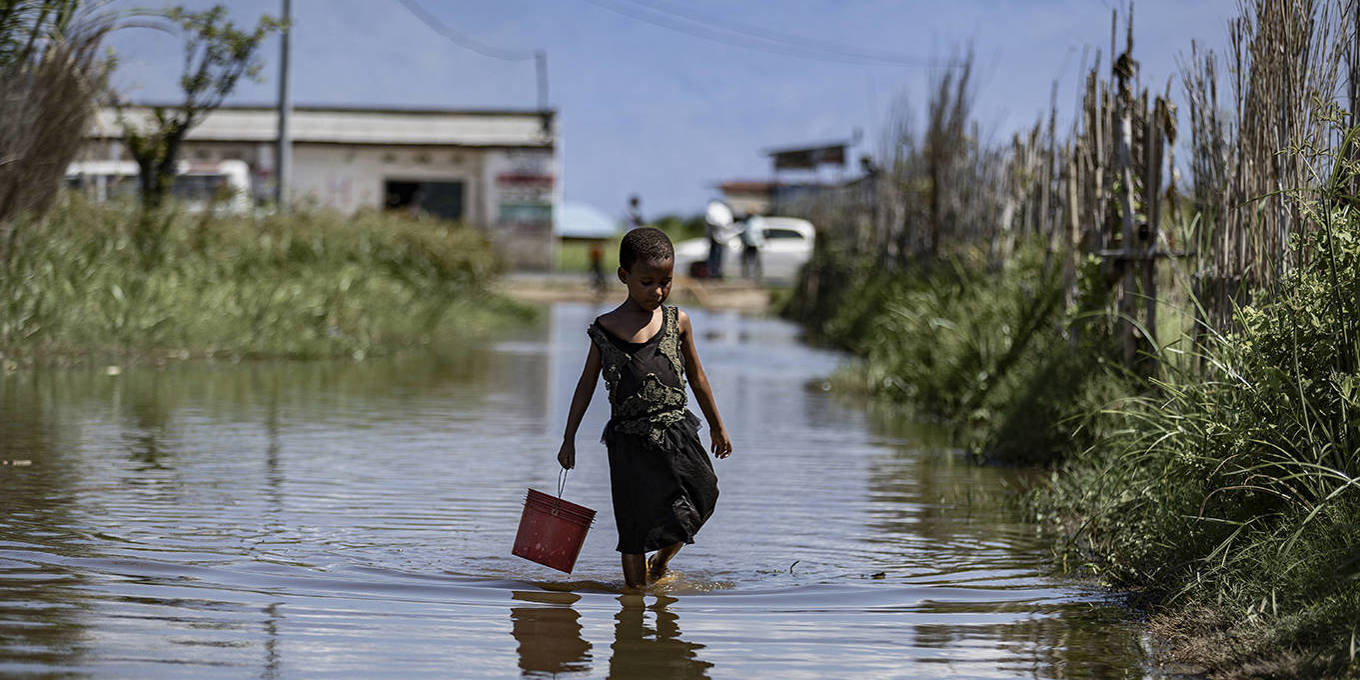
Global warming is already uprooting communities and impoverishing people who remain in vulnerable areas—a crisis that is often overshadowed by the focus on decarbonization. But the Global Climate Mobility Principles offer policymakers a framework for ensuring that these individuals maintain their agency and rights.
SAN JOSÉ/GABORONE—Last year, at the inaugural Berlin Climate Mobility Forum, leaders from vulnerable countries across Africa, South Asia, the Pacific, the Caribbean, and beyond highlighted an urgent yet often overlooked reality: climate change threatens not only the planet, but also the people who call it home. As the effects of climate change intensify, frontline communities face increasingly difficult choices. While some people remain to preserve cultural traditions and livelihoods despite mounting risks, others feel that they have no choice but to leave their homes. In some cases, entire communities have been displaced.
Of course, individuals alone cannot solve this issue. It was widely agreed at the forum that governments must direct resources where they are needed most and support communities in adaptation planning. But a year later, as leaders prepare to meet for the second Berlin Climate Mobility Forum on June 18–19, global and national policy frameworks remain inadequate and fragmented.
When sudden-onset disasters such as storms, floods, and wildfires displace people, countries’ emergency response is responsible for the delivery of aid and assistance, with varying levels of success. Beyond the emergency phase, however, people uprooted by disasters may find it impossible to rebuild or return, requiring long-term solutions. While most climate-displaced persons remain within their countries, those who cross borders face an added challenge: they rarely meet the definition of refugees under international law, falling into a legal gray area that makes it difficult to protect them from threats.
The situation is even more complex when climate change gradually erodes living conditions. While those compelled to move do so out of necessity rather than choice, formal pathways offering assistance to rural-urban migrants or legal status for those settling abroad remain scarce. And those remaining behind in severely affected areas may slide deeper into poverty, becoming increasingly vulnerable. Climate negotiations, migration compacts, and disaster-risk-reduction frameworks are all part of the solution, but none provides a comprehensive response. These efforts are siloed and reactive, resulting in communities that are underprepared for climate-related risks.
A new approach is desperately needed. A crucial first step is to find a common language for this complex, deeply human reality. The concept of climate mobility accurately encompasses the different types of movement—forced displacement, migration, and planned relocation, as well as the risk of immobility—motivated by the adverse effects of sudden and slow-onset climate disasters, which occur within and across borders.
Next, policymakers must devise an appropriate course of action. The Global Climate Mobility Principles, which will be presented for endorsement at this month’s forum, provide precisely that.
These voluntary, non-binding principles were designed to complement and consolidate existing international law and policy commitments, including the Paris climate agreement, the Sendai Framework for Disaster Risk Reduction, the Global Compact for Migration, and the Nansen Initiative Protection Agenda. Crucially, they offer common objectives—defending human agency and rights, as well as localizing adaptation measures—around which sectors and stakeholders can align.
The principles call for protecting people’s right to remain by pursuing climate action and locally led adaptation, and providing safe, legal, and dignified pathways for those who must or choose to move. More broadly, they seek to ensure the creation of legal frameworks for climate-displaced persons; preserve the statehood of countries threatened by sea-level rise; safeguard cultural heritage; and provide frontline communities with climate data, early-warning systems, and finance. This is the coherent framework that the world’s response has so far lacked.
Momentum is building behind the endorsement of these principles, challenging the narrative that geopolitical competition has narrowed the space for international cooperation. Coalitions of willing countries, cities, civil-society organizations, Indigenous groups, private firms, and affected communities are demonstrating that forging a new multilateralism is possible. Even as some governments retreat from global commitments, a consensus is emerging around the importance of centering people and evidence to achieve tangible results in the fight against climate change.
After endorsement comes implementation. The second Berlin Climate Mobility Forum seeks to initiate an extensive multi-stakeholder process for putting these principles into practice. The aim is to establish committed coalitions of affected communities, champion governments, regional organizations, the United Nations system, financial institutions, and experts, with an eye toward delivering a community transition roadmap by June 2027.
Climate change is already uprooting communities and impoverishing people who remain in vulnerable areas. But if we act with foresight and solidarity, we can ensure that those who move retain their rights, and those who stay do so with dignity. The Global Principles for Addressing Climate Mobility offer a path toward this future. We must choose to follow it.
