

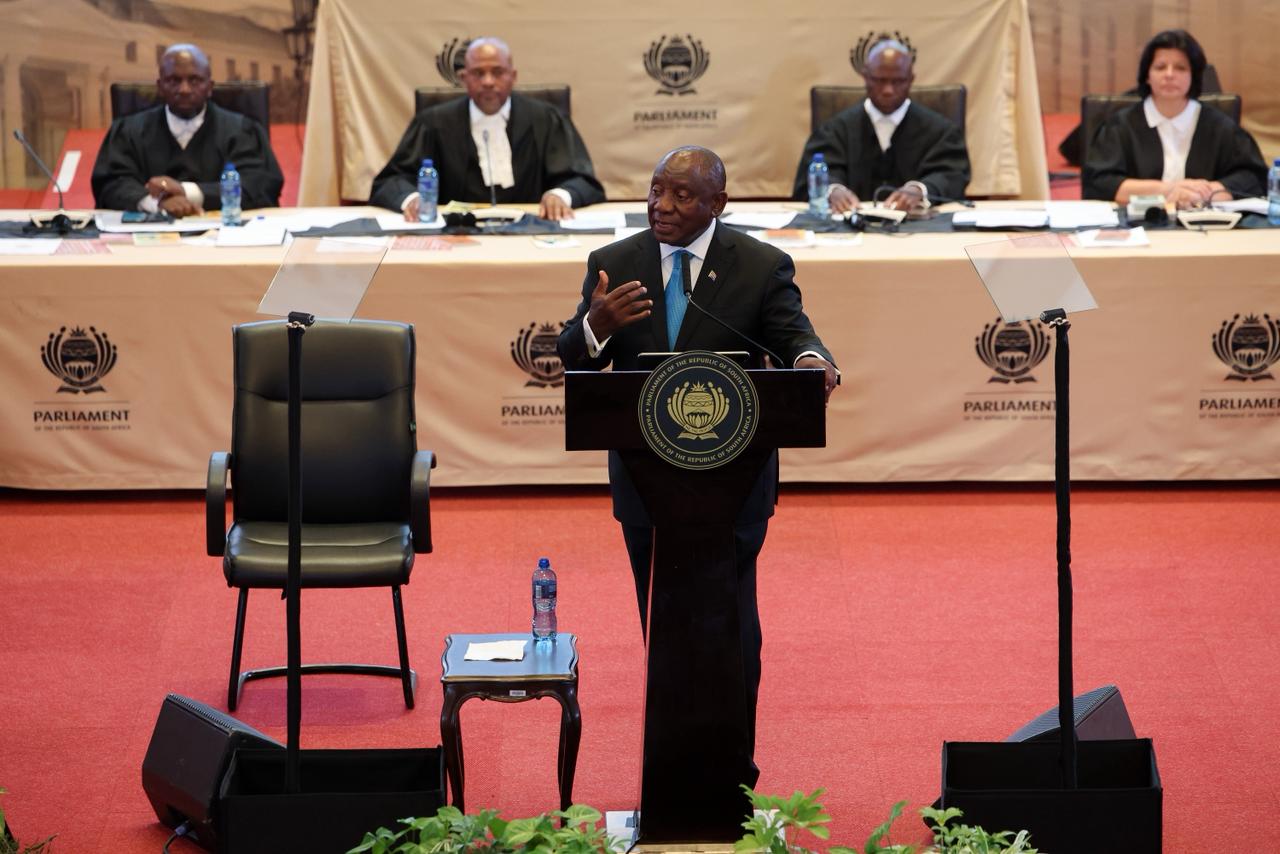
President Cyril Ramaphosa delivers the 2026 Sona. (GCIS)
Every State of the Nation Address (SONA) in South Africa has become a platform not only for democratic accountability but also for predictable criticisms. Long before the President rises to speak, rebuttals have been drafted, headlines framed and conclusions drawn. By the time the applause fades in the National Assembly, criticism is already rehearsed and just waiting for the cameras. This year was no different.
Yet intellectual honesty requires that criticism be weighed carefully. Which objections are substantive and grounded in fact? Which ones are ideological contestations masquerading as technical critique? And which ones are simply recycled lines from prior years, deployed irrespective of what was actually said? A sober analysis reveals a far more nuanced picture than the political theatre suggests.
This article critically assesses the key criticisms levelled at the State of the Nation Address.
The “no new ideas” critique
One of the most common criticisms is that the President merely “repeated old promises” and offered “nothing new.” This argument rests on a fundamental misunderstanding of governance. Structural reform, infrastructure expansion, energy transition, industrial development and state capability are not once-off or one-year events. They are multi-year undertakings.
When the President reaffirmed commitments to stabilise energy supply, accelerate logistics reform, strengthen water security, deepen industrialisation and expand social protection, he was not recycling rhetoric. He was reinforcing continuity in a reform agenda that is, by design, cumulative.
Countries that successfully reform do so through persistence, not policy hit-and-run. To demand novelty for its own sake is to mistake continuity for repetition or stagnation. A reform agenda requires sustained execution, institutional consolidation and policy coherence over time.
“Too little detail”
Another recurring complaint is that the Address lacked sufficient detail. There are no timelines, no cost breakdowns, no technical blueprints, we are told. This critique ignores constitutional and procedural convention. The State of the Nation Address is a policy and strategic outline of priorities and direction. It sets the macro frame. Detailed implementation plans, specific budget allocations and regulatory instruments are properly elaborated through cluster briefings, ministerial statements, briefings to portfolio committees and the Budget Speech.
Expecting the President to deliver operational plans of all departments in a single address reflects a deep misunderstanding of both governance architecture and parliamentary practice. He does not have the luxury of an entire day to speak, nor should he. Strategic clarity is the purpose of Sona. Operational detail is the responsibility of line ministries.
Critics know this. Yet the “lack of detail” argument persists, often less as a genuine concern but more as a convenient rhetorical device.
“It is all about electioneering”
Some detractors framed the announcements as part of electioneering, implying that delivery during an election cycle is inherently suspect. This line of criticism is deeply flawed. The government does not suspend its constitutional duty because an election is approaching. Service delivery cannot be paused for the sake of political optics. To suggest otherwise is to imply that citizens should endure stagnation and lack of services until all ballots have been counted.
If infrastructure investments accelerate, if social protection expands, if reforms gain momentum, that is governance in action and a nation at work, not electioneering. It would be far more troubling if the government chose inaction to avoid accusations of political timing.
Rehashed opposition scripts
A noticeable portion of the criticism bore striking resemblance to responses delivered in previous years, sometimes word for word. This suggests that, for some political actors, critique is not contingent on content but predetermined by position.
In a vibrant democracy, ideological opposition is legitimate. But there is a difference between principled disagreement and reflex hostility. When criticism is drafted before the speech is heard, it ceases to be analytical and becomes performative.
That performative instinct weakens democratic discourse. South Africa deserves a debate rooted in substance, not recycled indignation.
On economic reform and structural constraints
More substantive criticism points to slow economic growth, unemployment and persistent inequality. These are real concerns and deserve serious engagement.
However, to attribute structural economic challenges solely to the present administration ignores both global and domestic realities. Any fair criticism must take into account the COVID pandemic that contracted GDP, global inflationary shocks, energy supply disruptions, logistics backlogs and longstanding structural inequality embedded over decades. The President’s Address acknowledged these constraints while outlining ongoing reforms, particularly in energy generation liberalisation, logistics sector reform, industrial policy, infrastructure investment and public employment programmes.
Reform in complex systems does not yield instant results. It requires regulatory change, market confidence, institutional rebuilding and sustained fiscal discipline. The direction articulated is consistent with global best practice for middle-income economies seeking inclusive growth.
On social protection and fiscal responsibility
Another line of attack suggested that social support measures reflect fiscal recklessness. This argument oversimplifies the delicate balance between social protection and fiscal sustainability.
South Africa’s social grant system has long been recognised as one of the most effective redistributive mechanisms in the developing world. Social protection stabilises demand, reduces extreme poverty and cushions households against economic shocks. The President’s reaffirmation of social support, alongside commitments to fiscal consolidation and revenue reform, reflects an attempt to hold together growth and dignity, rather than sacrifice one at the altar of the other.
Responsible governance is not austerity at all costs. It requires a delicate balance.
Areas of broad convergence
Despite loud dissent, there are areas where even critics concede the President struck the right notes.
There is broad agreement on the urgency of energy security and the need to sustain reforms that have stabilised generation capacity. There is consensus that infrastructure investment, particularly in logistics, water systems and digital connectivity, is indispensable to economic recovery. There is recognition that crime and corruption must be confronted decisively and that rebuilding institutional capability is non-negotiable.
On youth employment and skills development, too, the resonance was unmistakable. South Africa’s demographic reality demands deliberate intervention and the Address placed young people squarely at the centre of the national development agenda.
Perhaps most importantly, the speech acknowledged that economic reform and social justice are not opposing objectives. They are mutually reinforcing pillars of national stability.
What is the alternative?
Criticism is easy but governing is more complex and difficult. A serious critique must offer an alternative macroeconomic framework, an alternative fiscal strategy, an alternative infrastructure financing model, an alternative energy transition pathway. Few of the loudest detractors provided one.
Instead, much of the opposition oscillated between demanding faster reform while opposing reform measures; calling for fiscal restraint while demanding expanded spending; criticising state intervention while objecting to market liberalisation. Such contradictions reveal not a coherent counter-vision, but political positioning.
South Africa’s challenges are profound. But the path forward requires disciplined implementation, not populist rhetoric.
Conclusion
The President’s Address did not promise instant transformation. It did something more difficult. It committed to sustained structural reform, institutional rebuilding, infrastructure acceleration and social protection within tight fiscal parameters.
Leadership in a complex democracy is not measured by applause lines. It is measured by policy coherence, institutional strengthening and long-term stability.
This moment demands more than reflex opposition or uncritical praise. It demands civic maturity. Institutional rebuilding is underway but incomplete. Economic recovery is gradual but visible. Political parties must engage in substantive debate rather than scripted hostility. Civil society must hold the government accountable while recognising genuine progress. Most importantly, citizens must refuse to be passive spectators in the unfolding South African story. Democracies do not collapse because problems exist. They weaken when people disengage.
South Africa’s future will not be secured by a single speech, nor undone by a single criticism. It will be shaped by collective resolve and a refusal to surrender to despair.
Cornelius Monama is a government communicator and public servant. He writes in his personal capacity (X: @cmonama)
