

In 2026, data engineers working with multi-agent systems are hitting a familiar problem: Agents built on different platforms don’t operate from a shared understanding of the business. The result isn’t model failure — it’s hallucination driven by fragmented context.
The problem is that agents built on different platforms, by different teams, do not share a common understanding of how the business actually operates. Each one carries its own interpretation of what a customer, an order or a region means. When those definitions diverge across a workforce of agents, decisions break down.
A set of announcements from Microsoft this week directly targets that problem. The centerpiece is a significant expansion of Fabric IQ, the semantic intelligence layer the company debuted in November 2025. Fabric IQ’s business ontology is now accessible via MCP to any agent from any vendor, not just Microsoft’s. Alongside that, Microsoft is adding enterprise planning to Fabric IQ, unifying historical data, real-time signals and formal organizational goals in one queryable layer. The new Database Hub brings Azure SQL, Cosmos DB, PostgreSQL, MySQL and SQL Server under a single management plane inside Fabric. Fabric data agents reach general availability.
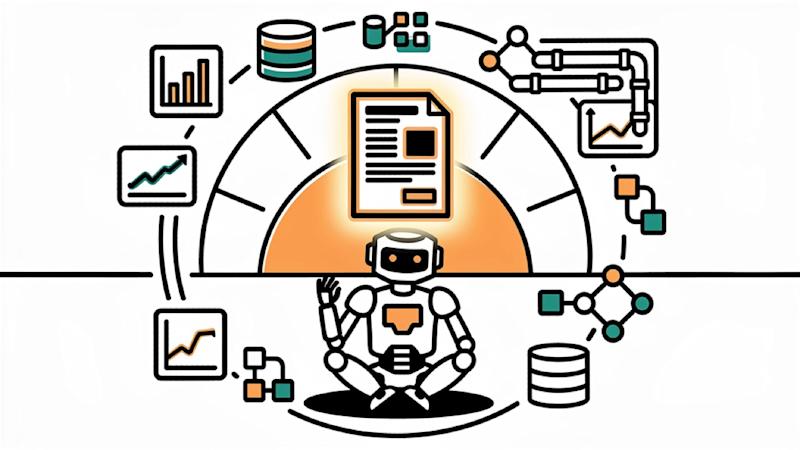
The overall goal is a unified platform where all data and semantics are available and accessible by any agent to get the context that enterprises require.
Amir Netz, CTO of Microsoft Fabric, reached for a film analogy to explain why the shared context layer matters. “It’s a little bit like the girl from 50 First Dates,” Netz told VentureBeat. “Every morning they wake up and they forget everything and you have to explain it again. This is the explanation that you give them every morning.”
Why MCP access changes the equation
Making the ontology MCP-accessible is the step that moves Fabric IQ from a Fabric-specific feature into shared infrastructure for multi-vendor agent deployments. Netz was explicit about the design intent.
“It doesn’t really matter whose agent it is, how it was built, what the role is,” Netz said. “There’s certain common knowledge, certain common context that all the agents will share.”
That shared context is also where Netz draws a clear line between what the ontology does and what RAG does. He did not dismiss retrieval-augmented generation as a technique — he placed it specifically. RAG handles large document bodies such as regulations, company handbooks and technical documentation, where on-demand retrieval is more practical than loading everything into context.
“We don’t expect humans to remember everything by heart,” he said. “When somebody asks a question, you have to know to go and do a little bit of a search, find the right relevant part and bring it back.”
But RAG does not solve for real-time business state, he argued. It does not tell an agent which planes are in the air right now, whether a crew has enough rest hours, or what the current priority is on a given product line.
“The mistake of the past was they thought one technology can just give you everything,” Netz said. “The cognitive model of the agents is similar to humans. You have to have things that are available out of memory, things that are available on demand, things that are constantly observed and detected in real time.”
The execution gap analysts say Microsoft still has to close
Industry analysts see the logic behind Microsoft’s direction but have questions about what comes next.
Robert Kramer, analyst at Moor Insights and Strategy, noted that Microsoft’s broad stack gives it a structural advantage in the race to become the default platform for enterprise agent deployments.
“Fabric ties into Power BI, Microsoft 365, Dynamics and Azure services. That gives Microsoft a natural path to connect enterprise data with business users, operational workflows and now AI systems operating across that environment,” he said. The trade-off, Kramer said, is that Microsoft is competing across a wider surface area than Databricks or Snowflake, which built their reputations on depth of the data platform itself.
The more immediate question for data teams, Kramer said, is whether MCP access actually reduces integration work.
“Most enterprises do not operate in a single AI environment. Finance might be using one set of tools, engineering another, supply chain something else,” Kramer told VentureBeat. “If Fabric IQ can act as a common data context layer those agents can access, it starts to reduce some of the fragmentation that typically shows up around enterprise data.”
But, he said, “If it just adds another protocol that still requires a lot of engineering work, adoption will be slower.”
Whether the engineering work is the harder problem is open to debate. Independent analyst Sanjeev Mohan, told VentureBeat, that the bigger challenge is organizational, not technical.
“I don’t think they fully understand the implications yet,” he said of enterprise data teams. “This is a classical capabilities overhang — capabilities are expanding faster than people’s imagination to use them. The harder work will be ensuring that the context layer is reliable and trustworthy.”
Holger Mueller, principal analyst at Constellation Research, sees MCP as the right mechanism but urges caution on execution.
“For enterprise to benefit from AI, they need to get access to their data — that is in many places unorganized, siloed — and they want that in a way that makes it easy for AI in a standard way to get there. That is what MCP does,” Mueller told VentureBeat. “The devil is in the details. How good is the access, how well does it perform and what does it cost. Access and governance still need to be sorted out.”
The Database Hub and the competitive picture
The Fabric IQ announcements arrive alongside the Database Hub, now in early access, which brings Azure SQL, Azure Cosmos DB, PostgreSQL, MySQL and SQL Server under a single management and observability layer inside Fabric. The intent is to give data operations teams one place to monitor, govern and optimize their database estate without changing how each service is deployed.
Devin Pratt, research director at IDC, said the integrated direction tracks with where the broader market is heading. IDC expects that by 2029, 60% of enterprise data platforms will unify transactional and analytical workloads.
“Microsoft’s angle is to bring more of those pieces together in one coordinated approach, while rivals are moving along similar lines from different starting points,” Pratt told VentureBeat.
What this means for enterprise data teams
For data engineers responsible for making pipelines AI-ready, the practical implication of this week’s announcements is a shift in where the hard work lives.
Connecting data sources to a platform is a solved problem. Defining what that data means in business terms, and making that definition consistently available to every agent that queries it, is not.
That shift has a concrete implication for data professionals. The semantic layer — the ontology that maps business entities, relationships and operational rules — is becoming production infrastructure. It will need to be built, versioned, governed and maintained with the same discipline as a data pipeline. That is a new category of responsibility for data engineering teams, and most organizations have not yet staffed or structured for it.
The broader trend this week’s announcements reflect is that the data platform race in 2026 is no longer primarily about compute or storage. It is about which platform can deliver the most reliable shared context to the widest range of agents.
