

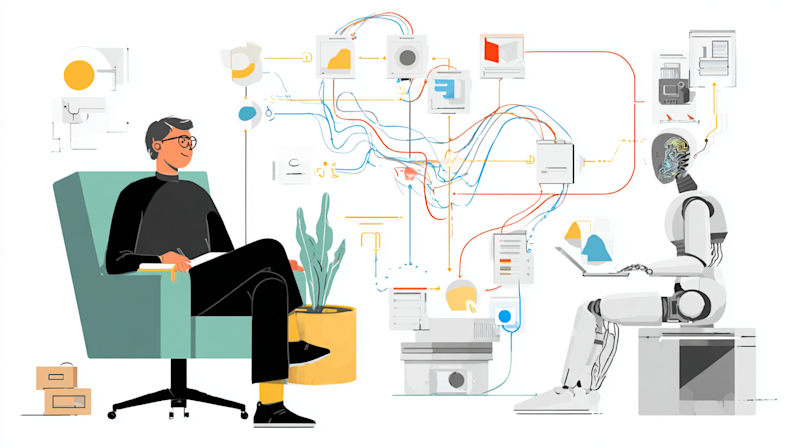

When an AI agent visits a website, it’s essentially a tourist who doesn’t speak the local language. Whether built on LangChain, Claude Code, or the increasingly popular OpenClaw framework, the agent is reduced to guessing which buttons to press: scraping raw HTML, firing off screenshots to multimodal models, and burning through thousands of tokens just to figure out where a search bar is.
That era may be ending. Earlier this week, the Google Chrome team launched WebMCP — Web Model Context Protocol — as an early preview in Chrome 146 Canary. WebMCP, which was developed jointly by engineers at Google and Microsoft and incubated through the W3C’s Web Machine Learning community group, is a proposed web standard that lets any website expose structured, callable tools directly to AI agents through a new browser API: navigator.modelContext.
The implications for enterprise IT are significant. Instead of building and maintaining separate back-end MCP servers in Python or Node.js to connect their web applications to AI platforms, development teams can now wrap their existing client-side JavaScript logic into agent-readable tools — without re-architecting a single page.
AI agents are expensive, fragile tourists on the web
The cost and reliability issues with current approaches to web-agent (browser agents) interaction are well understood by anyone who has deployed them at scale. The two dominant methods — visual screen-scraping and DOM parsing — both suffer from fundamental inefficiencies that directly affect enterprise budgets.
With screenshot-based approaches, agents pass images into multimodal models (like Claude and Gemini) and hope the model can identify not only what is on the screen, but where buttons, form fields, and interactive elements are located. Each image consumes thousands of tokens and can have a long latency. With DOM-based approaches, agents ingest raw HTML and JavaScript — a foreign language full of various tags, CSS rules, and structural markup that is irrelevant to the task at hand but still consumes context window space and inference cost.
In both cases, the agent is translating between what the website was designed for (human eyes) and what the model needs (structured data about available actions). A single product search that a human completes in seconds can require dozens of sequential agent interactions — clicking filters, scrolling pages, parsing results — each one an inference call that adds latency and cost.
How WebMCP works: Two APIs, one standard
WebMCP proposes two complementary APIs that serve as a bridge between websites and AI agents.
The Declarative API handles standard actions that can be defined directly in existing HTML forms. For organizations with well-structured forms already in production, this pathway requires minimal additional work; by adding tool names and descriptions to existing form markup, developers can make those forms callable by agents. If your HTML forms are already clean and well-structured, you are probably already 80% of the way there.
The Imperative API handles more complex, dynamic interactions that require JavaScript execution. This is where developers define richer tool schemas — conceptually similar to the tool definitions sent to the OpenAI or Anthropic API endpoints, but running entirely client-side in the browser. Through the registerTool(), a website can expose functions like searchProducts(query, filters) or orderPrints(copies, page_size) with full parameter schemas and natural language descriptions.
The key insight is that a single tool call through WebMCP can replace what might have been dozens of browser-use interactions. An e-commerce site that registers a searchProducts tool lets the agent make one structured function call and receive structured JSON results, rather than having the agent click through filter dropdowns, scroll through paginated results, and screenshot each page.
The enterprise case: Cost, reliability, and the end of fragile scraping
For IT decision makers evaluating agentic AI deployments, WebMCP addresses three persistent pain points simultaneously.
Cost reduction is the most immediately quantifiable benefit. By replacing sequences of screenshot captures, multimodal inference calls, and iterative DOM parsing with single structured tool calls, organizations can expect significant reductions in token consumption.
Reliability improves because agents are no longer guessing about page structure. When a website explicitly publishes a tool contract — “here are the functions I support, here are their parameters, here is what they return” — the agent operates with certainty rather than inference. Failed interactions due to UI changes, dynamic content loading, or ambiguous element identification are largely eliminated for any interaction covered by a registered tool.
Development velocity accelerates because web teams can leverage their existing front-end JavaScript rather than standing up separate backend infrastructure. The specification emphasizes that any task a user can accomplish through a page’s UI can be made into a tool by reusing much of the page’s existing JavaScript code. Teams do not need to learn new server frameworks or maintain separate API surfaces for agent consumers.
Human-in-the-loop by design, not an afterthought
A critical architectural decision separates WebMCP from the fully autonomous agent paradigm that has dominated recent headlines. The standard is explicitly designed around cooperative, human-in-the-loop workflows — not unsupervised automation.
According to Khushal Sagar, a staff software engineer for Chrome, the WebMCP specification identifies three pillars that underpin this philosophy.
-
Context: All the data agents need to understand what the user is doing, including content that is often not currently visible on screen.
-
Capabilities: Actions the agent can take on the user’s behalf, from answering questions to filling out forms.
-
Coordination: Controlling the handoff between user and agent when the agent encounters situations it cannot resolve autonomously.
The specification’s authors at Google and Microsoft illustrate this with a shopping scenario: a user named Maya asks her AI assistant to help find an eco-friendly dress for a wedding. The agent suggests vendors, opens a browser to a dress site, and discovers the page exposes WebMCP tools like getDresses() and showDresses(). When Maya’s criteria go beyond the site’s basic filters, the agent calls those tools to fetch product data, uses its own reasoning to filter for “cocktail-attire appropriate,” and then calls showDresses()to update the page with only the relevant results. It’s a fluid loop of human taste and agent capability, exactly the kind of collaborative browsing that WebMCP is designed to enable.
This is not a headless browsing standard. The specification explicitly states that headless and fully autonomous scenarios are non-goals. For those use cases, the authors point to existing protocols like Google’s Agent-to-Agent (A2A) protocol. WebMCP is about the browser — where the user is present, watching, and collaborating.
Not a replacement for MCP, but a complement
WebMCP is not a replacement for Anthropic’s Model Context Protocol, despite sharing a conceptual lineage and a portion of its name. It does not follow the JSON-RPC specification that MCP uses for client-server communication. Where MCP operates as a back-end protocol connecting AI platforms to service providers through hosted servers, WebMCP operates entirely client-side within the browser.
The relationship is complementary. A travel company might maintain a back-end MCP server for direct API integrations with AI platforms like ChatGPT or Claude, while simultaneously implementing WebMCP tools on its consumer-facing website so that browser-based agents can interact with its booking flow in the context of a user’s active session. The two standards serve different interaction patterns without conflict.
The distinction matters for enterprise architects. Back-end MCP integrations are appropriate for service-to-service automation where no browser UI is needed. WebMCP is appropriate when the user is present and the interaction benefits from shared visual context — which describes the majority of consumer-facing web interactions that enterprises care about.
What comes next: From flag to standard
WebMCP is currently available in Chrome 146 Canary behind the “WebMCP for testing” flag at chrome://flags. Developers can join the Chrome Early Preview Program for access to documentation and demos. Other browsers have not yet announced implementation timelines, though Microsoft’s active co-authorship of the specification suggests Edge support is likely.
Industry observers expect formal browser announcements by mid-to-late 2026, with Google Cloud Next and Google I/O as probable venues for broader rollout announcements. The specification is transitioning from community incubation within the W3C to a formal draft — a process that historically takes months but signals serious institutional commitment.
The comparison that Sagar has drawn is instructive: WebMCP aims to become the USB-C of AI agent interactions with the web. A single, standardized interface that any agent can plug into, replacing the current tangle of bespoke scraping strategies and fragile automation scripts.
Whether that vision is realized depends on adoption — by both browser vendors and web developers. But with Google and Microsoft jointly shipping code, the W3C providing institutional scaffolding, and Chrome 146 already running the implementation behind a flag, WebMCP has cleared the most difficult hurdle any web standard faces: getting from proposal to working software.
