

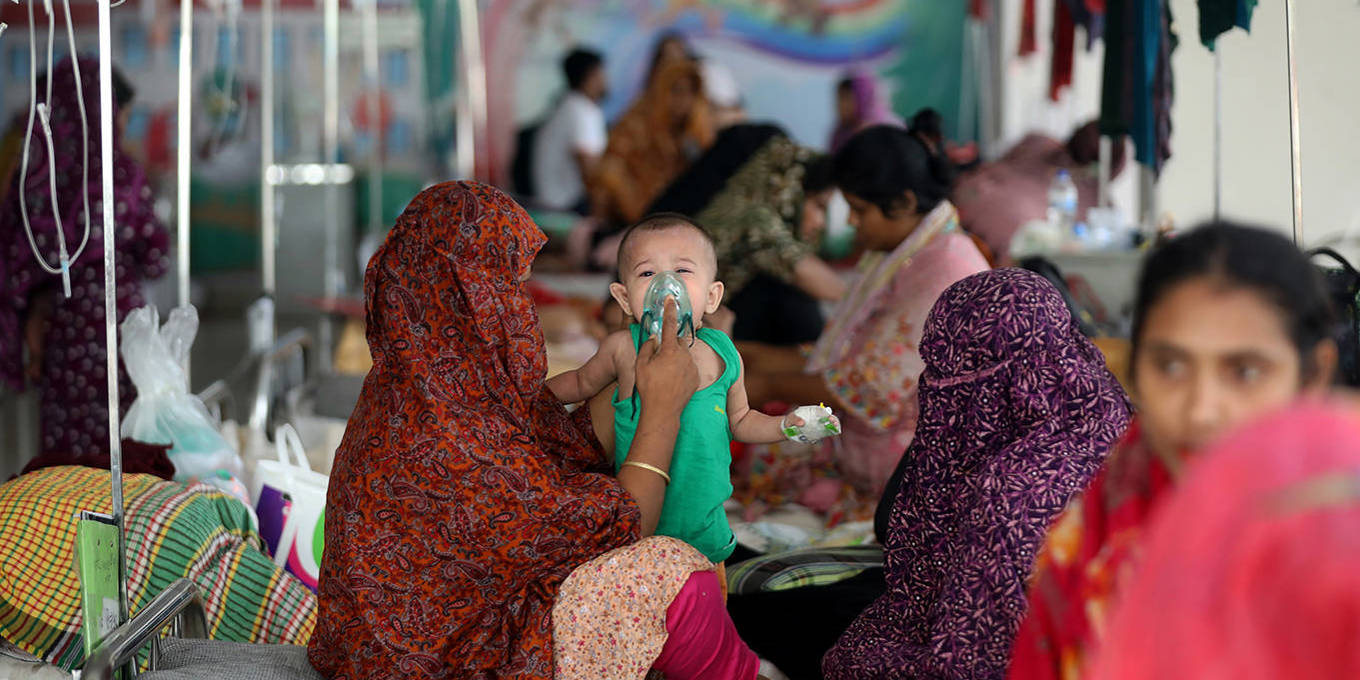
Bangladesh is facing soaring measles cases not because of a single localized failure, but because of years of systemic erosion. Ultimately, maintaining herd immunity against highly contagious viruses requires relentless attention to supply and demand, as well as to the broader social and institutional foundations of public health.
DHAKA—Once on the brink of elimination in many parts of the world, measles has made a troubling global comeback in recent years, with approximately 10.3 million cases in 2023, up 20% from 2022. While outbreaks have been concentrated in Africa, the Eastern Mediterranean, Southeast Asia, and the Western Pacific, high-income countries have also experienced a resurgence, with the United States reporting 1,983 confirmed cases this year alone. These experiences highlight a painful truth of public health: even the most successful immunization programs are vulnerable to erosion.
Nowhere is this more apparent than in Bangladesh. For years, development scholars and public-health experts touted Bangladesh as a model of how low-income countries can achieve outsize gains in human development. And for good reason: despite scarce fiscal resources and limited infrastructure, the country massively expanded routine childhood vaccination coverage, from barely 2% in 1986 to over 80% by the mid-2000s, through community-based delivery systems and partnerships with NGOs. As a result of this “immunization miracle,” diseases like polio and neonatal tetanus were eliminated, and under-five mortality plummeted by more than 80%.
But the system that delivered these remarkable gains is now faltering. In 2025–26, there have been more than 62,000 suspected measles cases in Bangladesh, leading to more than 500 deaths, mostly among children under five.
Many blame the interim government, led by Nobel laureate Muhammad Yunus, that took power after a popular insurrection ousted Prime Minister Sheikh Hasina and her Awami League government in 2024. Critics argue that reforms aimed at improving transparency in vaccine procurement contributed to supply chain bottlenecks.
This assessment misses the bigger picture. In fact, the current crisis cannot be reduced to a single administrative failure or leadership decision. Nor did it begin with Yunus’s government. Instead, it is the result of multiple, interrelated vulnerabilities, quietly accumulating for many years.
Bangladesh’s vaccination coverage, while high by global standards, was probably always below the 95% epidemiological threshold required for herd immunity against measles. While the World Health Organization and UNICEF estimate that 93-97% of the population had both doses of the measles-rubella vaccination in 2019–23, the Coverage Evaluation Survey put coverage at 80–86%.
In any case, aggregate figures obscure substantial heterogeneity across the population, with underserved groups—including children in urban informal settlements, mobile and transient communities, geographically hard-to-reach districts, and refugee settings—consistently left out of immunization programs. Others are only partly immunized: pervasive dropout between the first and second dose of the measles vaccine undermines overall immunity.
The resulting vulnerabilities remained largely invisible until external shocks exposed them. The COVID-19 pandemic was one such shock. Not only did the crisis disrupt routine immunization services; it also fueled vaccine hesitancy, owing to factors like vaccine fatigue and misinformation, which undermined trust in health services. In fact, Bangladesh’s vaccination problem is at least as much a demand-side problem as a supply-side one.
With 1.1% of children having received no routine vaccinations (“zero-dose”), immunization gaps widened between 2024 and 2025, and measles, a highly contagious virus, surged. Underlying health vulnerabilities—including persistent deficiencies in child nutrition, such as a lack of Vitamin A—facilitated contagion and increased susceptibility to severe outcomes. While Bangladesh’s government has now launched an emergency measles-rubella (MR) vaccination campaign, the scale of the initiative—targeting over 1.2 million children in 18 high-risk districts—underscores how much ground has already been lost.
The failures that allowed for the weakening of Bangladesh’s immunization system are fundamentally political. For starters, the government has long been underinvesting in health. The budgetary allocation for the health sector dropped from an already-low 1.1% of GDP in 2010 to 0.8% in 2017. As a result, public health-care facilities are chronically understaffed, and out-of-pocket expenses are high, amounting to 74% of all health expenditures in 2023.
Low health-care spending reflects broader institutional complacency, particularly during Hasina’s nearly 16 years of authoritarian rule. Delays in integrating the Health, Population, and Nutrition Sector Programme, introduced in 2003, into government operations disrupted service delivery. (The health ministry ultimately scrapped the HPNSP in March 2025.) In 2020–25, no supplementary nationwide MR immunization campaign was carried out. America’s abrupt slashing of funding through its Agency for International Development (USAID) in 2025 further undermined health-service delivery.
To be sure, the interim government’s policy choices are not beyond reproach. Its effort to restore integrity in public systems, including vaccine procurement, was necessary and overdue, given the entrenched corruption associated with Hasina’s regime. But the agenda’s across-the-board application reflected a fundamental misdiagnosis: procurement reforms were not as urgently needed as the revival of mass immunization campaigns and the restoration of public trust in vaccination.
This failure could have been avoided. Sri Lanka underwent a significant political transition in 2024, following two years of volatility and protests, yet it managed to respond effectively to a 2023 measles outbreak, bringing the disease under control. While similar political instability in Nepal—where mass youth-led protests ousted Prime Minister K. P. Sharma Oli—disrupted measles-elimination efforts, the interim government has placed a high priority on closing immunization gaps and avoided the collapse in immunization rates affecting Bangladesh, at least for the time being.
The lesson is clear. When an immunization program succeeds, it is not finished. Maintaining herd immunity against diseases like measles requires constant attention to both supply and demand, as well as to the broader social and institutional foundations of public health. Bangladesh is paying the price not for a single localized failure, but for gradual systemic erosion. The greatest public-health risks often stem from what is being taken for granted.
