

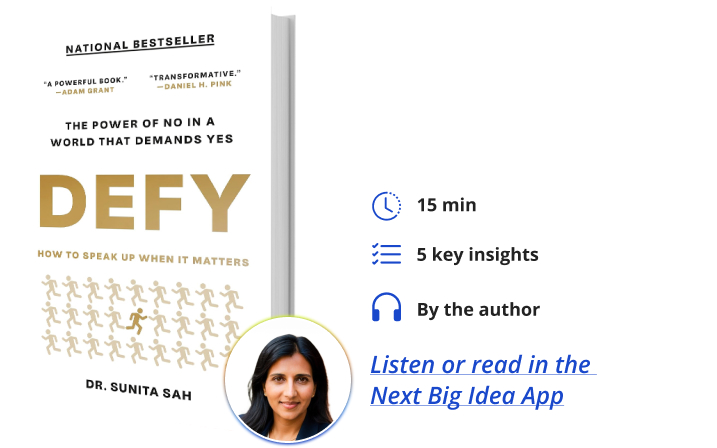
Below, Dr. Sunita Sah shares five key insights from her new book, Defy: The Power of No in a World That Demands Yes.
Sah is a physician-turned-organizational psychologist. She teaches business and healthcare students at Cornell University and Cambridge University, and served as commissioner on the National Commission of Forensic Science.
What’s the big idea?
Learning how to defy is important, relevant, and meaningful for anyone who wants to speak up when it matters and to do the right thing in the moment.
Listen to the audio version of this Book Bite—read by Sah herself—in the Next Big Idea app, or buy the book.
1. We’re wired to comply.
Soon after my son was born, I was frequently puzzled when well-meaning relatives would ask: Is he good? What they meant was: Does your baby sleep when you want him to? Does he stop crying when you want him to? In other words, does he do what you want him to do? Does he do what he’s told?
As someone who has spent years studying defiance, this moral equation of obedience to goodness always perplexed me. And yet, when my baby got older and became a toddler, I caught myself repeating the very equation I’ve spent my career questioning: Compliance equals good, defiance equals bad.
And that’s not an accident. From the moment we’re born, we’re trained to obey—by caregivers, teachers, peers. Compliant behavior is rewarded with dopamine. It literally shapes our neural pathways. We don’t just learn to comply. We become wired for it. And that wiring follows us into adulthood—into our workplaces, relationships, and the moments when it matters most to speak up.
But here’s what my research has shown me: We can change that wiring. When we understand the pressures that keep us compliant, we can begin to do something different. It takes self-awareness, effort, and practice, but we can disentangle the idea that compliance is always good and defiance is always bad. We can begin to recognize situations where compliance is actually harmful, and defiance is what’s needed.
2. Tension is your strength.
If we’re wired to comply, what does it feel like when that wiring runs up against our values?
Early in my career, as a junior physician in the U.K., I was invited to meet with a financial adviser at the hospital. His name was Dan. He was charming, asked many questions about my extremely limited disposable income, and built up a great rapport with me. By the end of the hour, he recommended I invest in a mutual fund and offered to write a report for me. All of it, absolutely free. Sounds great, doesn’t it?
In my tired state, I blurted out: “What’s in it for you?”
He smiled and said, “Well, there’s no such thing as a free lunch. I get a commission if you invest in the fund I’m recommending.”
That disclosure changed everything. For the previous hour, I had thought Dan was giving me good advice. But now that his ulterior motive was revealed, I didn’t trust him as much. Perhaps that’s rational. But here’s the crucial thing: I didn’t want him to know that I didn’t trust him anymore. I didn’t want him to think that his disclosure had corrupted our good rapport. I didn’t want to imply in any way that I thought he was biased or giving me bad advice. So I actually started to feel more pressure to say yes and sign on the dotted line.
That feeling has a name. I call it insinuation anxiety—the fear of implying something negative about someone, especially when they’re standing right in front of you. It’s a powerful force that keeps us silent and compliant, not because we agree, but because we don’t want to offend. We don’t want to insinuate that our bosses, coworkers, friends, or family cannot be trusted or are incompetent.
But that tension you feel? That knot in your stomach and flutter in your chest? That’s not weakness. That’s your strength. Learning to listen to it is the first step toward defiance.
3. Find Your True No.
If tension is the signal, how do we move from feeling it to acting on it? My research shows that a true no is not a snap judgment. It’s a process that progresses through five stages:
- Feeling that tension. Often, we disregard it—we think it’s not worth our doubt, or that the other person knows better. That’s unfortunate, because this is the first warning sign that we might need to defy.
- Acknowledging that tension. Recognizing that the discomfort you feel is a sign of your agency, not your weakness, and figuring out which of your values is being compromised.
- Escalating—expressing your concern out loud to someone else. People who vocalize their discomfort early are far more likely to follow through. You can still be in a deferential position at this stage by simply saying, “I’m not comfortable with this,” or asking, “Have you considered it this way instead?”
- Threat of noncompliance, meaning letting others know you may not go along. Something like, “I can’t put my name to that report unless those sentences come out.”
- The act of defiance itself. Your True No.
These stages don’t always happen in order. You might skip one, toggle between two, or circle back. But understanding that defiance is a process is liberating because it means you don’t have to wait for some dramatic moment of courage. And here’s what’s remarkable: that tension present in stage one? If you get to stage five, it dissipates. It melts away. You feel in alignment with your values and what you stand for. It’s more honest, more authentic, and even joyful when the pressure is released.
Many famous moments of defiance follow these stages. Rosa Parks didn’t make a spontaneous decision with her famous act of defiance on that bus. She had been preparing—through decades of training—for that moment. A true no is not just a no to the situation. It’s a true yes to your values.
4. Defiance is a practice, not a personality.
My mother was the most compliant person I knew. Petite—barely 4-foot-10—she was quiet, gentle, and conflict-avoiding. She apologized when someone stepped on her foot. For most of my childhood, I thought that this is what goodness looks like: being compliant, not defiant.
Until one day, when I was 7. We were walking home from the grocery store in West Yorkshire, England, dragging our rickety shopping cart down a narrow alleyway—a snicket, as we called it. A group of teenage boys blocked our path. One of them yelled, “Go back home.”
My training kicked in. I looked down, grabbed my mother’s arm, and tried to pull her past them. But she didn’t move. My quiet, deferential, never-confrontational mother stopped, turned, and looked those boys straight in the eye, and said—calmly but firmly—“What do you mean?”
I was stunned. And in that moment, everything I thought I knew about who defies and who doesn’t started unraveling. We think defiance belongs to a certain kind of person—someone bold, fearless, extraordinary—but it doesn’t. We can choose to be defiant one day and compliant the next. It’s not a personality.
Defiance is a skill, and like any skill, we can train for it. We can practice in small moments, like sending back the wrong coffee order or telling the hairdresser to stop cutting, so we’re ready when the bigger moments come. That moment in the alley taught me that you don’t need to be a certain type of person to defy. You just need to be connected to what matters.
5. Become a moral maverick.
We often think of defiance as loud, aggressive, violent—someone staring down tanks or raising a fist before the world. But a lot of defiance happens quietly, behind the scenes. And it doesn’t always require superhuman power. Defiance simply means knowing who you are and acting in alignment with those values. That’s what I call being a moral maverick. Not a rebel without a cause, but a person with a moral compass who chooses to act on it.
It starts with just one person. One kid in an alleyway who says to the others, “That’s not okay, let them pass”—so that an immigrant mother doesn’t have to carry that weight alone. One shake of the head, one snap of a camera phone. One person who says, “No—that isn’t right.”
For far too long, compliance has been our default. We’ve said yes so often that we’ve forgotten what it means. And we’ve reserved no for the troublemakers. But every single act of consent, compliance, and dissent shapes not just our own story, but the story of our society, our workplaces, and our world. It is time to put no on an equal footing with yes. Choice by choice. Decision by decision. Each one of us has the power to defy.
Enjoy our full library of Book Bites—read by the authors!—in the Next Big Idea app.
This article originally appeared in Next Big Idea Club magazine and is reprinted with permission.
