

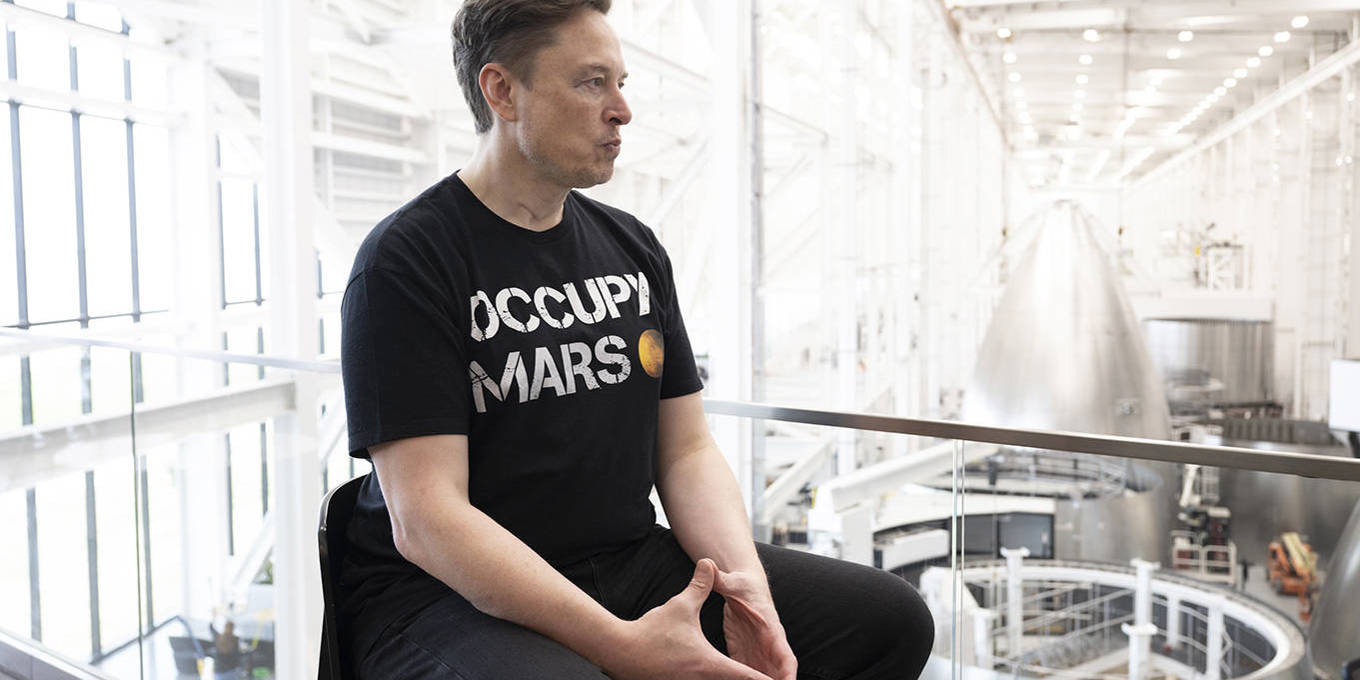
Some may argue that the world’s first trillionaire is a story of technological triumph and a win for American capitalism. But markets have not bet on cutting-edge technology or a company too big to fail, but rather on the idea of a mega-monopolist with wealth and influence so vast that the US government will not allow him to fail.
WASHINGTON, DC—Following SpaceX’s IPO this month, Elon Musk’s fortune comfortably exceeds $1 trillion. The significance of the world’s first trillionaire cannot be overstated. Musk’s wealth, which has been rising by more than one million dollars per minute over the past year, is now greater than that of nearly four billion people combined—or 46% of the global population.
In 2017, my team at Oxfam predicted that the world would see its first trillionaire minted within 25 years. In 2024, we conservatively revised our estimate to less than a decade, inspiring fretful headlines. But the speed of wealth concentration has surprised us all, raising questions about whether democracy can be preserved amid such yawning inequality.
Some may argue that the world’s first trillionaire is a story of technological triumph and a win for American capitalism. To be sure, powerful space rockets that can return to Earth are awe-inspiring, and Musk’s firms have made huge contributions to satellite internet and electric vehicles. But the narrative that SpaceX investors are solely rewarding engineering prowess is a fiction. Markets have not bet on cutting-edge technology or even a company too big to fail, but rather on the idea of a mega-monopolist whose wealth and influence are so vast that the US government will not allow him to fail.
Recognizing how Musk’s status is inextricably tied to government backing is crucial to understanding and redressing wealth inequality—and not only in the United States. It is, on one level, a byproduct of a billionaire US president’s economic agenda. Donald Trump’s 2025 One Big Beautiful Bill Act marked the largest wealth transfer from the working class to the ultra-wealthy in recent history. Safeguards against corporate overreach, like the Consumer Financial Protection Bureau, are on life support.
In his former role as head of the Department of Government Efficiency under Trump, Musk dismantled government agencies and slashed aid to the world’s poorest. This could lead to an estimated 700,000 deaths annually by 2030. Meanwhile, the administration has bolstered Musk’s position: awarding new contracts to his companies, halting investigations into them, and loosening regulations that constrained them.
The result is a perilous public-private entanglement, with the state running on hardware and data provided by Musk’s companies. Consider how vital Starlink has become for the US government’s connection to low-Earth-orbit communications. The reliance by the US military and space complex on Musk’s empire implies significant leverage over the state.
But such dependence is not built overnight. Musk’s power may have culminated under Trump, but it was cultivated over decades. A trillionaire is a bipartisan creation. Musk has been able to extract public subsidies to secure market dominance, with his companies receiving some $38 billion from several administrations. President Barack Obama, for example, helped create Musk’s apparent “monopoly on space.” The origins and continued existence of Tesla and SpaceX depended on federal and state support. But while US taxpayers assumed the risk, they received no equity, profit-sharing, or affordability guarantees.
The minting of a trillionaire demands a reckoning with extreme inequality. Every country should learn from how the US political system has enabled Musk’s rise. That includes a pro-billionaire tax code under which Tesla and Musk have paid almost nothing in federal income taxes for years; an antimonopoly regime that has allowed two-thirds of active satellites orbiting Earth to be under Musk’s control; and campaign-finance laws that created the conditions for Musk to spend nearly $300 million backing Trump and other Republican candidates in the 2024 election.
Only government-backed structural reform can turn the tide. While Musk’s power undoubtedly requires our collective attention, especially given his obsession with race and boosting of far-right figures, the problem of oligarchy is bigger than him. We are living in a dystopian age of obscene concentration of wealth and power, with a handful of companies controlling frontier technologies like AI, and industrial giants in the oil and gas, defense, and finance sectors raking in record profits from seemingly endless war.
The US can draw on the country’s long history of grappling with extreme inequality and defending democracy. The late-19th-century Gilded Age led to the creation of the income tax. The Social Security program, the minimum wage, and top income tax rates of 94% were established in the wake of the Great Depression and World War II. In the decades that followed, the government nurtured the middle class and reined in monopolies.
But it would be a mistake to focus only on reforms in America. Wealth inequality must be addressed everywhere. In 2026, some governments are showing that action is possible, from implementing wealth taxes to pursuing universal health care, bringing down prices, and strengthening workers’ rights. It is an example that others should follow.
Following the minting of the world’s first government-backed trillionaire, the importance of rethinking our pro-oligarchy international economic order cannot be underestimated. While global debates often center on great-power conflicts, the much bigger problem is that the multilateral rules governing international cooperation—on trade, intellectual property, taxation, and debt—have in recent decades been wired in favor of the wealthy, to the detriment of working people around the world. The Trump administration’s role in rupturing the US-built multilateral system should motivate other countries to forge new forms of cooperation.
Nearly a century ago, US Supreme Court Justice Louis D. Brandeis warned that America must choose between extreme wealth concentration and democracy. His warning has gained new and acute relevance for everyone. Musk is proof of that.
