

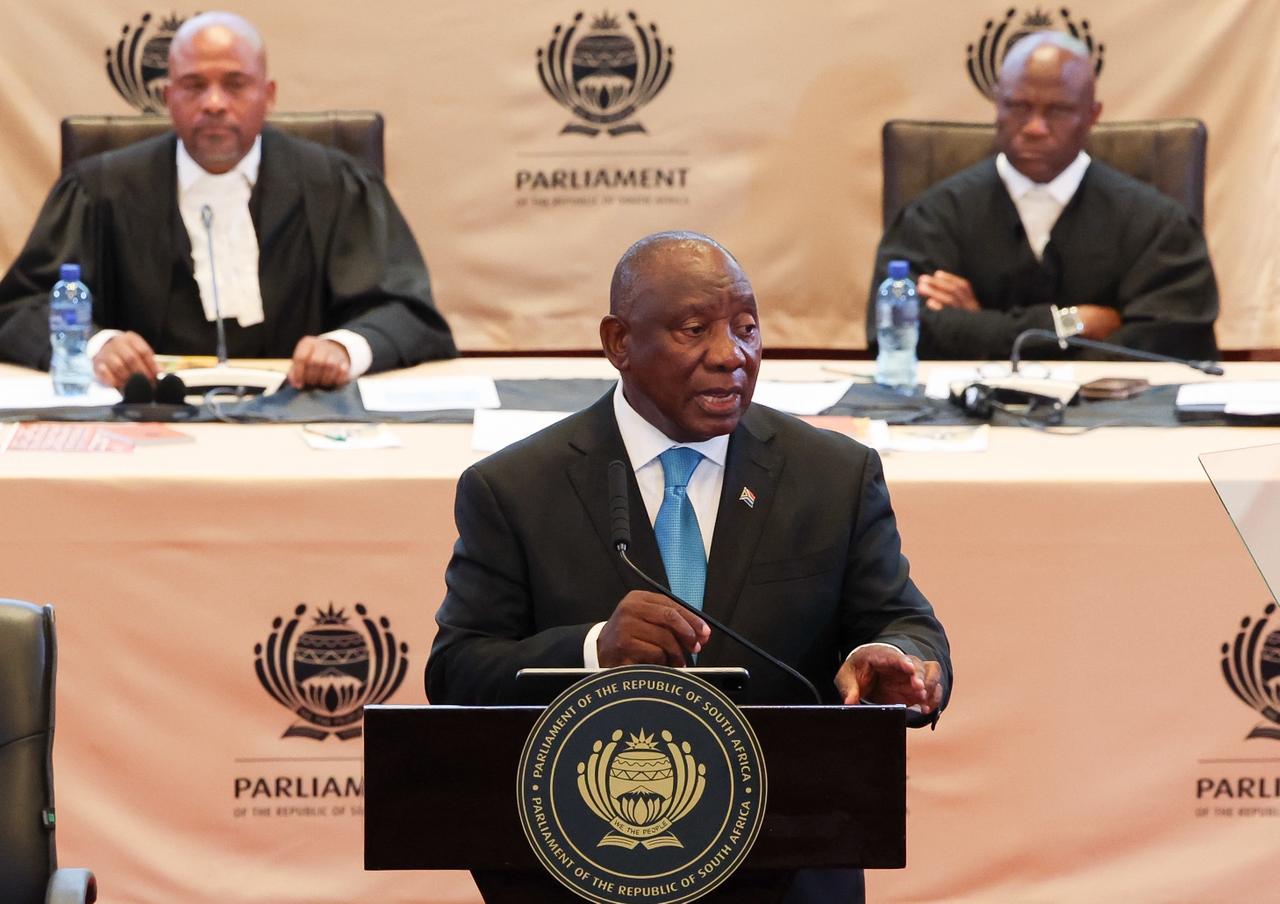

President Cyril Ramaphosa used his 2026 State of the Nation address to argue that South Africa has moved beyond crisis management and into consolidation. (GCIS)
President Cyril Ramaphosa used his 2026 State of the Nation address to argue that South Africa has moved beyond crisis management and into consolidation. The speech was measured and technocratic. Its central claim was that key economic fault lines have stabilised and the country is positioned to build from firmer ground.
There is evidence behind that assertion. South Africa has gone close to a year without major load-shedding. Freight movement through ports and along key rail corridors has improved from the severe disruptions that constrained exports in 2022 and 2023.
The country has exited the Financial Action Task Force grey list. Sovereign credit ratings have strengthened. Borrowing costs have moderated. Inflation has eased. The government recorded four consecutive quarters of GDP growth and primary budget surpluses.
“We are on a clear path of stabilising our national debt,” Ramaphosa said.
For the first time in several years, electricity did not dominate the address. That shift in emphasis is significant. The energy crisis has moved from acute emergency to managed risk. Logistical bottlenecks that once paralysed mining and manufacturing have softened. The macroeconomic environment is more predictable than it was three years ago.
Yet beneath the stabilisation narrative lies a persistent structural constraint. Unemployment remains largely unchanged.perxe
The official unemployment rate remains above 30%. On the expanded definition, including discouraged job seekers, it exceeds 40%. Youth unemployment among those aged 15 to 34 remains acute. Millions of young South Africans are neither employed nor in education or training. The labour market has not shifted in proportion to the macroeconomic gains government now foregrounds.
The speech acknowledged the jobs crisis but did not signal a departure from the existing macroeconomic framework. Debt containment, infrastructure-led growth, regulatory reform and expanded private sector participation remain central pillars. The direction is incremental. The strategy rests on accelerating investment and restoring institutional credibility.
Whether that approach can generate labour absorption at scale is the central economic question.
Daniel Meyer, professor of economics at the University of Johannesburg, argues that current growth levels are insufficient.
“Still too low growth, we need 3% or more,” he said. “Low inflation means the economy is flat.”
Growth has improved from contractionary lows but remains below the threshold widely viewed as necessary to absorb new entrants into the labour market. At current levels, growth stabilises the economy rather than expanding employment meaningfully.
Infrastructure is positioned as the primary lever. The government has committed more than R1 trillion in public infrastructure spending over three years. Public private partnerships in rail and ports are expanding. Independent transmission projects are expected to unlock additional electricity grid investment. Water and sanitation infrastructure has been allocated R156 billion over the same period.
Infrastructure can raise productive capacity and reduce logistics costs. It can crowd in private capital. But scale and composition remain constraints.
“It’s not nearly enough. We need investment to GDP ratio at 30%t,” Meyer said.
South Africa’s investment to GDP ratio has remained well below that level for years. Without sustained capital formation, productivity gains remain modest and growth cycles shallow. The composition of investment also matters. Capital intensive energy and mining projects do not automatically translate into broad-based employment.
Meyer questioned whether the current growth mix will integrate low skilled workers.
“No shift. Low skilled people will still not be absorbed into the economy. We need a massive upskilling of skills.”
Industrial policy featured prominently in the address. Ramaphosa positioned South Africa as a supplier of green products, critical minerals and new energy vehicles. A 150% tax deduction for investment in new energy vehicles will take effect in March
International pledges under the just energy transition framework now stand at roughly R250 billion. Mining was framed as a renewed growth frontier, with mineral reserves valued at more than R40 trillion.
These sectors promise higher value exports and industrial diversification. They align with global decarbonisation trends and may attract foreign direct investment. Employment outcomes, however, depend on domestic linkages and skills formation.
Small and medium enterprises were again described as central to job creation, with R2.5 billion earmarked for 180 000 businesses this year. Structural constraints facing small firms, including access to finance, energy reliability and uneven municipal services, remain significant.
Political economist Dale McKinley sees continuity rather than structural redirection.
“There was nothing really structural,” he said. “Structural change would require shifts in monetary policy, fiscal policy, industrial policy. A much more bottom up approach.”
In his view, improved logistics and fiscal metrics do not in themselves alter patterns of ownership and participation. Without deeper shifts in productive structures, unemployment remains embedded.
“The infrastructure strategy will help,” he said. “But it is not sufficient to tackle unemployment at scale.”
Social protection continues to function as a stabiliser. The president confirmed that the Social Relief of Distress grant will be retained in some form and emphasised the Presidential Employment Stimulus. These measures cushion poverty and provide temporary work opportunities, but they do not alter labour market dynamics.
Economic commentator Reg Rumney described the broader policy environment as more coherent than in recent years.
“Things do seem to be moving in the right direction on a number of fronts,” he said. “Stability in government in the volatile geopolitics of today is a plus.”
He cautioned, however, that policy effectiveness depends on accurate diagnosis.
“The SONA shows that the government’s diagnosis of our problems is wrong in some cases and this means the medicine will be wrong too.”
The water crisis illustrates the execution challenge. Ramaphosa announced the creation of a National Water Crisis Committee modelled on the energy response structure credited with stabilising electricity supply. The government signalled possible intervention where municipalities fail.
Rumney questioned whether bypassing local government addresses systemic weakness.
“The promised bypassing of municipalities to provide water doesn’t solve poor municipal governance,” he said. “By cutting off a source of finance it could make things worse.”
Institutional performance runs through the address as a quiet constraint. Alex van den Heever, a professor at the University of the Witwatersrand, has argued that state capability remains a binding limit on growth.
“One of the key obstacles to economic growth is the poor performance of the state,” he said.
Policy ambition frequently exceeds administrative capacity. Infrastructure plans, industrial incentives and employment programmes depend on execution. Where implementation falters, growth momentum weakens.
Security concerns were also elevated. Ramaphosa confirmed that the South African National Defence Force will support police operations against gang violence and illegal mining in parts of the Western Cape and Gauteng.
Organised crime, construction site extortion networks and illicit mining syndicates were described as threats to economic stability. The recruitment of 5 500 new police officers and the introduction of a Whistleblower Protection Bill were presented as institutional reinforcements.
Politically, the address reflected the stabilising effect of the Government of National Unity between the ANC and the DA. Fiscal consolidation, inflation targeting and private sector participation now enjoy cross party backing. Policy volatility has narrowed.
The stabilisation gains are measurable. Electricity supply has improved. Fiscal slippage has slowed. Investor sentiment has strengthened. Analysts broadly acknowledge those shifts.
The unresolved question is whether consolidation will translate into sustained employment growth. At current levels, output expansion is unlikely to reduce unemployment meaningfully. Investment intensity remains below the level required for durable expansion.
Skills formation lags. Municipal governance is uneven. State capability continues to constrain delivery.
The emergency phase may be receding. The structural constraint remains.
