

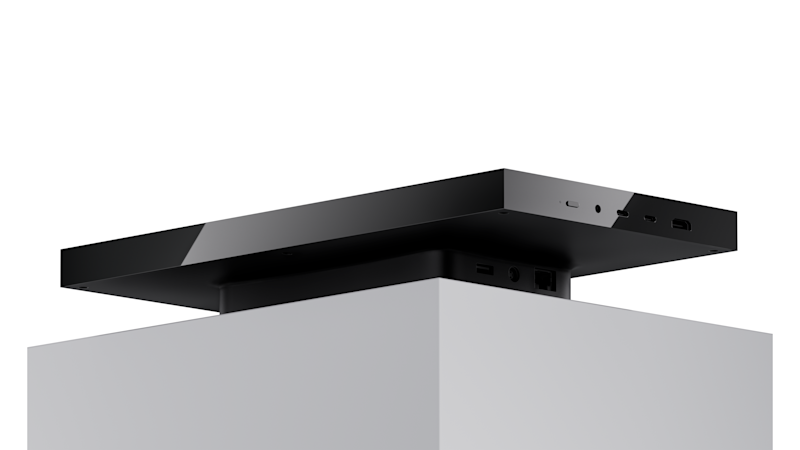
Microsoft on Monday unveiled the Surface RTX Spark Dev Box, a compact desktop computer designed to let software developers run large AI models on their desks instead of paying for cloud computing — a move that directly challenges the per-token pricing model that has defined the AI industry’s economics since ChatGPT launched three and a half years ago.
The device, announced at Microsoft Build 2026, packs Nvidia’s new Blackwell-architecture RTX Spark processor and 128 gigabytes of unified memory into a small-form-factor chassis, delivering what Nvidia rates at one petaflop of AI compute. In practical terms, that means a developer can load, run and interact with AI models exceeding 120 billion parameters without sending a single API call to the cloud.
“These class of devices, we think, will get to about 100 billion parameter model running,” Pavan Davuluri, Microsoft’s executive vice president of Windows and Devices, said during a press briefing ahead of the event. He emphasized that raw model size is only part of the equation: “The model size is one thing, but for the model to be effective, it kind of needs to be able to have enough context, because a larger model, you feed it larger context.” At 100,000 tokens of context, he noted, the key-value cache alone can consume 40 to 50 gigabytes of memory — which is precisely why Microsoft and Nvidia engineered the device around a 128-gigabyte unified memory pool shared dynamically between the CPU and GPU.
The machine will be available later this year in the United States, sold exclusively through Microsoft.com. The company did not disclose pricing.
Why Microsoft is betting that AI’s future runs on fixed costs, not cloud meters
The Surface RTX Spark Dev Box arrives at a moment when the economics of AI development have become a boardroom-level concern. Companies large and small are grappling with cloud GPU bills that scale unpredictably: every fine-tuning run, every inference call, every agentic workflow that loops through a frontier model accumulates cost. For a developer iterating rapidly on a prototype — running the same model dozens or hundreds of times a day — those charges compound fast.
Microsoft is framing the Dev Box as a release valve for that pressure. Andrew Hill, corporate vice president of Surface, wrote in the announcement blog post that the device “changes that equation” by letting developers “reserve frontier model calls for truly frontier problems and handle the rest on their own hardware.” The pitch is not that cloud computing is obsolete, but that much of the work currently being sent to remote data centers does not require state-of-the-art models and would be better served by capable local hardware with predictable, fixed costs.
This is a significant strategic shift for Microsoft, a company that derives tens of billions of dollars in annual revenue from Azure cloud services. By selling hardware that explicitly reduces customers’ cloud dependency, Microsoft is acknowledging a tension that has been building across the industry: the marginal cost of AI inference at scale is unsustainable for many teams, and the market is demanding alternatives. The bet appears to be that developers who prototype locally will still deploy to Azure when they need to scale — and that owning both ends of that workflow is more valuable than owning only the cloud.
Inside the 128GB unified memory architecture that makes local AI possible
The technical architecture of the Dev Box reflects a set of deliberate engineering choices aimed at sustained, not peak, performance — a distinction that matters enormously for AI workloads that can run for hours.
At the center is Nvidia’s RTX Spark system-on-chip, which combines an ultra-efficient ARM-based CPU with a Blackwell-generation RTX GPU. In a traditional Windows PC, Davuluri explained during the briefing, this configuration would require four separate components: a CPU, a discrete GPU, dedicated graphics memory and system RAM. The RTX Spark collapses all of that into a single chip paired with a single unified memory pool.
That unification is the critical design decision. Conventional gaming laptops with high-end Nvidia GPUs top out at roughly 24 gigabytes of GPU-accessible memory. The Dev Box’s 128 gigabytes of unified memory — accessible to both the CPU and GPU through what Nvidia calls its Unified Memory Access architecture — is what makes it possible to load models that would otherwise require cloud GPU instances with specialty high-bandwidth memory configurations.
Microsoft did substantial work at the operating system level to exploit this architecture. The company implemented new memory management logic in Windows that raises the ceiling on how much system memory the GPU can address, introduces smarter page-size allocation for shared memory regions and ensures that heavy GPU workloads do not starve the CPU of the resources it needs for multitasking. The Windows scheduler was also optimized for RTX Spark’s heterogeneous core layout, routing demanding workloads to performance cores while keeping efficiency cores available for background tasks.
How a 3D-printed aluminum chassis doubles as a heatsink
The thermal design is equally deliberate. The Dev Box operates within an approximately 100-watt sustained thermal envelope — modest by desktop standards, but meaningful for a device intended to run training jobs and inference workloads continuously. The aluminum chassis itself is engineered to function as a passive heatsink, and the method Microsoft used to build it is among the most striking details about the machine.
The top panel is manufactured using metal 3D printing, a process that enables internal geometries too complex for conventional CNC machining or injection molding. The perforations are not simple through-holes; they are angled in multiple directions around the internal fan to optimize airflow from cold-air intake through heat dissipation. During the press briefing, Harry, a Surface industrial designer, explained the rationale: “The complexity is something other manufacturers wouldn’t be able to do, like CNC, or like any molding, because of the complexity of shape.”
When asked whether 3D printing would constrain mass production, the designer acknowledged the challenge but suggested Microsoft had developed a process robust enough to scale. The result is a machine that runs quietly enough for an open office while sustaining the kind of continuous GPU workloads that would throttle most conventional desktops of similar size. For a device that Microsoft expects developers to leave running overnight on fine-tuning jobs, quiet sustained performance is not a luxury — it is a requirement.
A developer-first setup that eliminates hours of configuration
Microsoft is shipping the Dev Box with Windows 11 Pro pre-configured at the image level for development work — a detail that sounds minor but reflects a growing recognition that the out-of-box experience for developer hardware has historically been poor.
The machine boots into a dark theme with a simplified taskbar, widgets removed and Do Not Disturb enabled. Developer Mode is turned on. PowerShell 7 is the default shell. WSL 2 — the Windows Subsystem for Linux — comes pre-installed with GPU passthrough and CUDA support already configured. Visual Studio Code, GitHub Copilot, Git, Python and Node.js are all installed and ready.
“We’ve said, ‘Hey, you know what, we got you, you want to go fast,'” a Microsoft engineer who demonstrated the configuration during the briefing told VentureBeat. The philosophy, he explained, is that developers were going to install all of these tools anyway — the friction was in the hours of setup and configuration that stood between unboxing a machine and writing the first line of code.
The Dev Box also ships with integration points across Microsoft’s AI stack: AI Toolkit for VS Code for model conversion and fine-tuning, Windows ML and Windows Copilot Runtime for local inference, and Microsoft Foundry for connecting local prototypes to cloud deployment pipelines. For enterprises, the device integrates with Entra ID and Intune for identity and device management, and includes Secured-core PC architecture, BitLocker encryption and Microsoft Defender.
Why Apple’s Mac Mini may not be the real competition anymore
The most obvious competitive comparison is Apple’s Mac Mini, which has dominated the compact-desktop category and has been widely adopted by developers drawn to Apple Silicon’s unified memory architecture and power efficiency.
Davuluri addressed the comparison directly during the briefing, saying the Dev Box is “in a different class of performance than Mac Minis, intentionally.” He declined to share specific benchmarks, noting that detailed specifications and performance targets would come closer to the fall launch. But the architectural advantage Microsoft is claiming is clear: while the current Mac Mini with M4 Pro tops out at 48 gigabytes of unified memory and the M4 Max configuration reaches 128 gigabytes, the RTX Spark Dev Box pairs its 128 gigabytes with a Blackwell-class GPU that has a fundamentally different CUDA-based compute model — one that the vast majority of the AI/ML ecosystem’s tooling (PyTorch, TensorRT, llama.cpp, Hugging Face frameworks) is already optimized for.
That CUDA ecosystem advantage is difficult to overstate. While Apple’s Metal framework has made progress, the overwhelming majority of AI training and inference frameworks are built and tested first against Nvidia’s CUDA stack. A developer running models on the Dev Box can use the same code, the same libraries and the same workflows they would use on a cloud GPU instance — a level of portability that Apple Silicon cannot currently match.
From laptop to supercomputer: Microsoft’s three-tier plan for local AI hardware
The Dev Box is one piece of a three-tier hardware strategy Microsoft laid out at Build. The Surface Laptop Ultra, announced days earlier at Computex, brings the same RTX Spark silicon into a 15-inch laptop form factor for developers and creators who need portability. At the other end of the spectrum, the DGX Station for Windows — built on Nvidia’s GB300 Grace Blackwell Ultra Superchip — targets organizations that need to run frontier models up to one trillion parameters on a deskside system. That machine is expected in the fourth quarter of this year.
The three devices map to a tiered computing model that Microsoft is calling “unmetered intelligence”: small on-device language models (the company’s new Aion 1.0 family) handle lightweight tasks at zero marginal cost; RTX Spark-class hardware runs mid-range models locally for the bulk of development work; and cloud resources are reserved for genuinely frontier-scale problems.
The GitHub Copilot CLI is getting a concrete implementation of this model with a new feature called /fleet, which allows a cloud-based primary agent to build a plan, assess the complexity of each task and route appropriate subtasks to a local model running on the developer’s hardware. The cloud agent handles what requires frontier capability; the local model handles what does not. The result, in theory, is lower cost without lower quality.
The real question is whether hybrid AI can shift from buzzword to business model
Whether Microsoft’s bet pays off depends on questions that will take months to answer. How does the Dev Box actually perform under sustained, real-world workloads? What will it cost? How quickly will the open-source model ecosystem continue to produce capable models in the 70-to-120-billion-parameter range that fit within its memory envelope? And perhaps most critically: will enterprise procurement teams, trained to think of AI as a cloud line item, accept a capital expenditure on desk hardware as an alternative?
The strategic logic, however, is difficult to dismiss. For three years, the AI industry has operated on an implicit assumption: serious AI work happens in the cloud, and the economics of that arrangement are simply the cost of doing business. Microsoft, a company with every incentive to reinforce that assumption, is now selling a machine that undermines it. That is not a contradiction — it is a recognition that the market is moving, and that the company that controls the developer’s local environment and the cloud they deploy to has a more durable advantage than one that controls only the cloud.
Every dollar a developer does not spend on cloud inference is a dollar that can fund another experiment, another iteration, another prototype. For years, the AI industry told developers they needed to rent their intelligence by the token. Microsoft is now asking a different question: what if you could just buy it?
