

Sounding amused, publisher Pramod Kapoor recalls the reaction of the Indian cricketing legend Bishen Singh Bedi when he learned Kapoor was printing 3,000 copies of his autobiography. “Only 3,000?” he protested. “I fill stadiums with 50-60,000 people coming to see me play and you think that’s all my book is going to sell?”
Kapoor, the founder of Roli Books, explains that Bedi’s legions of admirers were unlikely to translate into book buyers. “That was in 2021. Nothing has changed. The average book in English sells only around 3-4,000 copies. If it tops 10,000, it’s counted a bestseller.”
India does not have a great book-reading tradition. The author and columnist Parsa Venkateshwar Rao Jr calls this a mystery that social scientists should explore. “Maybe it’s because of the strong oral story-telling tradition? The epics are well known and passed down the generations and taken very seriously. I’m baffled by why so few Indians buy books and read,” he says.
If most middle-class homes are devoid of books; if you can sit in an airport departure lounge or train all day and not see anyone reading; if some affluent people think Reader’s Digest copies are literary heavyweights worth binding in leather to display in “studies” that are purely for show then why, come winter, do more than 100 literature festivals bloom every year, even in the smallest and unlikeliest of towns?
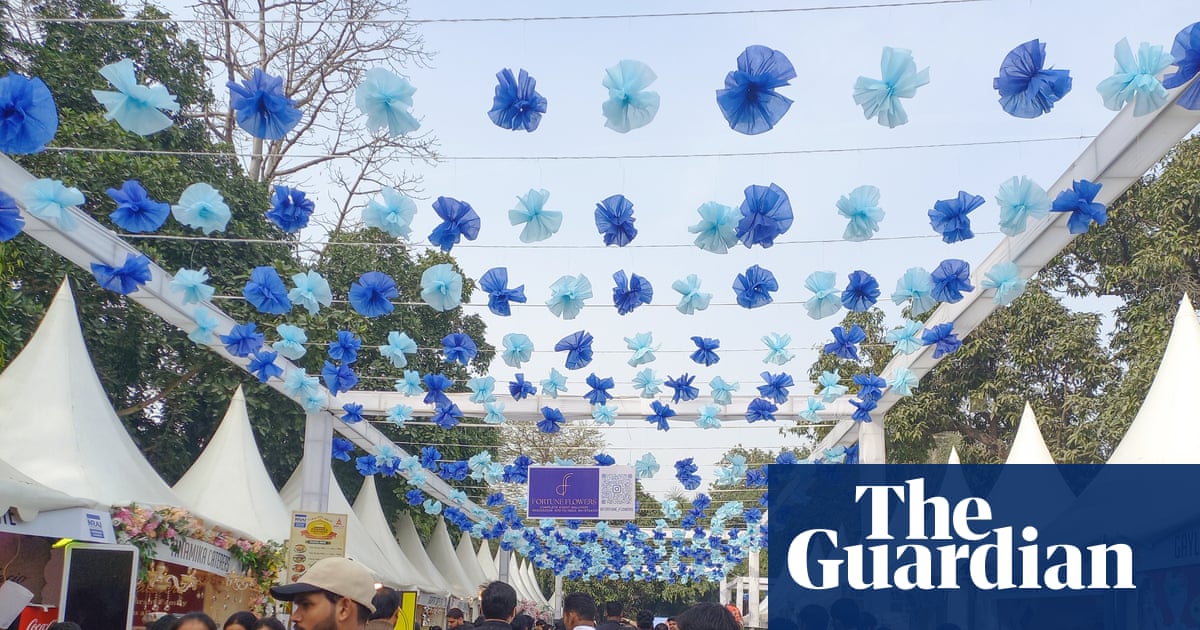
The answer is that festivals in India are only partly about books. They are a “spectacle” offering music, dance, handicraft sales and food. Even the T rex of them all, the Jaipur literature festival (which attracted 400,000 visitors last month according to its marketing team), would almost certainly attract fewer people without these extras.
“Buying books is still a luxury for the middle and lower-middle class,” says Priyanka Malhotra, CEO of Full Circle Publishing and owner of the Café Turtle book store in Delhi.
At the Banaras Lit Fest in Varanasi, the Durbar Hall is full for the discussion on screens v books. Outside, on the parched lawns of the Taj Ganges hotel, a writer speaks of “the different way time and space are conceived in western art”. Nearby, local artists paint at easels placed under the dust-laden mango trees.
All day, the lawns are buzzing – a mime show, standup comedy, handicrafts, carpets and saris for sale and a fashion show. Later, on the main stage, the Grammy award-winner and classical instrumentalist Vishwa Mohan Bhatt performs to a rapt audience.
In the carnival atmosphere, visitors and schoolchildren mill about happily. Broadly speaking, Indians dislike hushed, decorous settings. Hubbub is much preferred. “For many, a book festival is a social and cultural experience where the book is often the background, not the main event,” says Malhotra.
The festival’s president, Deepak Madhok, who owns the Sunbeam chain of schools in the Hindu holy town, knows that serious discussions alone will not cut it.
“You have to provide a ‘masala’ mix with a bit of something for everyone. Children need variety. I told the pupils attending from my schools that they can take as many pictures at the selfie booth as they want but they must listen to at least one author and discuss the session back at school with the teacher,” says Madhok.
He turns as a schoolboy, Suryavansh Raj, 11, approaches. “I’m here because I love history, but history other than textbooks,” says Raj.
“See?” says Madhok, “He’s here for history now but next year he might walk into a session and one chance remark by an author might spark an interest in another subject. I’m hoping these seeds will germinate and produce a new generation of readers.”
Literacy rates have risen significantly in India, but there remains a gap between the ability to read and the habit of reading for pleasure. For some, a standard family weekend outing might be to go to a mall and have a burger. A literature festival, with known names, influencers, a sprinkling of Bollywood stars (Varanasi had the actor Anupam Kher), sportsmen and razzmatazz is a welcome change. What’s more, at Banaras entry is free.
“India hasn’t made the transition to a literate, book-reading class. A literature festival provides a lively atmosphere, crowds and the chance to be ‘cool’ by being seen at a prestigious cultural event. There isn’t much real engagement with books,” says Chiki Sarkar, co-founder of Juggernaut Books.
The former diplomat and author Pavan Varma thinks a general dumbing down has taken place. He notes that the Jaipur festival was packed, particularly with young people.
“This made me happy, but I did get an inescapable sense that more readers now want neatly packaged, short, simplified, easily comprehensible, capsuled – and if possible, summarised – texts that can be read on a brief flight, rather than works of lasting literary value,” he wrote in the Hindustan Times.
Mobile phones have thrown a further spanner in the works. “India is one of the largest consumers of mobile data. Short videos, YouTube, reels and gaming have largely filled what little leisure time might have been spent on books,” says Malhotra.
Books in English are, however, only a tiny part of the literary scene. For the vast majority of Indians, English is a functional tool, not the language they think, love, hate and dream in – all of that happens in the languages they grew up speaking. Yet information about book sales in regional languages is scarce.
Some believe that reading in Hindi, Gujarati, Tamil or Bengali, or any of the 24 regional languages, is probably higher. But since English occupies an exalted status, until a book has been translated into English (and so accessible to the elite), it remains confined to its state boundary.
“There are no statistics for book sales in the regional languages. It’s an opaque area. We do know anecdotally that at the local level, the literary scene is very vibrant with much discussion of authors and ideas. Moreover, authors are influential, their views on social and political affairs in their state matter,” says Rao.
One example is Banu Mushtaq, a feminist writer who has spent her career chronicling lives of Muslim women in Kannada, the language of Karnataka in south India. A huge name in the state, she has won many awards.
Yet until last year she was not well known outside Karnataka. It was only when her book Heart Lamp was translated into English that her renown spread, and she won the International Booker prize 2025.
Dan Morrison, the American author of The Poisoner of Bengal (The Prince and the Poisoner in the UK) was at the Varanasi festival, looking exhausted but happy to talk to admirers and pose for selfies. He believes regional literature presents a different world, closed to people outside the state.
“You feel that something great could be cooking in a state but I can’t smell it, I won’t know it, until it’s translated into English,” he says.
The profusion of festivals is a “democratisation of literature” he says, happening “in places that people would have laughed at as venues just 10 years ago”.
Morrison says that no matter what motivates non-reading people to flock to literary festivals, there is no downside. “At least you’re around some culture that is not a screen.”
As the sound of a flute wafts across the lawns, only to be met with competition from a rap band, Arya Mohan, a 22-year-old student of English literature at the local Banaras Hindu University, strikes a philosophical note.
She is reading Christopher Hitchens and Dostoevsky’s Crime and Punishment, which separates her from the more aimless in the crowds. But she has hope.
“At least the festival is raising awareness about books. Even if just a handful of people hear something they will remember for the rest of their lives, it’s worth it.”
