

PRINCETON—In the autumn of 403 BCE, democracy triumphed in Athens. It was a hard-fought victory. The 27-year conflict with Sparta known as the Peloponnesian War had ended the previous year with the besieged Athenians capitulating. An authoritarian regime called the Thirty then took control of the city and, despite their claims of “virtue” and “justice,” soon executed more than 1,500 people.
This paroxysm of violence inspired a democratic resistance movement, comprised in part of working-class resident foreigners and slaves. After nearly a year of civil war, the rebels had won—a remarkable moment of democratic restoration that still resonates today. To celebrate, they offered a sacrifice on the Acropolis to the city’s patron goddess, Athena.
But far from the festivities, a very different kind of commemoration was taking place. Remnants of the Thirty were setting up a monument to their fallen leader, Critias. An older relative of the philosopher Plato, Critias was an intellectual, poet, and political theorist who virulently opposed the city’s democracy. He had spearheaded the Thirty until his death in battle earlier that year.
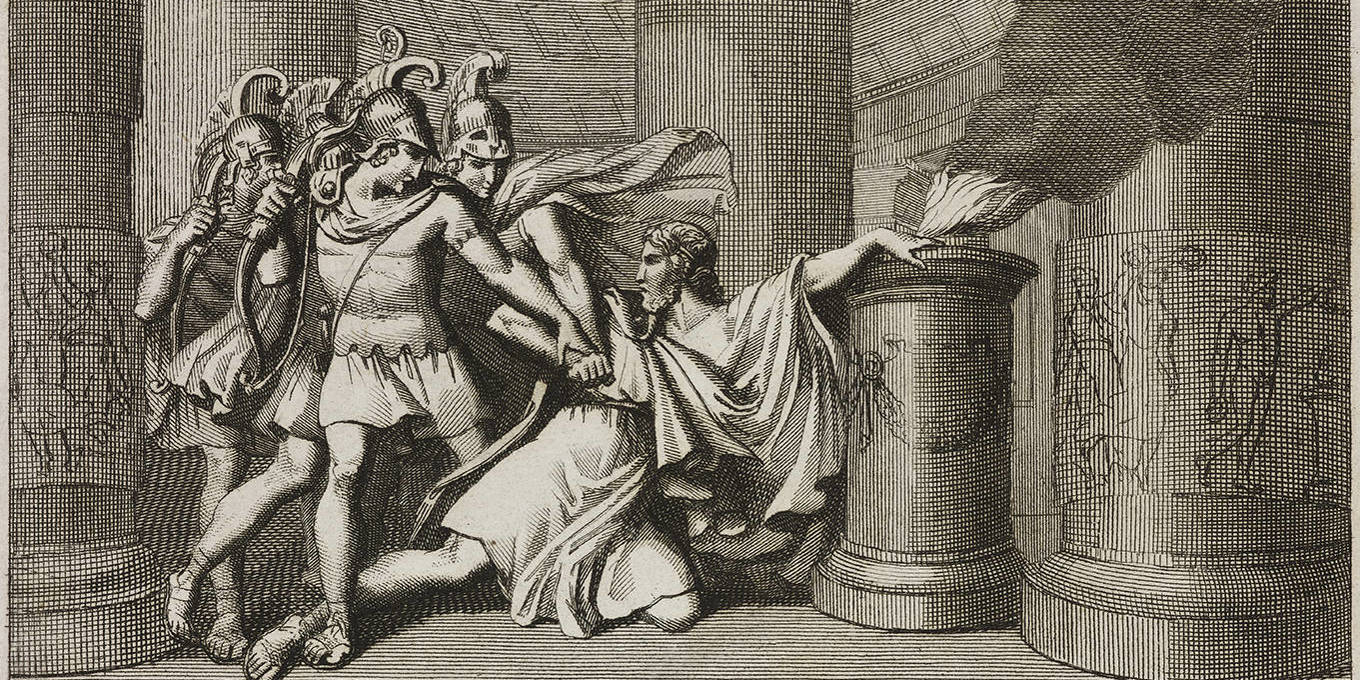
To pay tribute to Critias and the entire anti-democratic movement, his fellow partisans erected an elaborate marble gravestone. A carved relief showed a fierce young woman brandishing a torch and setting another woman on fire, with the epitaph: “This is the memorial of good men, who for a brief time restrained the hubris of the cursed Athenian people.” According to an ancient Greek commentator, the woman holding the torch is Oligarchy personified. Her victim is Democracy.
Democracy’s Nemesis
No trace of Critias’ gravestone survives, and the only reference to it is in the marginal note of a manuscript. Some scholars have understandably doubted its existence. Surely, they argue, such a subversive object would have been built in secret, raising the question of how anyone could have recorded its content. Perhaps it is a bit of ancient fan fiction.
Still, real or invented, the monument encapsulates a major political phenomenon of classical Greece: oligarchy, or “the rule of the few.” Oligarchs viewed themselves as a rarefied minority set apart by their breeding, wealth, manners, and superior education, which rendered them fit to rule. They were, in a word, the “good” of Critias’ epitaph, as opposed to the unwashed majority—the demos—who lacked the training and discernment necessary for politics, and whose misplaced priorities could result only in hubris. It was the duty of every right-thinking member of the elite to hold back the tide of ignorance by whatever means necessary. (In ancient sources, the demos is often compared to a rushing river or inundating wave; the torch imagery of the tombstone, opposing fire to water, may therefore be deliberate.)
If the oligarchic sentiment embodied in Critias’ monument seems extreme, that is because it reflects the bitterness of the struggle between democracy and oligarchy in classical Greece. It is well known that, beginning in the fifth century BCE, Greek thinkers devised a simple yet ingenious method for classifying constitutional types based on number. States could be ruled by the one (tyranny), the few (oligarchy), or the many (democracy). What is less understood is that democracy and oligarchy quickly became the two most common—and most violently opposed—forms.
Writing in the fourth century BCE, Aristotle observed in The Politics that “most constitutions are either democratic or oligarchic.” It would not be an exaggeration to say that the choice between the two nearly tore the Greek world apart. Columbia University historian John Ma, in his recent history of the ancient Greek polis, refers to the period between about 460 and 360 BCE as a “Hundred Years’ War” between democracy and oligarchy. Much more than tyranny, oligarchy was the great nemesis of popular government.
But oligarchy, no matter how ubiquitous, never had widespread appeal. Oligarchs were not a political “party” who alternated with democrats through peaceful transfers of power. Most constitutional changes were the result of a coup d’état. That was true even for the establishment of democracies. But whereas democracies, almost by definition, enjoyed the support of a majority of citizens, oligarchies often managed to persist in spite of their unpopularity.
The Rules of the Few
Ancient Greek oligarchies are a case study in how skillfully designed institutions can preserve even the most authoritarian regimes. On the surface, oligarchy relied on a property requirement to ensure that only a minority of the population, perhaps the wealthiest 10–15% of the male citizen population, had access to political office. But oligarchy had a strong ideological class component, too. As Aristotle rightly observed, oligarchy and democracy refer to number, but actually entail the rule of the rich and the poor, respectively.
To maintain power, the oligarchic “gentlemen’s club” employed a classic strategy of divide and rule. Leading lights from the opposition were co-opted into the regime. Publicly posted rewards for informants sowed doubt and division among would-be conspirators. Movement in the central spaces of the polis, where protest could spiral into revolution, was heavily regulated. And if the domestic scene grew turbulent, international allies stepped in to restore “order”: the Spartans in particular were notorious for intervening to help shore up oligarchies.
One set of institutions thus dealt with the restive demos; another maintained tolerable relations within the ranks of the oligarchs themselves. Cooperation among these outsize egos could not be taken for granted, even though their survival depended on it. (If that sounds far-fetched, just imagine a government composed exclusively of the billionaires who flanked US President Donald Trump at his second inauguration. Mark Zuckerberg, Jeff Bezos, Tim Cook, Sergey Brin, and Elon Musk may benefit from the current order, but it is far from clear that they could cooperate long enough to sustain it.)
Equipped with this institutional order, oligarchy had a decent run. In the end, however, it could not withstand the spread of democracy. This may come as a surprise: a common narrative—promoted by, among others, the framers of the US Constitution—holds that the tumultuous direct democracies of antiquity inevitably succumbed to demagoguery and disorder. The history of Athens itself, as told by the historian Thucydides, has been used to bolster this story.
But contemporary scholars, drawing on new literary, inscriptional, and archaeological discoveries, increasingly agree that democracy did not begin and end with classical Athens. In fact, between the third and second centuries BCE, democracy may have been the most common form of government in the ancient Greek world. It was celebrated in painting, coinage, sculpture, and everyday discourse as the best way to secure freedom and equality for the free male citizen (slavery and gender-based exclusion being notorious features of the ancient Greek regimes that identified as “democracies”). Then as now, hardly anyone spoke well of oligarchy in public—in fact, Critias’ tombstone, if it existed, would represent the sole attested instance of oligarchia depicted in art.
The Supermajority Trap
After some time in abeyance, the word “oligarchy” has come roaring back in the United States. It first reappeared on the political agenda in the 2010s, with the Occupy Wall Street movement and Bernie Sanders’s 2016 presidential campaign, and gained wider currency in January 2025, when former US President Joe Biden warned in his farewell address of “an oligarchy … of extreme wealth, power, and influence that literally threatens our entire democracy.” When people hear the term now, they are more likely to think of American tech bros than the Russian super-rich who accumulated their wealth by appropriating state assets in the 1990s.
In many ways, American society is ill-prepared for this moment. Despite the importance of oligarchy in Greek antiquity, where so many of the United States’ political ideas originate, the issue was largely sidelined in constitutional debates of the early modern period. That is partly because the US Constitution’s framers shifted the terms of discourse away from “democracy vs. oligarchy” and toward a contrast between the rule of law and the tyranny of the majority.
The Federalists, in particular, sought to downplay the loss in democratic power that might come with the incorporation of the separate states into the strong federal union they envisaged. As numerous scholars have pointed out, the proposed Constitution of 1787 was far less democratic than many state politicians and constituents preferred. But in the first of the Federalist Papers, Alexander Hamilton assured readers that “a dangerous ambition more often lurks behind the specious mask of zeal for the rights of the people than under the forbidden appearance of zeal for the firmness and efficiency of government.” In other words, it was an excess of democracy, rather than its deficit, that would lead to political instability.
As a result, the Federalists were somewhat on the defensive when it came to touting the popular bona fides of the Constitution. James Madison admitted in Federalist 38 that the most common charges against the document were that it would end in monarchy or aristocracy; there was little danger, it seems, that it was too democratic.
But we can still draw on the Federalists for rhetorical ammunition against the idea that the US Constitution was not meant to be democratic at all. The claim that the United States is a “republic, not a democracy” continues to circulate, with the understanding that a majority vote should not necessarily prevail. As Madison explained in Federalist 10 and 14, however, what “republican” means in practice is primarily the use of representative, rather than direct, voting on legislation. In both cases, the method for tallying votes is majoritarian.
In fact, in an indirect allusion to oligarchy, Madison stated that “[i]f a faction consists of less than a majority, relief is supplied by the republican principle, which enables the majority to defeat its sinister views by regular vote.” Madison seems incapable of imagining that a majority could be held hostage to a stubborn minority holdout.
Hamilton, while not necessarily a friend of democracy, also had sharp words for super-majoritarian, as opposed to bare majority, voting rules. “To give a minority a negative upon the majority,” he wrote in Federalist 22, “(which is always the case where more than a majority is requisite to a decision), is, in its tendency, to subject the sense of the greater number to that of the lesser.” Such a system aims “to substitute the pleasure, caprice, or artifices of an insignificant, turbulent, or corrupt junto, to the regular deliberations and decisions of a respectable majority.”
And yet, the process that Hamilton disparaged is precisely how the US now regularly formulates policy, through the use of the Senate filibuster. Two-fifths of the Senate, potentially representing only about 10% of the total US population, can stymie legislation through its de facto veto. So long as this continues, America is effectively governed by an oligarchy, against the express intentions of the Federalists—men who were not all that enamored of democracy to begin with.
The US faces unprecedented challenges. In addition to Trump’s daily attacks on the rule of law, American society must decide how to navigate the rise of AI, climate change, and runaway inequality, among many other issues. Progress will require, at a minimum, insisting on the basic rights of democratic majorities as guaranteed by the Constitution. To maintain the status quo is to do the oligarchs’ work for them. In antiquity, oligarchy was imagined as actively setting fire to democracy. Today, as the meme goes, democrats sit in a burning building of their own making and declare, “This is fine.”
