

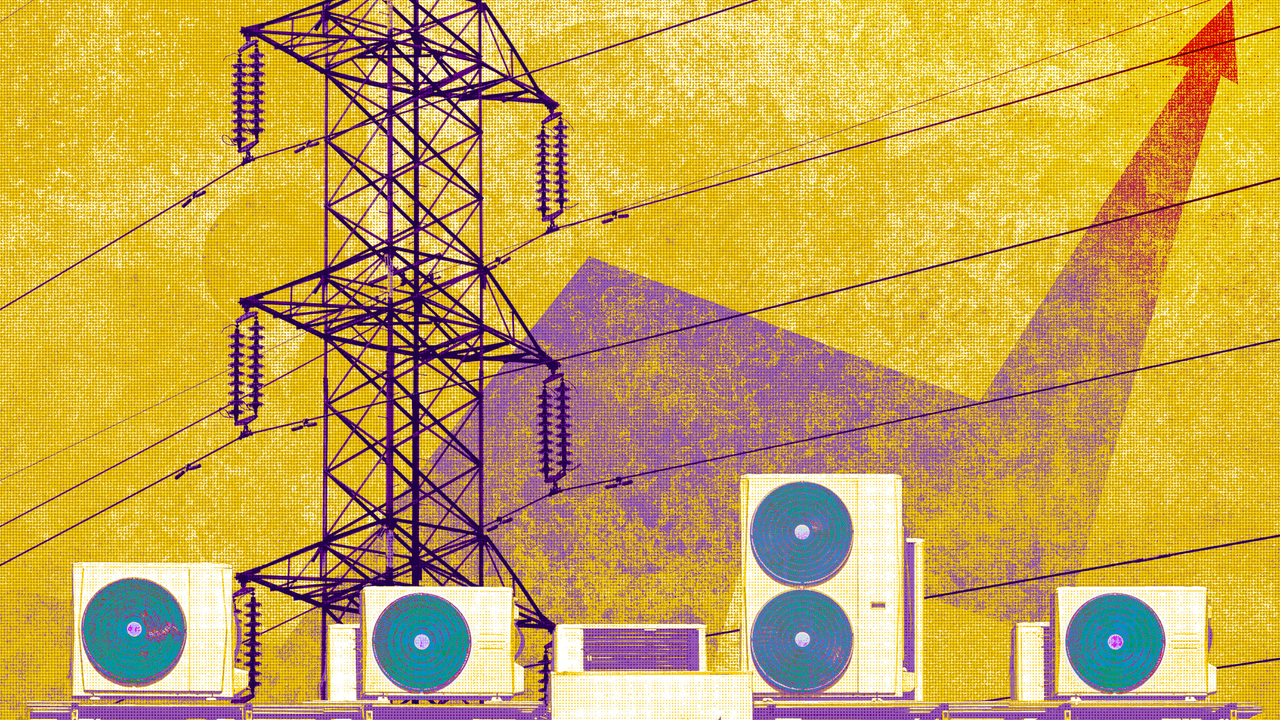
The U.S. electric grid is the largest and most expensive machine on the planet. Its interconnected pathways cover nearly 7 million miles, serve 400 million customers, and its value is placed at about $1.5 trillion. To build it today, the grid would cost almost $5 trillion.
Despite that high price tag, the grid in its current form was built for a different era—one defined by centralized generation, shorter transmission distances, and long planning cycles aligned with steady, predictable load growth.
That era is over.
The grid is the bottleneck
The grid wasn’t designed for the rapid acceleration in power demand that we’re seeing today.
In addition, the industry that built the grid hasn’t changed how it deploys infrastructure in decades. Manual processes, legacy machinery, and construction methods have not fundamentally changed in decades. Expanding grid capacity has never been more urgent, yet we’re using outdated tools to do so.
The difference is not simply that grid demand has surged; it’s that the entire system architecture has changed: where generation is built, where load shows up, and how power is consumed. AI data centers, industrial reshoring, and electrification are driving a structural shift in U.S. electricity consumption, with federal forecasts pointing to the strongest multi-year growth since 2000.
What’s becoming abundantly clear is that power delivery—rather than power generation—is the biggest constraint on keeping pace with this new demand. New power generation can be built far faster than the network expansions and upgrades required to move power to where it is needed. Utility-scale solar projects can be developed in four to five years, while major new transmission projects still take seven to 10-plus years to deploy.
The grid’s structural speed problem
This has resulted in flooded generation interconnection queues with five-year timelines. Large-load interconnections are following the same path with multiyear timelines accepted as the typical waiting period. Efforts are underway to accelerate these queues through expedited studies and interconnection rules, but those fixes don’t address the first-principles problem we’re facing. Even when sufficient generation capacity is available and the grid tie-in process is smooth, infrastructure must be in place to physically move the power.
And that’s where the grid is breaking down. Construction methods that are stuck in the last century. The regulatory framework that recovers capital costs regardless of efficiency and permitting processes treat urgency as irrelevant. None of this creates pressure to move faster.
Utilities want to build. Developers want to connect. But the structural conditions they operate within weren’t built for the speed the moment demands. Over the last 20 years, utility spending on transmission and distribution doubled, while spending on energy generation fell by 25%. We’re living through a period of falling energy generation prices, held back by a sluggish, costly grid construction process. As a result, energy affordability is suffering.
Access to power is gating economic growth. “Speed-to-power” has now entered the mainstream vernacular of manufacturing facilities and technology providers alike. “Powering” was quoted in twice as many S&P 500 calls in 2025 as the previous year. Workarounds to the issue are rising, with 30% of planned data center capacity expected to come from behind-the-meter strategies – generation built directly on or near a facility’s site, rather than supplied through the broader electric grid. That matters because companies are increasingly redesigning projects around grid constraints, often at higher cost and with greater reliance on on-site fossil generation, simply to secure power on a commercially viable timeline.
Constrained at every stage of construction
Faster transmission construction is one of the clearest levers to accelerate speed-to-power, but capacity is constrained at every stage. Long-lead equipment, such as transformers and substations, remains difficult to procure. Permitting is slow and cumbersome. Public opposition continues to rise. Skilled labor remains scarce, with Andreessen Horowitz, a venture capital firm, projecting a shortage of about 78,000 skilled linemen in the U.S. by 2030. Even after a project is shovel-ready and well-staffed, building the infrastructure can take years. Utilities, developers, and system operators alike are confronting a system that can’t move at the speed required.
Some of these roadblocks require regulatory-heavy, region-specific solutions that can be clunky to propose and implement. But others, like the construction process itself, are well-suited for technology-enabled solutions that offer the greatest opportunity for efficiency and scale.
In most sectors, when demand accelerates, productivity follows. Innovation drives improvements in performance and capacity, and competition pushes further advancements. We’ve seen it across the energy industry already—from solar and batteries to advanced metering infrastructure and grid-enhancing technologies.
Grid construction hasn’t followed that trajectory, and it won’t until someone forces it to.
Even a highly instrumented, smart grid won’t solve the underlying issue of fledgling, inadequate infrastructure. The largely used to build transmission and distribution infrastructure today are the same ones used a generation ago. We’re relying on hundreds of people, manual processes, and legacy machinery to meet the challenge of installing 50,000 additional miles of power lines globally by 2040.
It just won’t work.
Bottom line
Now is the time to deploy existing, proven technology that reduces the time and cost of grid construction and introduces a new talent pool into an insufficient supply of skilled labor. The introduction of this technology would put transmission and distribution construction on the same learning curve as other energy technologies and bring grid deployment into the 21st century.
We’ve entered an era of energy abundance and staggering demand growth, but both are trapped behind a century-old grid. The generation side of the energy industry has had its Moore’s Law moment—a sustained cycle of technological improvement, falling costs, and rising performance. Transmission construction hasn’t. Not because it’s impossible, but because nobody with the right incentives has forced it to happen yet. That will change when investors, developers, and operators stop treating grid construction as an inevitable bottleneck and start treating it as the highest-leverage unsolved problem in energy.
The markets that adapt will decarbonize faster by connecting more renewable generation and reducing reliance on emissions-intensive behind-the-meter workarounds, while also powering the next decade of economic growth. Everyone else will wait in the queue.
The tools exist. The urgency is real. The question is whether the people building the energy future are paying attention to the right problem.
Cameron Van Der Berg is founder and CEO of Infravision.
