

The following is an edited version of a conversation from the July 20, 2025 edition of the Frommer’s Travel Show podcast. Please note that this article contains a photo some readers may find disturbing.
Pauline Frommer: In our guide books, we often talk about the fact that prices rise and crowds grow at festival times. And so the advice often becomes “go at another time.”
But the truth is, whenever I have gone to a festival—and I’ve had the privilege of going to the Fringe Festival and the Edinburgh Festival, [the] Olympics twice, [as well as] other festivals—I find those are the most sublime types of travel experiences, and the most eye-opening.
Which is why I was so excited to hear about a new book that is all about festival travel. It’s called Fiesta: A Journey Through Festivity, and the author, Daniel Stables, is here now to talk with us about it.
Hey, Daniel, thank you so much for appearing on the Frommer’s Travel Show.
Daniel Stables: Hi, thank you so much for having me. It’s my pleasure.
Frommer: How many festivals did you go to [in the course of researching this book]?
Stables: [This book] draws on 10 years or so of experience. I’ve been working as a travel writer for about that length of time… First, I started off writing guide books, and nowadays, I write articles for magazines. But I’ve been very, very privileged in that time to go to all kinds of festivals all over the world.
And yeah, every time I’ve been lucky enough to go to one, I’ve had this feeling that it is kind of like culture in its most distilled form—human experience [where] everything’s turned up to 11.
That’s the case in very obvious physical ways, like with costumes and sights and sounds and the smells of food and music and all these things.
Also, the more festivals I went to, the more I realized maybe there’s something deeper going on here.
Frommer: [At the start of the book] you introduce the concept of liminality… So let’s talk about liminality and festivals.
Stables: Sure. So liminality is [an] idea [that] comes from anthropology. It describes the state of being on a threshold or in between two stages of society. It originated with a guy called Arnold van Gennep. He [also] coined the term rites of passage.
He describes people who are in between various stages of their lives. You know, whether that’s between adolescence and adulthood, or when you’re graduating from college, or whatever it is. When you’re in these in-between states, you’re in a liminal state. …
There’s another anthropologist called Victor Turner who elaborated on this in lots of depth in the 1970s, and he specifically spoke about festivals as events where the normal hierarchies and ways of being in society get dissolved and stripped away. Suddenly everyone enters onto this level playing field and it engenders very powerful feelings of what he called communitas, which is communal feelings which strengthen societal bonds.
And then you go back to normal. [But] the idea is that the shared experience has in some way strengthened bonds between people. And yes, it’s a very powerful thing.
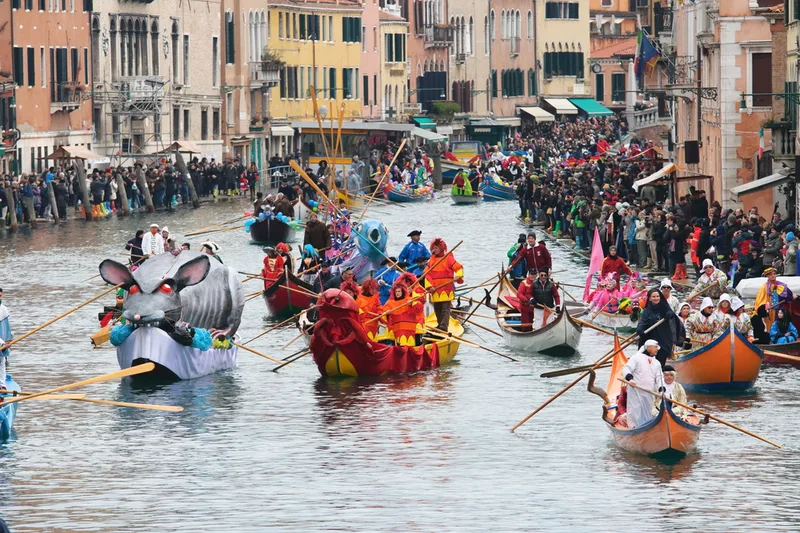
Frommer: Let’s talk first about the second place you discuss in the book, which is Venice, where people throw off the strictures of daily life by wearing masks.
Stables: That’s right.
Frommer: And I love the fact that the Venice Carnival has influenced what certain geographic locations are called. So, let’s talk about the ‘Bridge of Tits’.
Stable: Sure. Yeah. So, the background here: Venice Carnival goes back sort of almost a thousand years in one form or another. Like carnival celebrations across the Christian world, [it is] celebrated in the week leading up to Lent. And so traditionally, it was this time of release before Lent, which was a much more somber and lean period.
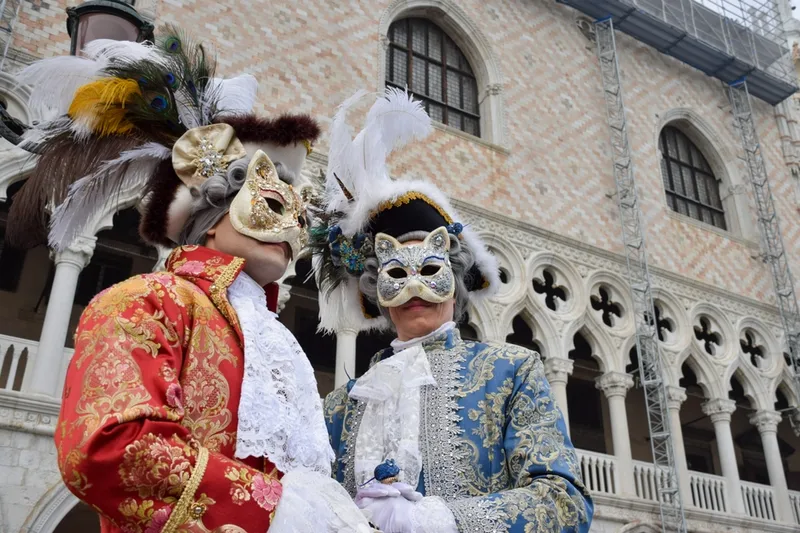
As you said, at the Venice Carnival everyone would wear masks. It’s a perfect example of what I was just saying about this leveling power of festivals. Everybody wore a mask and originally the masks all looked the same. It was very different from now, where they’re all kind of extravagant. They were just plain white masks.
And so underneath that mask, it could be anybody. It could be a pauper or a king or a cardinal or a nun. And all these people, including cardinals and nuns, acted in ways which you would not necessarily expect them to during those times because they could because of the anonymity afforded by wearing a mask.
And one of the reasons why, periodically, carnival has been suppressed over the centuries is because that anonymity allows for criminality. And if not criminality, then behaving in ways which were frowned upon by the authorities.
One of the groups of people who were emboldened to live the way that they wanted to live, but weren’t allowed to most of the time, was homosexual men. Homosexuality was illegal during the Venetian Republic, even though Venetians were kind of famous for their sexual freedom. I mean, Casanova was Venetian.
Frommer: Sure, right.
Stables: One of the very early variations on the plain white mask which emerged in the Venice Carnival was the cat mask, or feline mask, which you still see at the Venice Carnival today. It’s called the Gnaga, and that name is onomatopoeic. It comes from the sound of a cat’s meow, supposedly.
One of the really interesting things about masquerade in general—and you see this not only in Venice Carnival, but in other examples of festivals across the world, and cultures across the world—[is] there’s this idea that, at least historically, when you put on a mask… it is actually like you’ve taken on the role and the personality of the mask that you’re wearing.
The feline cat mask was considered to be a feminine role. So the reason gay men wore it was because if they had gay affairs during that time, they were deemed technically not to have had a gay affair, because they were kind of considered to be women because they were wearing that costume.
It’s kind of hard for us to get our heads around in the modern age. But it was kind of like a loophole.
So there’s a bridge in Venice called the Ponte della Tette, which means the Bridge of Tits.
Legend has it that Venice’s male prostitutes were so emboldened by this loophole during carnival time—they were getting so much business—that the city’s female prostitutes began to go out of business.
And so [the female prostitutes] appealed for help from the Bishop of Venice, funnily enough. [He] said to them, okay, to boost business, I’ll allow you to flaunt your wares in public, in this very specific part of the city, which was this bridge in the Red Light District.
And so they were allowed to stand topless on this bridge. And hence it became known as the Bridge of Tits. And it is known that way to this day.
Frommer: Incredible. So that was one of the masks: the feline mask. You also talk about the fact that a plague doctor mask was always big during carnival. And, in fact, often celebrations dig deep into themes of death and decay and disease. You’ve seen this come back since Covid, right?
Stables: Yeah, yeah. When I went to Venice Carnival in 2023, the Plague Doctor mask was out in full swing. I went to an atelier where they make traditional masks and they said that the Plague Doctor mask has become even more popular than normal in the years since Covid.
Partly it’s just gallows humor, which is absolutely a feature of carnival parades and festivals across the world. But it’s also this feeling of [the] power of festivals… these explosions of uninhibited behavior that sometimes would be considered transgressive, [like] getting really drunk or using drugs or being promiscuous. And I think part of the reason for that is that [festivals] serve as memento mori in some cases.
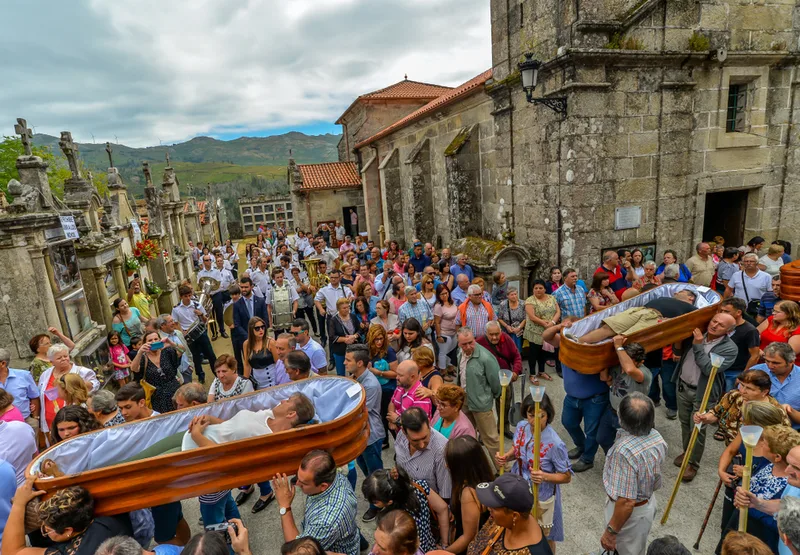
I mean, lots of festivals specifically have an end-of-life theme. There’s one in Spain, for example, called the Festival of Near-Death Experiences. It takes the form of a parade of coffins which goes through this town. Inside the coffins are people who have genuinely in life survived a near-death experience. They’re in these coffins and they get carried through the town. And then they open the coffin, they leap out, and they dance around the town. It’s a celebration of life, a victory of life over death.
Festivals are good on these big themes: life and death and food and birth and sex.
Frommer: One of the most stunning parts of your book was when you talk about the festivals of the Daoists in Phuket, which is something I’d never heard of before.
Stables: Sure, yeah. In Phuket, as you say, in Thailand, there’s a festival called the Nine Emperor Gods Festival, [which is also known as] the Phuket Vegetarian Festival, which sounds pretty, you know, wholesome. But it’s actually one of the most incredible, bizarre, and actually kind of gory festivals that you can imagine.
It’s held over nine days in the ninth lunar month of the year, which is normally in September or October. Its origins are in the 1820s, with a, strangely enough, a touring opera group from southern China that was on tour in Phuket and got caught up in an epidemic—either cholera or maybe malaria—the story [is] a bit sketchy on the details. But they had been a bit lax on their religious practices from back home. They were Daoists, and those religious practices included abstaining from meat (hence ‘vegetarian festival’), and also abstaining from alcohol, sex, and practicing acts of self-ritual self-mortification. So they would put skewers through their cheeks and they’d walk on hot coals, things like that.
And once they did [these acts of ritual mortification] they emerged unscathed from the epidemic.
[The troupe] went home and ever since, their legacy has remained on Phuket, though there’s a big Chinese community on Phuket as well. So through them and in the Chinese shrines on Phuket, they’ve kept alive this festival, which has over the years, particularly in terms of the self-mortification, became much, much more elaborate.
Frommer: Yeah. You said Hieronymus Bosch would wince at some of the things you saw there, like a man with a table lamp through his cheek.
Stables: Yeah. Swords, table lamps, there was a guy with a BMX bike frame through his face—life-changing body modifications.
I mean, not that they walk around year round with table lamps through their face, but you see people who are old hands at it. They’ve been doing it for years and have huge, massive scars.
They are called “masong” and during adolescence they feel they are chosen by a god or different gods [to do these mortifications]. This was also fascinating because of the pluralistic religions on the island of Phuket. Sometimes people are doing this in honor of Hindu gods. Sometimes they’re doing it in honor of other gods and they dress in different costumes to show honor to those gods.
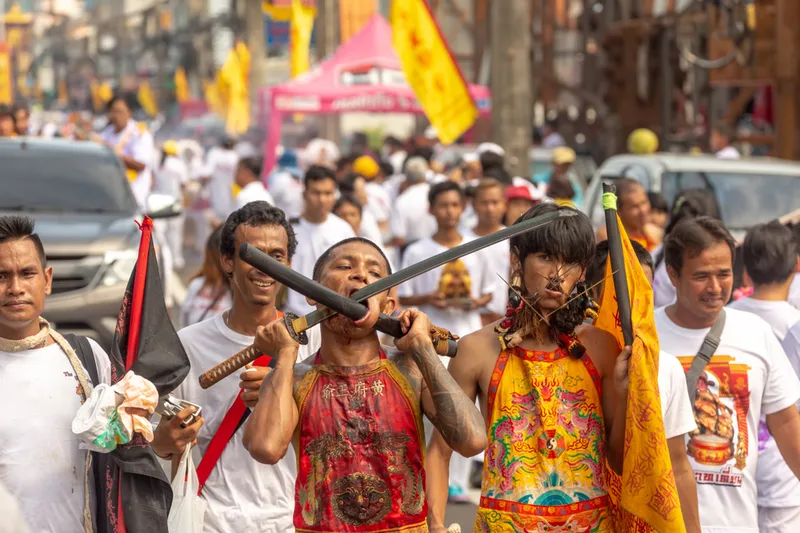
I interviewed a lady who had been doing it for 20 odd years. She was in her 40s and she had been chosen, as she put it, in her adolescence by a deity.
As she described it—and this I think is quite a common kind of pattern—these people will have various problems in their younger lives. They describe it as a spiritual sickness, but it manifests in physical ways, so lots of illnesses. She said she had lots of near-death experiences as well, lots of accidents.
And then one day she passed out, and when she woke up she was holding a piece of paper, and on the piece of paper was written something in Chinese lettering. She didn’t speak Chinese, so she didn’t understand what it said. But she went to the Chinese shrine, and they translated it for her, and it was the name of the deity that had chosen her.
She said that after that, she realized that the reason for all her problems had been because she hadn’t yet been in communion with her deity, and that now that she had to go through a period of training. She had an aunt who was also a masong—[these things] run in the family, she said—[and the aunt] trained her to be able to control these periods of possession and trances. Now, at these festival times, she will enter the trance before the [ritual mortification].
I was talking to her at the temple beforehand, and she was dressed in these amazing festival clothes, a blue sort of tunic. But apart from that, she was just perfectly normal, just having a normal conversation. And then we stopped talking to her and suddenly [she started] shaking. My translator [told me] she’s entering her trance now. And there was like dozens of, hundreds of these people in a similar state, their eyes are all vacant and they’re like shaking like jelly. It’s really odd. And then you see them getting the piercings and there’s no anesthetic involved.
Frommer: Fascinating. And I love the fact that [as you write in the book] she works as a guide normally, and her company gave her time off to be part of this ritual. You write that [they do so] because it’s deemed to bring good karma to the company and the wider society. That’s the whole point of the self-mutilation practices. The masongs suffer for the rest of our sins, taking on the bad karma of the community. I’m not Christian, but it reminded me of Christianity.
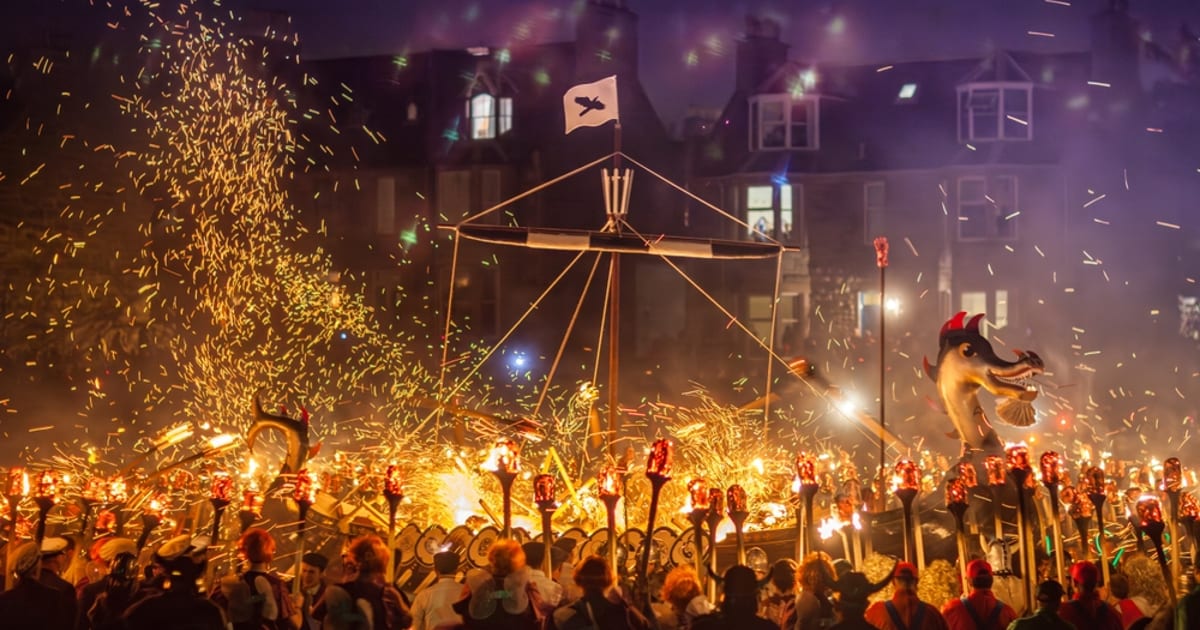
You start the book in the Shetland Islands, where for an entire year, it sounds like, people build these very detailed, very beautiful replicas of Viking ships. And then at this festival celebrating the end of winter, they’re set ablaze. That, too, is a common thing at festivals, where the temporariness of life is brought to the fore, right?
Stables: Yeah, totally.
Frommer: And what’s so interesting about the Shetland Festival is, you think of it as being part of Scotland, but in a certain way, they have more in common with Scandinavia, right?
Stables: That’s right, yeah. So, the archipelago of the Shetland Islands is way, way north, in the middle of the North Sea, between mainland Scotland and Scandinavia, effectively. If you talk to people there, they will tell you that they feel more Scandinavian than Scottish, certainly more Scandinavian than British.
And there’s a genetic basis for that. Genetic studies have been done on these people, and they are much more Scandinavian than most mainland Scottish people. But also, because of where the islands are, historically, they’ve been a crossroads for Vikings and people going to the Americas, and also, they’re kind of their own thing, really.
The festival is called Up Helly AA and it’s actually a series of festivals. There’s 12 of them, and they’re held between January and March.
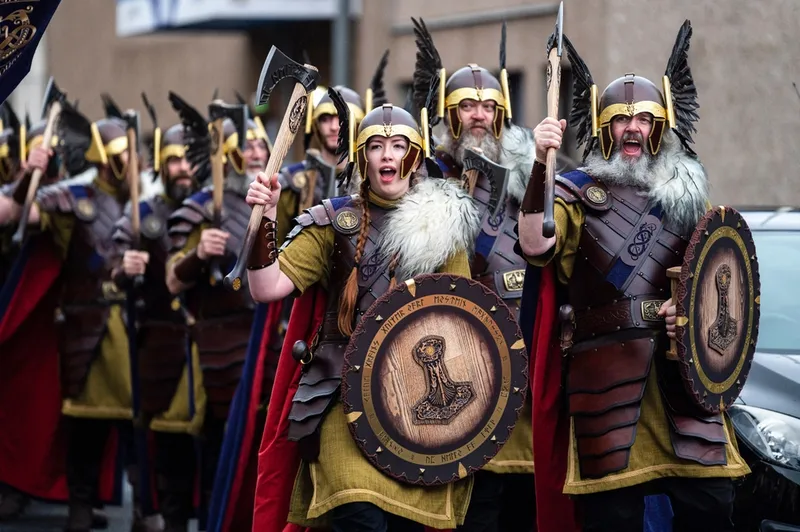
The main one is the one that I go to in the book, [in] a town called Lerwick. They don’t quite spend all year building it, but they spend all winter building these boats—the galley, as they call it. And it’s just all volunteers and locals, and they build these beautiful things, like proper reconstructions of old viking long ships, huge, huge things, painted beautifully with dragons on the prows and stuff.
And then they spend all this time and all this money and all this effort building these things, only to, yeah, ritualistically destroy them, set them alight.
You see it a lot in festivals, like you say. I liken it in the book to the sand mandala, which is the Tibetan Buddhist thing. These sand artworks made from colored sand, and they’re so intricate and elaborate. But the whole point of them, building them, is to destroy them, to represent the transience of life.
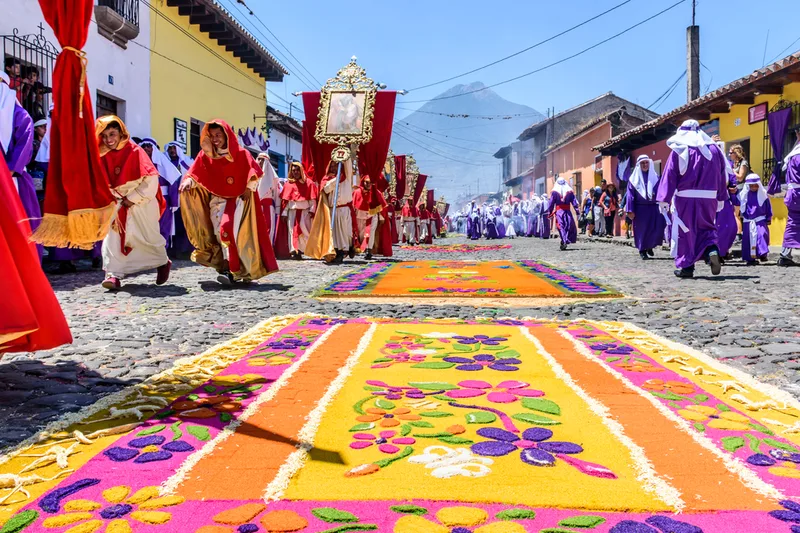
Frommer: I was in Guatemala once for Easter festivities, and they create these extraordinary rugs over the parade route using petals from flowers. And they spend hours—we actually got to help—painstakingly creating these rugs out of petals. They’ve also spent months raising money to buy the flowers and to bring them in from the mountains.
We spent hours putting these petals in incredibly intricate patterns. And then they were destroyed in seconds as the parade marched through. It’s a very emotional experience to see it and to be part of it.
Stables: I think it’s interesting as well. I put it to one of the locals when we were watching the galley emerge from this huge hanger shed that had been in all winter, this huge moment. And I mentioned that thing about it being like a sand mandala. And then one of the locals just sort of like said, like in a slightly dismissive way, there’s just nothing else to do around here all winter. As if I was completely over-intellectualizing it.
But I think sometimes, one of the things that’s interesting and fun about experiencing these things in lots of different cultures, as well as our own, is that with stuff close to home, often, we don’t really think about why we do it or realize why we do it. I mean, I think of Christmas, Easter, the cultural festivals that we’re used to—we don’t really give it much thought.
Frommer: Right.
Stables: So it’s kind of nice sometimes to have an outsider’s perspective.
With Up Helly Aa, it’s the end of winter. So it’s like the light, maybe, is just about to come back. So obviously, fire is another big symbolic thing.
Frommer: Sure. And firecrackers and all kinds of drinking.
Stables: Yeah, fireworks and a lot of drinking. Yeah, it’s a big, big party. Yeah, that’s one thing they definitely have in common with the Scots. Probably, I guess, the Scandinavians as well.
Frommer: The book takes you everywhere. There are pilgrimages in it. There are religious processions. There’s the equinox at a megalithic tomb on the island of Malta. You really bring festivals around the world to life. So thank you so much for the great conversation and the great read.
Stables: Thank you so much. It’s been a pleasure. Thank you.
