


karelnoppe/iStock via Getty Images
Fast Facts About The Defiance Daily Target 2X Long RKLB ETF
The Defiance Daily Target 2X Long RKLB ETF (RKLX) is a leveraged ETF based on the common stock of Rocket Lab Corporation (RKLB). RKLX was launched on 03/12/2025 and has a net expense ratio of 1.31%. It is a mid-size but very liquid ETF, with $329 million of AUM (assets under management) and a 3-month average daily dollar volume of $189 million. It means about 57% of AUM changes hands every day, pointing to the fund’s appeal to short-term traders. The issuer Defiance manages thematic, income, and leveraged ETFs, with a specialty in single-stock leveraged ETFs like this one.
Strategy and portfolio
RKLX has the objective to provide, before fees and expenses, twice (200%) the daily performance of the share price of Rocket Lab Corporation.
The fund may invest in swap agreements and options based on the underlying stock and hold cash equivalents and investment-grade debt instruments as collateral. Keeping a daily objective requires rebalancing the portfolio on a daily basis. The portfolio turnover was 416% in the most recent fiscal year. Defiance gives two warnings on RKLX:
- There is no guarantee the fund will achieve its daily objective.
- For periods longer than one day, the fund will lose money if the underlying stock is flat, and it may lose money even if the underlying stock goes up.
Fund performance for periods greater than a single day depends on a number of factors, including the underlying stock’s price path, financing rates, and other expenses. In particular, the daily leverage factor generates drift, a topic that I will discuss in this article.
As an example from July 3, 2026, the fund has 36% of net asset value in treasuries (mostly short-term) and a notional exposure of 199.8% in RKLB through eight swap contracts. Diversification in several swap issuers mitigates counterparty risk and dependency. Holdings may have changed by the time you read this.
Fundamentals
Rocket Lab Corporation is a leading space company established in 2006 in Long Beach, California, and offers a broad spectrum of launch and space systems services. Its closest competitors are “SpaceX” Space Exploration Technologies Corp. (SPCX), Northrop Grumman (NOC), and Blue Origin.
RKLB is classified by GICS in the Industrials sector and in the Aerospace & Defense industry. It has strong momentum and solid growth metrics, but weak value and profitability, as reported below by Seeking Alpha factor grades.
RKLB factor grades (Seeking Alpha)
Seeking Alpha’s aggregate quantitative ranking puts RKLB in 27th position in its industry among 71 companies, with ATI Inc. (ATI), Mercury Systems, Inc. (MRCY), and Astronics Corporation (ATRO) in the top ranks.
With the acquisition of Iridium Communications, Rocket Lab will enter the satellite communications market and compete more effectively against SpaceX. The transaction is expected to close in mid-2027. This vertical integration deal will enhance cash flow and profitability but also add potential financial risks by introducing leverage ($3.6 billion bridge loan to refinance within a year).
Performance
RKLX has gained 721% in total return from inception to 7/3/2026, while RKLB is up 472%, as reported by the chart below.
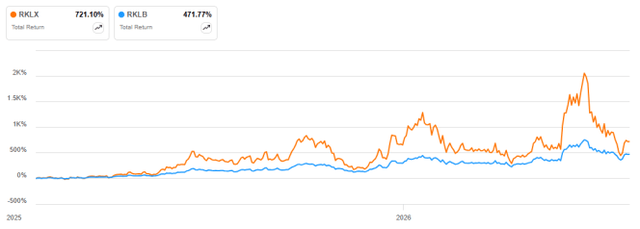
RKLX vs RKLB (Seeking Alpha)
The ratio of total returns RKLX/RKLB has varied a lot depending on time frames, as reported in the next table. It was even negative in the 6-month period.
Data: Portfolio123
Such variability points to path-dependent drift. This raises a question:
Why do leveraged ETFs drift?
Leveraged ETF drift has three main sources: beta-slippage, derivative rolling cost, and expense ratio. Beta-slippage is the main source in equity-leveraged ETFs such as RKLX. To understand it, imagine a very volatile asset that goes up 25% one day and down 20% the day after. A perfect 2X leveraged ETF goes up 50% the first day and down 40% the second day. On the close of the second day, the underlying asset is back to its initial price:
(1 + 0.25) x (1 – 0.2) = 1
At the same time, the perfectly leveraged ETF has lost 10%:
(1 + 0.5) x (1 – 0.4) = 0.9
It is just the result of compounding leveraged returns. In a trending market, beta-slippage can be positive. If the underlying index goes up 10% two days in a row, on the second day, it is up 21%:
(1 + 0.1) x (1 + 0.1) = 1.21
The perfect 2X leveraged ETFs are up 44%:
(1 + 0.2) x (1 + 0.2) = 1.44
Beta-slippage is path-dependent. If the underlying index gains 50% on day 1 and loses 33.33% on day 2, it is back to its initial value, like in the first example. However, the 2X ETF loses one third of its value, instead of 10% in the first case:
(1 + 1) x (1 – 0.6667) = 0.6667
This theoretical example shows that larger “whipsaw” daily price moves generate a larger decay. For this reason, beta slippage is commonly referred to as volatility decay. However, it is not mathematically related to a statistical measure of volatility, in particular because it is path-dependent.
Related ETFs
- RKLX has a bear counterpart: the Defiance Daily Target 2X Short RKLB ETF (RKLZ).
- GraniteShares is likely to launch leveraged 2X long and 2X short RKLB ETFs in the near future (GraniteShares SEC filings in progress). They will be direct competitors to RKLX and RKLZ.
- There is a 300% leveraged RKLB exchange-traded product available in EUR, GBP, and USD in European markets (LSE, Euronext Amsterdam): the Leverage Shares 3x Long Rocket Lab ETP (tickers: RKL3, 3RKL).
Takeaway: Who should consider RKLX?
RKLX is an instrument designed for traders executing strategies with precise entry and exit signals and who understand the fund’s behavior behind the leverage factor. Holding RKLX over a long period may have unpredictable results, due to leveraged drift magnified by the underlying stock’s high volatility. The leverage drift adds significant noise in RKLX’s price action; therefore, traders must base their technical analysis on RKLB.
This article answers these three main questions about RKLX:
- How is the RKLX portfolio structured?
- Are there specific risks to holding RKLX?
- Is RKLX meant for short-term trading or long-term investing?
Editor’s note: This article is intended to provide a general overview of the ETF for educational purposes only and, unlike other articles on Seeking Alpha, does not offer an investment opinion about the ETF.
