

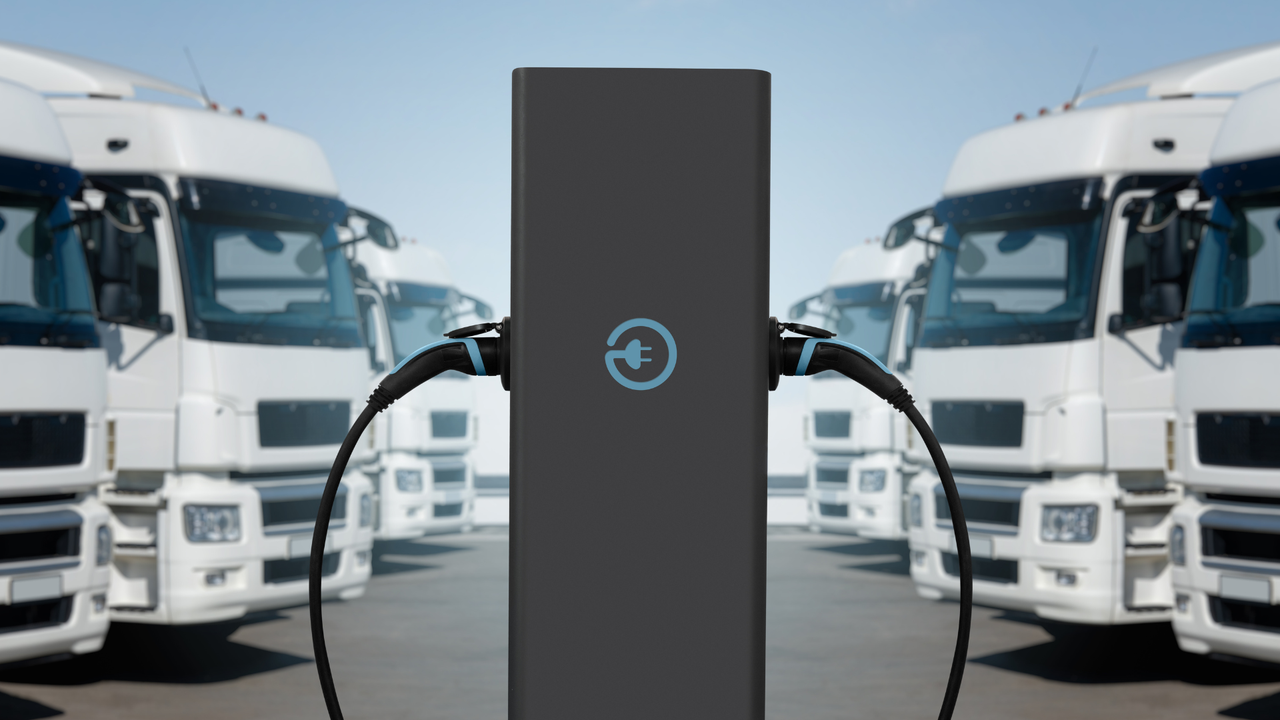
Every company that sells, ships, manufactures, or distributes physical goods is now exposed to transportation volatility. Even if a company does not own a single truck, it depends on freight capacity, delivery reliability, predictable transportation costs, and increasingly, lower-emission logistics.
Over the past six months, diesel prices have remained highly volatile, adding more uncertainty for shippers and carriers already managing tight capacity and rising costs. Electricity prices are not immune to change, but they are often more predictable and less exposed to daily swings in global oil markets. That matters when companies are trying to plan freight budgets, protect margins, and keep goods moving.
Electric trucking economics are improving, with costs projected to fall from roughly $425,000 today to approximately $300,000 by 2028, and below $230,000 by 2035, driven by battery cost reductions and increased vehicle standardization. In some states, including California, truck rebates can further reduce costs and bring electric trucks closer to diesel price parity. As adoption grows, charging infrastructure becomes the next critical challenge.
Commercial fleet electrification is often framed in a binary manner: build chargers at your own depot or rely on public infrastructure. That framing is understandable. Fleets need tight control of schedules and commitments. Depot charging offers that control because trucks return to a known location and charging happens overnight. But treating depot charging as the only option can limit commercial fleet electrification.
The future is not depot charging or public charging. It’s both. Diesel fleets did not scale around a single fueling model. They rely on private yards, truck stops, ports, distribution centers, and more. Electric trucking will need that same flexibility.
The value of shared infrastructure
A fleet that electrifies only at its depot is constrained by the boundaries of that depot: charger count, utility timelines, real estate, and whether routes reliably bring trucks back with enough time to charge. If a customer adds volume, a route expands, a charger goes down, or a utility upgrade is delayed, the operation can quickly become fragile.
That fragility does not stop with the carrier. It ripples to the shipper waiting on capacity, the retailer managing delivery commitments, and the brand trying to reduce emissions. The trucking industry already understands the value of shared assets. Less-than-truckload shipping allows multiple companies to share trailer capacity, reducing costs and improving utilization. Charging infrastructure can follow a similar model, where fleets access a shared charging network rather than each operator independently building chargers that may sit unused for much of the day.
We have seen other industries scale faster when companies do not have to build every piece of infrastructure alone. Cloud computing changed software because companies no longer had to operate all their own servers. Shared logistics networks helped companies move goods more efficiently without owning every warehouse, trailer, or terminal. Shared freight charging can play a similar role in transportation electrification: expanding access, reducing duplication, and giving companies more flexibility as demand changes.
In that environment, the best charging strategy is not always the one that looks at the lowest cost-per-kilowatt-hour. It is the one that gives fleets the most operational range. This same principle drives practices like slip seating, where multiple drivers operate a single truck across different shifts to maximize asset utilization. Trucks are expensive assets, and profitability often depends on keeping them moving. Public charging extends that same philosophy to infrastructure, helping fleets maximize vehicle utilization rather than limiting operations to the constraints of a single depot.
Trucks that drive more miles earn more revenue
A depot-only electric truck may run about 180miles per day depending on vocation and duty cycle. Over a year, that is roughly 45,000 miles and about $112,500 in gross revenue, assuming revenue of about $2.50 per mile. With longer-range electric truck models becoming available, that same truck could stay on the road longer by using corridor charging and run closer to 300 miles per day. That is about a total of 75,000 miles per year and $187,500 in gross revenue. Even after estimated energy costs, the truck could generate roughly $140,000 in revenue after energy costs, compared to about $90,000 in the depot-only scenario.
Compared with depot charging, corridor charging can unlock greater earning power from the same truck. For 50 trucks, that could mean as much as an additional $2.5 million.
Used correctly, public charging gives fleets optionality. It allows a truck to top up and extend range between assignments, cover longer routes or keep moving while depot infrastructure is still being built. It provides redundancy when equipment is down or utility capacity is constrained. It helps fleets deploy vehicles sooner instead of waiting years for every site upgrade.
Bottom line
The companies that succeed will treat charging as an operating system, designing infrastructure around how freight moves: along corridors, ports, warehouses, distribution centers, and logistics hubs. That means building sites for large vehicles, not adapting passenger-car models to trucks. It means pull-through access, reservations, uptime accountability, software integration, and energy management.
Depot charging will be the foundation for many fleets. Public charging is the network effect that makes electrification more resilient, scalable, and useful beyond the first carefully selected routes.
The next phase of fleet electrification will not be won by forcing companies into a single model. It will be won by giving the market more ways to say yes: starting sooner, serving routes beyond return-to-base operations, adding redundancy, and building infrastructure that works the way freight does.
Patrick Macdonald-King is CEO of Greenlane.
