


Celebrity food commentator, Errieda du Toit.
- South African culinary icon Errieda du Toit is recovering at home after a severe fall caused a fractured neck and a stroke, requiring two surgeries and months of hospital and rehabilitation care.
- Her recovery costs roughly R23 000 a month, largely outside medical aid cover.
- Throughout her decades-long career, Du Toit championed the belief that food tradition is “a living thing, not for the museum,” finding her greatest joy in inspiring others to cook forgotten dishes and preserve family recipes.
For South African food celebrity Errieda du Toit, food has never been just food. Food is memory, identity, innovation and love, all folded into a single bite.
South Africa’s most spirited culinary doyenne has spent decades insisting that our food traditions are “a living thing, not for the museum”, that the simple ritual of chopping an onion can be nothing short of sacred, and that a dish worth making should always move you to tears.
Now, the woman who has spent her life nourishing a nation’s culinary soul needs to be nourished herself.
READ | SA heritage food guardian Errieda du Toit honoured by local chefs
Du Toit is currently recovering at home after suffering a severe fall that resulted in a fractured neck and a stroke.
She underwent two surgeries and spent several months in the hospital and a rehabilitation facility before recently returning home.
Her recovery requires daily caregiving, physiotherapy, psychiatric support and ongoing medical attention, costs that amount to roughly R23 000 a month, much of which falls outside medical aid cover.
“Errieda came home from the step-down rehabilitation hospital a few weeks ago,” her husband, Ian du Toit, told News24 Food. “Her healing is a long, slow process. These expenses have been accumulating since last year.”
He adds that the ordeal has taken a significant toll on her mental health.
“One of the biggest issues has been the fact that all these setbacks have affected her mental health considerably. Part of the healing process is the element of motivation.”
A culinary icon
For decades, Du Toit has been the keeper of our culinary soul.
Through 10 cookbooks, her Afrikaans food segments on RSG, and television programmes, including Kokkedoor, In Die Sop with celebrity chef Bertus Basson, and MasterChef South Africa, she has documented, celebrated and fiercely protected South Africa’s food heritage.
In 2024, the South African Chefs Association honoured her with its president’s award for more than a decade of active contribution to the country’s culinary and hospitality industry.
“A natural feeling of accomplishment is when someone comes up to me and says they tried their hand at a dish I talked about, cooked a long-forgotten dish from their childhood, or collected all their family recipes in a cookbook for their children or daughter-in-law.”
During the filming of In Die Sop, a visit to the Durbanville Children’s Home inspired her to encourage the production team to help renovate one of its living units. Churches, businesses and donors came forward to refurbish all 12 units.
READ | This SA chef got a TV show to upgrade a room at this children’s home – then 7 others did the same
“That first involvement was a catalyst that changed me,” she told News24. “Giving can unexpectedly lead to receiving. It’s our saving grace.”
In a previous interview with News24 Food, Du Toit reflected on the tension between tradition and innovation that has defined much of her work.
“Tradition needs to be fed by innovation to survive; otherwise, it’s a relic. A food tradition is a living thing, not for the museum,” she said, adding that home cooks have always quietly innovated through clever substitutions, thrift and resourcefulness.
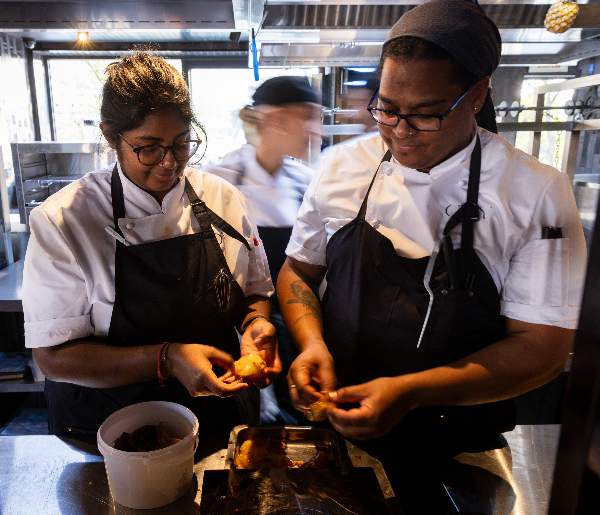
Teenola Govender and Geoffrey Abrahams.
She pointed to Ryan Cole’s COY restaurant, an ode to Southern African shoreline, which is led by chefs Geoffrey Abrahams and Teenola Govender, as an example of that balance done well, alongside young Stellenbosch chefs Dan Oosthuizen of Eike and Drikus Brink at Clara’s Barn.
“I look at COY’s menu, and I’m proud of chefs and restaurants encouraging people to tell their stories on a plate. The emotion people bring to the table is unmatched, and you don’t have to be South African to appreciate it.”
Her friends and supporters have launched a public Back-a-Buddy campaign to help cover mounting medical and caregiving costs, while she continues her recovery at home.
