

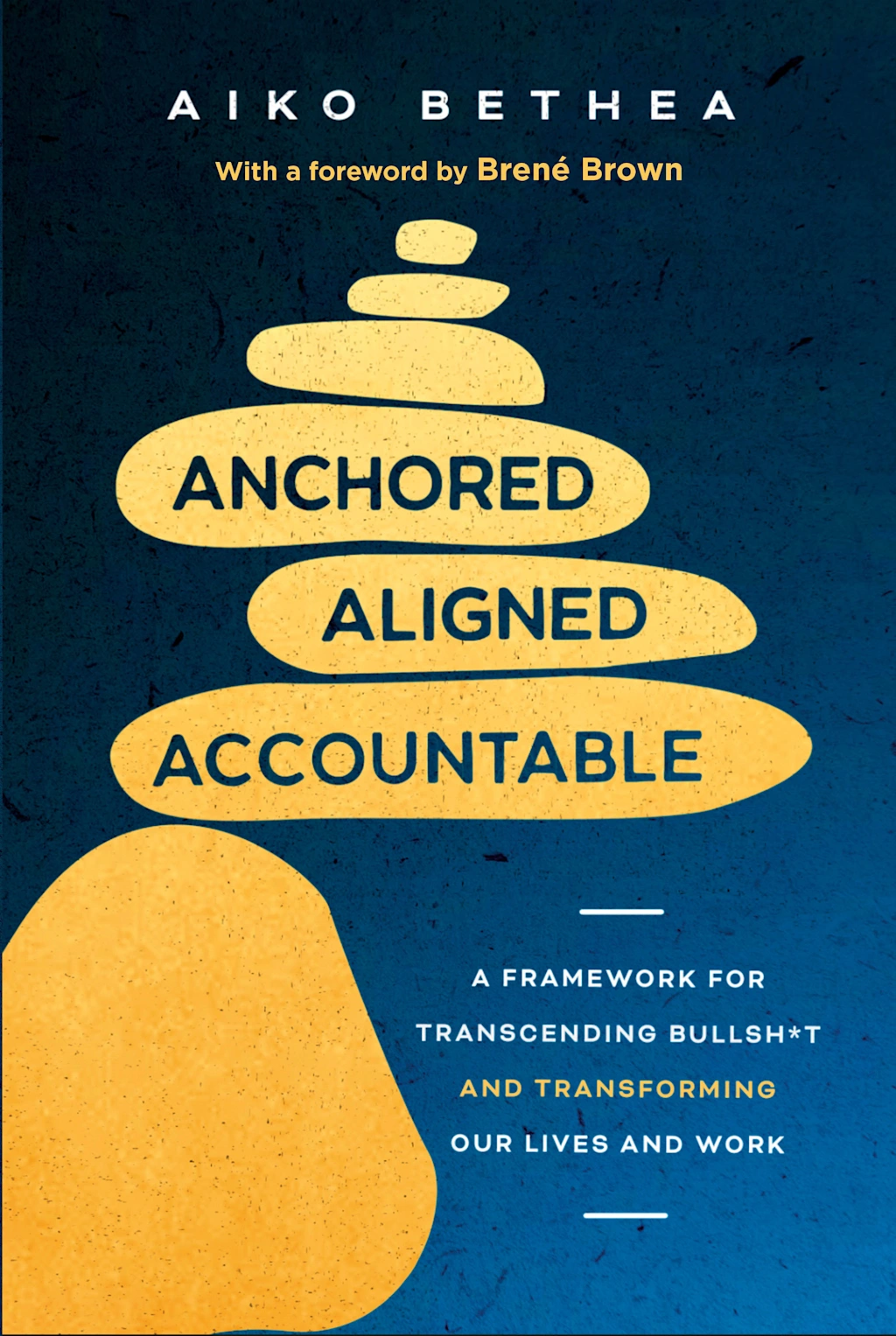
Conflict, while uncomfortable, is a fact of life. However, few of us deal with it well–either we avoid it until it swells into resentment, or it explodes creating damage we often fail to repair. In her new book, Anchored, Aligned and Accountable: A Framework For Transcending B*llshit and Transforming Our Lives and Work, (foreword by Brené Brown) leadership coach Aiko Bethea lays out a framework for transforming conflict into personal growth.
For Fast Company, Brené Brown sat down with Aiko Bethea to discuss the cornerstones of the framework and how applying it can change our lives.
Brené Brown: Your Anchored, Aligned and Accountable Framework, has completely shifted how I lead and how I engage with my husband, kids, friends, and family. So I’ll start with saying thank you.
In both of our experiences helping folks identify their core values, we’re often asked: “Do you want me to focus on my professional or personal values?” If the two of us are in a room together, we often share knowing glances and say, “Your core values drive all parts of your life. There is only one set of core values.”
My questions: What do you think drives the reflexive response to compartmentalize this way?
Aiko Bethea: We’ve been trained to bifurcate ourselves. I’m at home Aiko and at work Aiko. That argument with my parent or partner isn’t expected to (or allowed to) show up at work with me. Then there are the other ways we divide ourselves so that we can fit in, be successful, or not be targeted or perceived as a threat. I speak with a softer tone. I may even laugh when I don’t think the joke is funny.
When you consider the ways we divide ourselves—it makes sense to assume these very different versions of ourselves would have different values. However, we are the same person at home and at work, despite the artificial shifts we make to feel safe, liked, and obtain success and safety.
How does thinking about different values for different areas of our lives get in the way of the anchoring we need to do?
Our values reflect what’s most important to us as a whole person. They inform our boundaries, decisions and intrinsic motivation. Values are your truth and like an anchor they hold weight under pressure.
If values shift based on the room we’re in, you’re no longer anchored into your core truth. You’re unmoored and unstable. We look to external validation and judgment to inform us of who to be and who we’re becoming. This is the opposite of self-leadership.
My biggest work is in the middle of your framework—aligning intention with impact. Here’s my toughest question for you: If my intention is reasonable and the impact that it has on someone is really tough, how do I get aligned without back-peddling or over-apologizing?
For example, a colleague interrupts me three or four times in a meeting and I work with my coach to address this in a respectful and productive way while also setting an appropriate boundary. If this person gets really defensive or goes into a shame spiral because they’re uncomfortable with the accountability, I don’t feel like apologizing or taking care of them. What do you make of this? Do I need more coaching?
Alignment isn’t about comfort—it’s about consistency between your values, your actions, and the impact you create. Too often, people equate alignment with keeping things smooth or avoiding discomfort. But alignment doesn’t guarantee that others will feel good, respond calmly, or avoid defensiveness. And it doesn’t mean softening the truth to the point that it loses clarity.
Instead, alignment requires three things: your intention is grounded in your values, your delivery reflects those values, and you take responsibility for the impact you actually create.
In this instance you can be aligned with your values and the impact is also what you desired: your co-worker no longer interrupts you. And, your co-worker may have resentment and be defensive.
There’s an opportunity to grow with the co-worker who has an emotional response like a shame spiral.
Ask them how they would have wanted you to provide this feedback. If they simply say they didn’t want you to give any feedback and for you to endure the interruptions, then there is simply a fundamental difference between the two of you. You asked for what you needed and they don’t want to support that. You have the choice to set a different boundary in this working relationship since you two may be extremely far apart on how to support one another and how to work together. What you do have is clarity, not finding yourself constantly apologizing, fawning, or even moving against someone.
On the other hand, the colleague may say, I wish you didn’t elevate your voice and give this feedback in front of the whole team. In this case, you can hear them out and practice empathy and compassion. Thank them for the feedback and share that you’ll do your best to keep these preferences in mind and apologize for the impact.
Last, let’s talk about accountability. I feel like repair plays a critical role in accountability and trust-building across all domains of our lives. What do we get wrong about repair and what are one or two things we can do better? Asking for a friend.
Repair is about the relationship, about connection. It is a wholehearted sport. For repair, we look beyond words to the full context of a conversation, picking up on tone, energy, body language, and what remains unspoken in order to understand what’s really happening. There is no repair without tending to emotions. Also, repair can’t be outsourced. Here are two steps that are helpful:
- Anchor in your values: First, we go back to being anchored and grounded into our values. And we understand what that means in terms of how we show up with this other person. For me that can mean what do my values of loyalty and growth require me to do/not do in this situation?
- Align our actions and get curious: Get our actions and delivery aligned with those values. And when practicing curiosity we explore what impact we had on this person. Curiosity is care. When we suspend our inner chatter, put the stories we tell ourselves on pause, and invite the other party to share not only how they feel- but what could have been done differently, we are showing care. We are also learning. When I am asking someone what didn’t work for them, they must pause and actually think about where they’re coming from and communicate this. They must hear themselves. In just this part of the conversation a lot can shift. I am getting data and insight about this person….and they are also becoming more self-aware. Sometimes, they may simply hear themselves and falter, recognizing their hurt or activation wasn’t about you. It was about context, or a story they were living in.
These conversations that only center on connection and repair are rare. When we have them, it’s like an amazing exhale, a gift.
If readers take away just one shift or practice in how they show up at work or in relationships, what do you hope it is?
The most important shift right now is practicing self-leadership. When everything feels fast-moving and uncertain, it’s easy to outsource your judgment—to trends, pressure, or external expectations. Instead, get clear on your values, align your behavior with what matters, and take ownership of your impact. That begins with self-awareness and extends to how you make decisions and show up day to day. Without it, people and organizations lose focus. With it, they operate with greater clarity, consistency, and accountability.
