

The Trump administration is pushing to unleash the power of artificial intelligence for the U.S. military while facing calls to put up guardrails around the rapidly developing technology from some companies — and even notes of caution from top leaders in uniform.
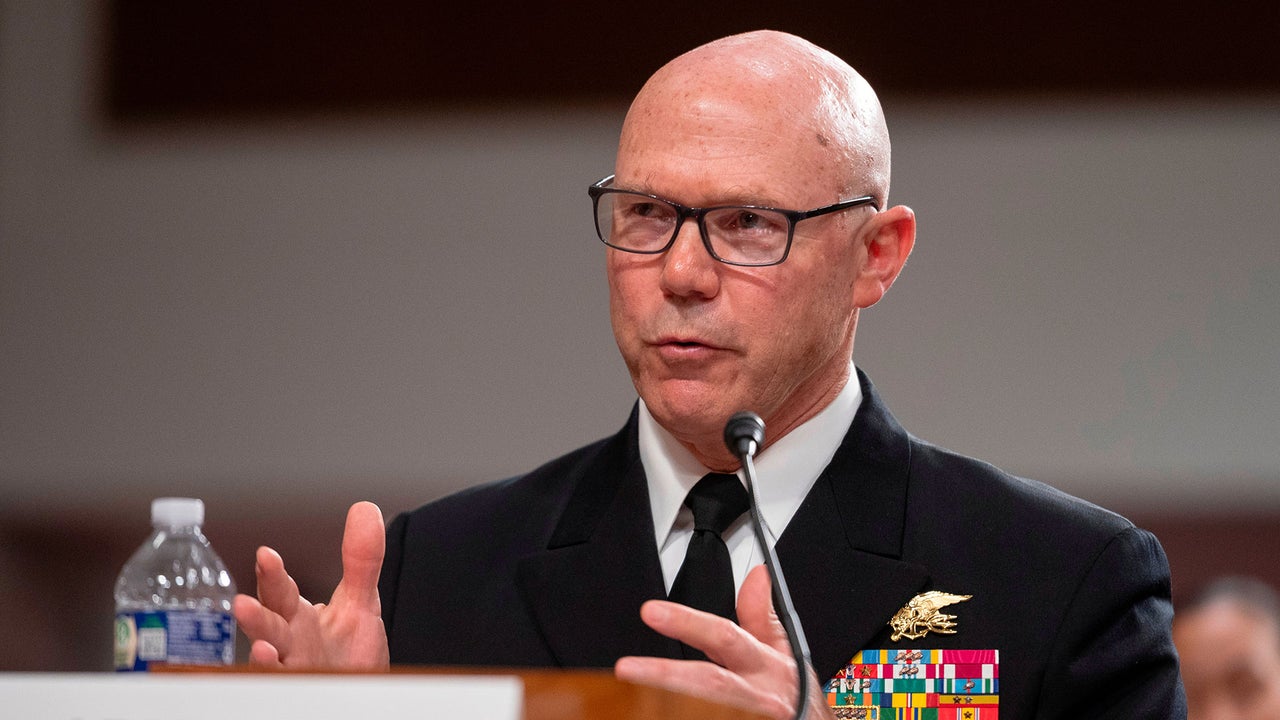
Adm. Frank Bradley, head of U.S. Special Operations Command, told attendees of a recent annual special forces conference in Tampa, Florida, that troops “have to be very careful about how we come to (AI’s) employment and its inspiration into the delivery of lethality.”
Bradley said he can see a future where AI determines what targets to hit but that “we, as humans, have to have the confidence that … it’s going to deliver violence only where we intend it to be delivered.”
The remarks from Bradley, who oversees the units that handle the military’s most difficult and dangerous operations, about the need to ensure safeguards come as his boss, Defense Secretary Pete Hegseth, is pushing to rapidly evolve the military through AI. It is a push that has led to clashes with some tech companies worried about safety measures.
Hegseth has insisted that the Pentagon be allowed to use the technology any legal way it sees fit. He told an audience of SpaceX employees in January he would reject any AI models “that won’t allow you to fight wars” and that his vision for the technology was systems that operate “without ideological constraints that limit lawful military applications.”
AI’s use in the military is part of the Republican administration’s larger push to grow the capability it sees as a unique American advantage even as it faces pressure to ensure responsible safeguards.
President Donald Trump abruptly called off plans to sign a new AI executive order hours before an expected White House ceremony over concerns the measure could dull America’s edge on AI technology.
“We’re leading China, we’re leading everybody, and I don’t want to do anything that’s going to get in the way of that lead,” Trump told reporters.
Two differing AI worlds within the military
When asked about Bradley’s remarks, a Pentagon official said efforts are focused on using AI to create “functional battlefield tools” that can help troops come up with and identify targets more quickly and, as a result, speed up strikes on those targets. The official spoke on condition of anonymity to offer more candid remarks.
Officials at U.S. Special Operations Command talked about AI not as something that will help eliminate targets but rather as a tool that can offer troops more time to focus on their mission.
Sgt. Maj. Andrew Krogman, the top enlisted official for U.S. Special Operations Command, said at the conference that he sees AI handling administrative tasks to free up operators or helping modernize how the command does business.
Melissa Johnson, the top acquisition official for the command, said AI should be “reducing the cognitive workload on mundane tasks.”
“We’re leveraging AI more and more, but it’s not to replace operator judgment, it’s to enhance it,” she added.
Helen Toner, interim executive director at Georgetown University’s Center for Security and Emerging Technology, said those differing descriptions about AI in the military are both true.
“There are a huge number of potential uses for AI in these kinds of bureaucratic settings, which the U.S. military is actively exploring,” Toner said.
Lt. Gen. Michael Conley, head of Air Force Special Operations Command, told a congressional committee in May that his troops used AI “bots” to convert top secret intelligence down to a secret classification within seconds to make it easier to share with drone operators on the ground during the Iran war.
However, there is no doubt that AI also is helping the military find and strike targets.
The center that Toner oversees published a case study two years ago on how the Army’s 18th Airborne Corps used AI to target artillery strikes “just as efficiently as the best unit in recent American history” and with 2,000 fewer service members.
“Human operators are still the ones making crucial decisions, but AI … is making it possible to operate with a new level of speed and scale,” she said.
AI safety has created a public dispute between the Pentagon and Anthropic
The clash over the integration of AI into the military, who ultimately controls the technology and the ethics behind its use has played out in unusually public fashion during the Trump administration.
Hegseth and Anthropic are embroiled in a bitter contract dispute over the company’s concerns about unchecked government use of its technology, including the dangers of fully autonomous armed drones and of AI-assisted mass surveillance that could track dissent.
After CEO Dario Amodei refused to back down over concerns about how the chatbot Claude is used in classified Pentagon networks, both Trump and Hegseth accused Anthropic of endangering national security.
The Pentagon formally labeled the San Francisco-based company a supply chain risk — ending its $200 million defense contract and prohibited other government contractors from working with the company.
Anthropic sued, claiming the Pentagon is illegally retaliating by stigmatizing the company with a designation meant to protect against sabotage of national security systems by foreign adversaries. The Pentagon has since emphasized its turn to Anthropic rivals — including Google, OpenAI and SpaceX — to secure AI technology that can “augment warfighter decision-making in complex operational environments.”
Toner, a former OpenAI board member ousted after a clash with CEO Sam Altman, said “the general public often seems to underestimate the caution with which the U.S. military approaches new technologies.”
“Commanders want their missions to succeed, which means both being able to create lethal effects at scale, and avoiding unintended effects like friendly fire, civilian casualties, or simply identifying targets incorrectly,” she said.
—Konstantin Toropin, Associated Press
