

Consumption demand, which has long powered America’s formidable economy, rests on the promise of cheap energy. But the Trump administration has conflated that with fossil fuels, confusing historic correlation with causation and, in the process, jeopardizing long-term prosperity.
CHARLOTTESVILLE, VIRGINIA—After the 9/11 terrorist attacks, US President George W. Bush called on Americans to go shopping. While some people claimed at the time that Bush was encouraging irresponsible spending (a criticism that gained traction following the 2008 global financial crisis), he was acknowledging the reality that consumption has long powered America’s formidable economy.
Over the past 20 years, household consumption has, on average, accounted for roughly 56% of the United States’ annual GDP growth—reflecting an atypical economic structure that is both an unintended byproduct of dollar dominance and the result of a deliberate growth strategy.
The dollar’s position as the world’s reserve currency has inadvertently created ideal conditions for the profligate US consumer. Providing dollars to the rest of the world enables the US to run current-account deficits indefinitely. Moreover, high demand for dollar-denominated assets pushes up the greenback’s exchange rate, making US exports relatively more expensive, boosting imports, and contributing to the decline of US manufacturing.
But, for decades, American policymakers have also used various policies to fuel household consumption. In housing, for example, the US government has long offered mortgage-debt relief, tax credits, and subsidies, allowing homeowners to use their property as collateral to borrow more. Similar, the government derisks lending for the financial sector through loan backstops and liquidity, which creates a kind of “finance culture” that normalizes spending beyond one’s means.
Crucially, and more overlooked, is how the US government props up household consumption with energy policy. High energy consumption is central to the American way of life. Houses are larger, requiring more energy to construct, heat, and cool. Compared to much of the rest of the world, Americans purchase more (and larger) cars, drive for longer distances, and consume more meat and other carbon-intensive goods.
Moreover, the US government has subsidized the oil and gas industry for more than a century through the tax code’s treatment of intangible drilling costs. With the US holding vast hydrocarbon reserves, this encourages production to exceed demand, leading to systematic underpricing of fossil fuels.
But the energy landscape is changing, owing to soaring energy prices for US households and the plummeting costs of renewables. The problem is that US President Donald Trump, while recognizing that abundant, cheap energy underpins America’s consumption-led growth model, conflates that with fossil fuels, confusing historic correlation with causation.
Trump’s “drill, baby, drill” agenda has sought to boost oil and gas production, even as other countries phase out fossil fuels. His administration’s One Big Beautiful Bill Act (OBBBA) has increased subsidies for the oil and gas industry while repealing nearly all of the tax credits enacted by the Biden administration’s Inflation Reduction Act (IRA) to accelerate the uptake of clean energy.
Research from Princeton University’s ZERO Lab projected that, by 2030, the OBBBA would raise US household and business energy costs by $28 billion. One year after the bill’s passage, that prediction seems to be coming to fruition and may even end up being optimistic, as supply shocks from the Iran war and the AI data-center boom cause energy prices to surge. Last year, data centers accounted for around half of new US electricity demand, with rapid growth potentially causing consumers’ electricity bills to increase by as much as 25% in some regions by 2030.
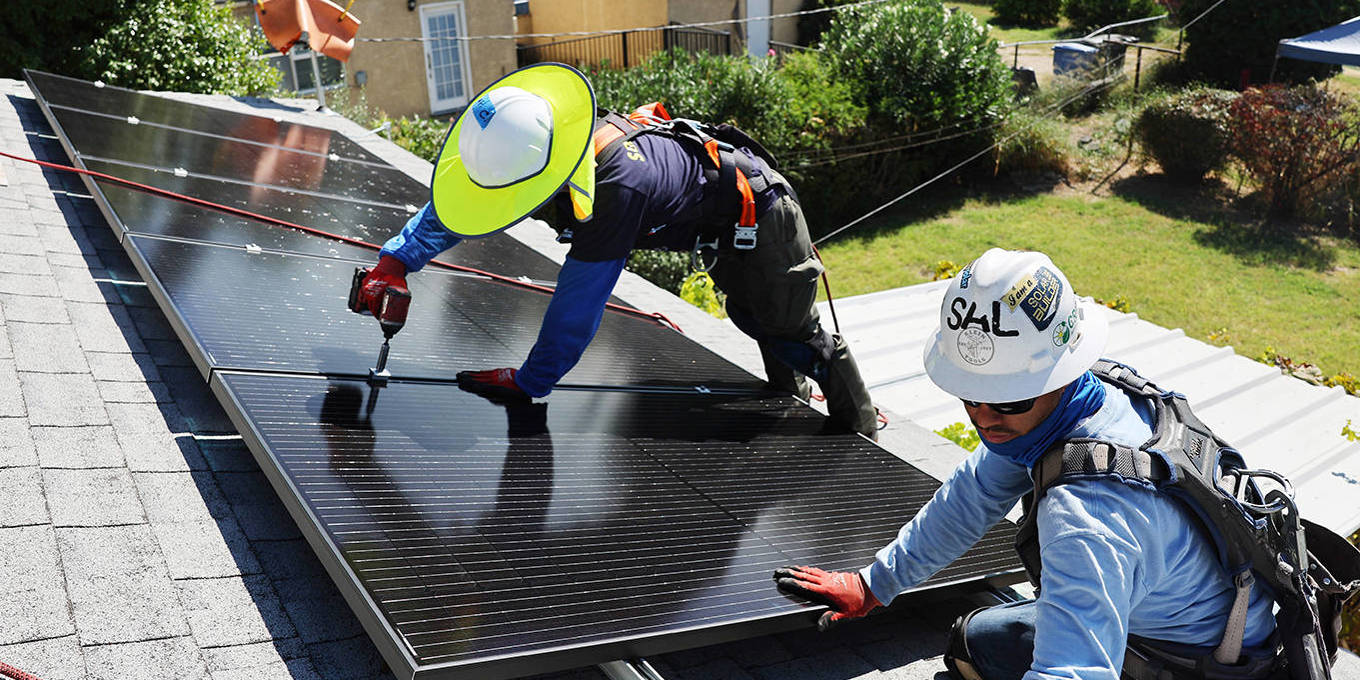
Meanwhile, the price of renewable energy continues to fall to new lows. In 2024, wind and solar were, respectively, 53% and 41% cheaper than fossil fuels. The months-long closure of the Strait of Hormuz, which severely disrupted global oil and gas flows, has led countries around the world to embrace renewables, using green technologies largely manufactured by China. Even in the US, consumer demand for electric vehicles has spiked along with inflation.
The American consumer economy can no longer run on fossil fuels. To maintain growth, the US must follow the lead of other countries and scale up renewables. Reviving the IRA, which was primarily focused on energy abundance, is an obvious first step.
To be sure, many policymakers in the US and the European Union are concerned that Chinese green tech poses security risks; the EU has even moved to ban inverters from China. But the best way to address these anxieties is by modernizing existing manufacturing to produce high-risk components like inverters domestically, while continuing to import secure, low-cost parts, like the solar panels themselves. This would require implementing industrial policy, but nothing outside the norm.
The Trump administration’s grim determination to ignore clean energy is not only costly; it also jeopardizes long-term economic growth. Actively suppressing renewables as fossil-fuel prices steadily rise will be the death knell for a growth model built on the promise of cheap energy.
