

When designers for the 1978 World Cup in Argentina designed a signage and wayfinding system for the tournament, they needed something that would be easy to read and scale. Their forgotten work was ingenious and economical—and it’s finally getting its due.
A new book takes a look back at Argentina’s World Cup signage system through the instruction manual that put it all together. Manual of Standards: Signage, FIFA World Cup ’78 Argentina faithfully reproduces that original standards manual, and it allows for a close look at a fascinating rendition of pre-digital wayfinding. The system took a grid-based approach, but was also completely modular: made from buttons affixed in patterns on a perforated panel to make shapes, symbols, and letters.

And yet, despite being among the largest sporting events in South America in the 20th century, the 1978 World Cup design system has been largely forgotten. That might have something to do with the military dictatorship that ruled the country up until 1983, and a collective desire to leave it in the past—a kind of anti-nostalgia.
Now, publisher Flecha Books is hoping to draw attention back to the designers’ work. The book, printed to the same standards as the original, is available for preorder until July 19 for $55.
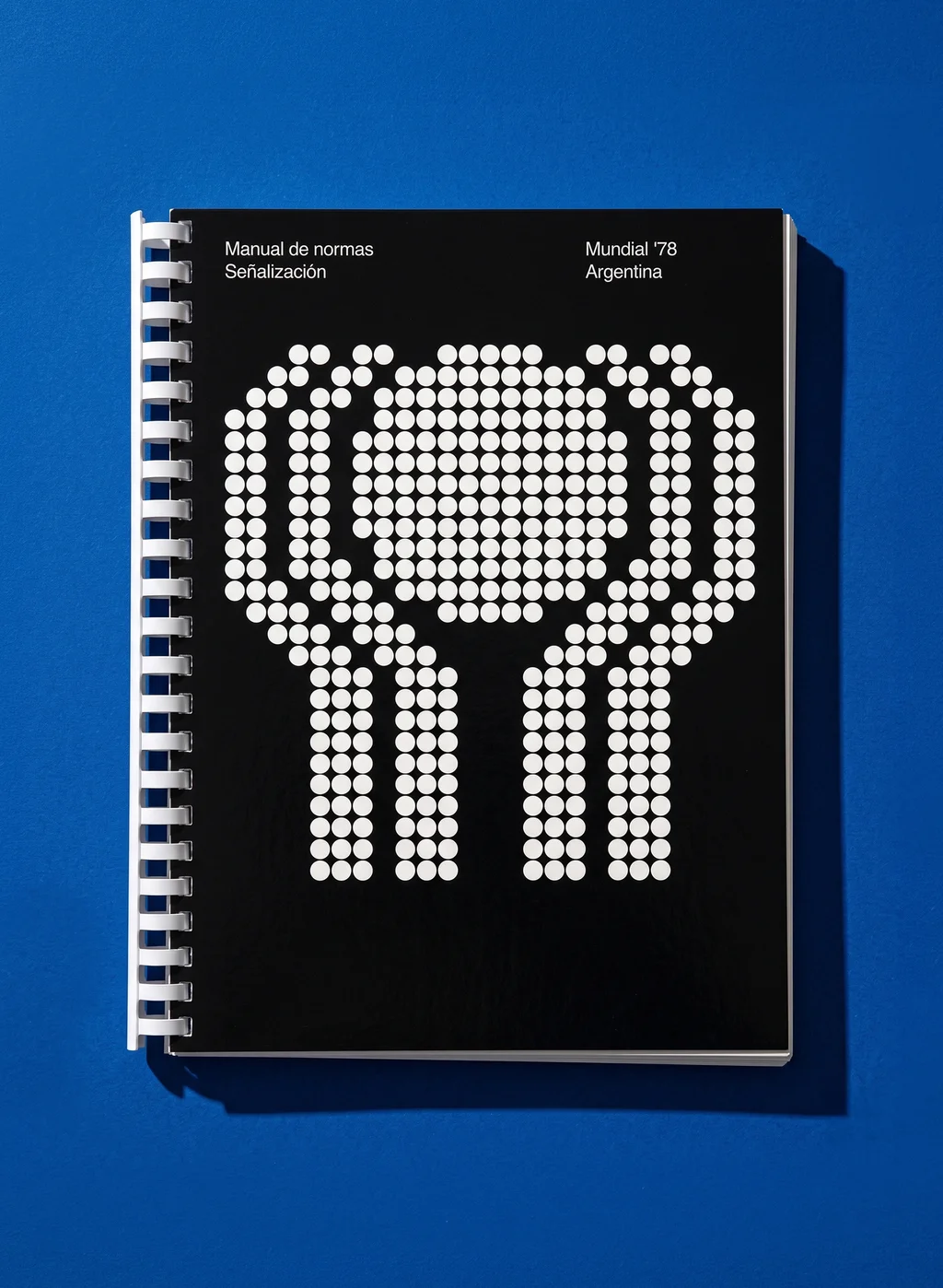
“In the last century, almost every sports event has been revisited from a design point of view, especially the Olympics, but also a few World Cups,” graphic designer and Flecha Books cofounder Francisco Roca tells Fast Company. “This was one of the largest sports events in South America at the time and also the first Argentinian systematic design solution or work for a large event, so it’s kind of special.”
Though unique, this wasn’t the first World Cup brand or wayfinding system. For that year’s tournament, though, organizers needed a standardized signage system that could be deployed across six venues that would be cheap to produce in large volumes. The solution was the system outlined in the standards manual and called Puntograma, Spanish for “dot-a-gram” or “point-a-gram,” a comprehensive grid-based system that workers on-site at stadiums could assemble themselves.

Puntograma used a modular grid on dark green perforated steel panels that were manually assembled with individual white polypropylene buttons inserted into the perforations to make a cohesive shape or image, like a Lite-Brite toy. There were also red buttons reserved for warnings.
The system was designed by designers Carlos Méndez Mosquera and Gus Bonsiepe at the Argentine studio MM/B. The firm also handled the rest of the 1978 World Cup’s industrial design, including seating and venue equipment. That industrial design mindset found its way into their modular, scalable signage.

The comprehensive graphic system for the 1978 World Cup used a typeface that took its proportions from the sans serif Univers, set at 80% height, which Roca says they’re working to recreate as a font.
It also included arrows; pictograms for restrooms, restaurants, cafés, and other amenities; and logos for each stadium. For the venue in Mar del Plata on the coast, for example, the logo featured waves; for Córdoba near the Sierras Chicas mountain range, it showed a mountain; and for Mendoza in Argentina’s wine country, it used grapes.
“Design-wise, it was a really clever and ingenious and different and approachable solution,” Roca says. And now it’s getting a much-deserved closer look.
