

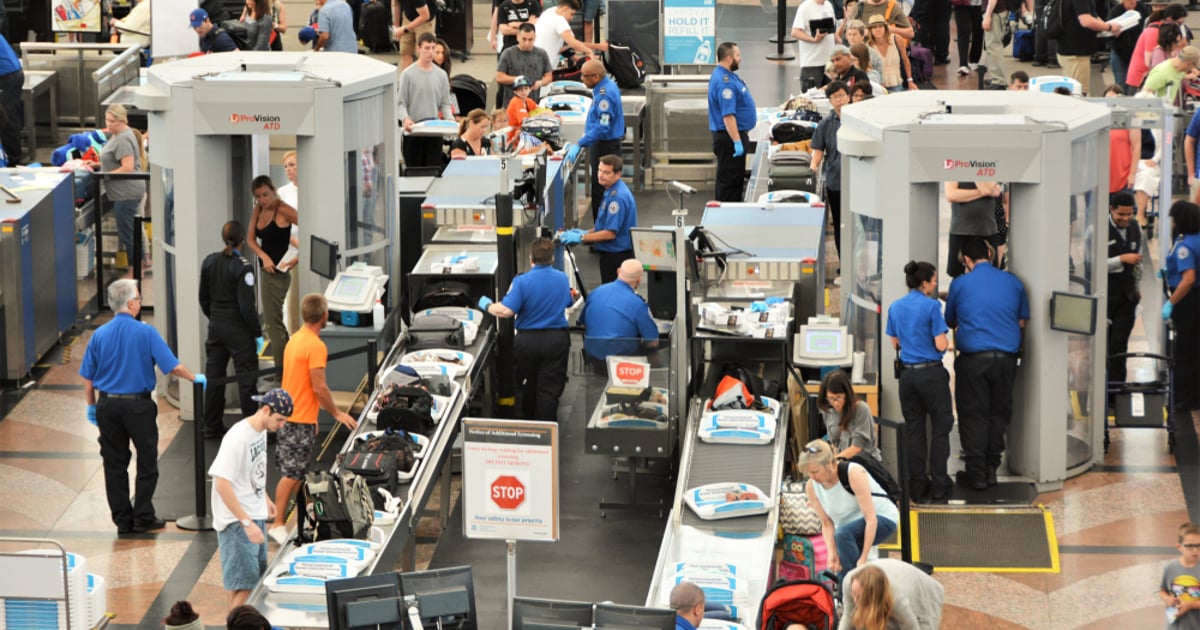
Fresh off a monthslong partial government shutdown that led to chaotic airport checkpoint lines, staff working without pay for 44 days, and more than 1,000 agents walking off the job permanently, the Transportation Security Administration is facing a new existential threat.
But this time, the call is coming from inside the house.
The Trump administration has taken another step forward in its initiative to transform the TSA from a government-run public service into a for-profit investment opportunity for private companies, curiously dubbed TSA Gold+.
That name might seem better suited to a streaming service or credit card than an agency responsible for ensuring the security of roughly 2.5 million passengers per day across more than 400 commercial airports. In any case, the administration hosted vendors, airports, and stakeholders in Springfield, Virginia, for a closed-door Industry Day pitch meeting on May 21 to sell would-be airport partners on the transition to the new program and to solicit comments and questions.
OK, but what is TSA Gold+?
Industry experts are asking themselves that same question. The agency released a flashy pitch site that offers a buffet of buzzwords but surprisingly few details. Here’s what we know so far.
“Through strong public-private partnerships, TSA Gold+ will unlock innovation, expand screening capacity, and achieve world-class security and customer experience,” reads the agency’s promo deck.

Not to be confused with services like TSA PreCheck or the private alternative/supplement CLEAR—which are opt-in programs aimed at individual travelers—Gold+ is geared toward airports, with the goal of drastically reducing TSA’s role as operator, transforming the federal agency into a supervisor, with private firms filling the hands-on roles.
The idea is that airports using TSA Gold+ could avoid the sort of chaos that resulted from the partial government shutdown because security personnel at those airports would be staffed from private companies and therefore not subject to federal budgets and federal staffing shortages.
Additionally, as NPR reports, the TSA says the new program would help enact technological innovations “to increase capacity and cut wait times, although the agency did not specify how those gains would be achieved.”
The plan definitely involves fewer TSA agents.
According to the New York Times, the TSA’s 2027 budget seeks to downsize its 50,000-agent workforce by about 4,300 and allow more “private contractors to deploy and manage screening equipment at checkpoints.”
In practice, Gold+ is largely an expansion of the existing Screening Partnership Program, which has been available since 2004 to airports looking to replace TSA agents with screeners from private security companies. Currently, San Francisco International Airport and Kansas City International Airport are the biggest U.S. hubs that have signed onto the program, with 18 more smaller regional and municipal airports joining as well.
Under that program, the TSA maintains strict oversight over the private screeners, and the security companies must meet TSA regulations, even if the workers carrying out the job at the airport aren’t TSA agents.
At a House Committee on Homeland Security hearing held last week, the committee’s chairperson, Andrew Garbarino, R‑N.Y., talked up the public-private initiative as a “modernization” for the agency created 25 years ago following 9/11.
But Rep. J. Luis Correa, D-Calif., pushed back, calling “the fancy new technology” promised by Gold+ “dangerous and reckless.”
Correa argued that “those who endorse the administration’s attempt to privatize TSA are placing profits over their promise to never forget,” referring to the 9/11 attacks.
The union that represents TSA officers, the American Federation of Government Employees, also opposes privatization, warning that TSA Gold+ “would hamper accountability and transparency” and lead to lower pay for contract workers, NPR reports.
TSA worker and Nevada union rep Jill DeJanovich echoed concerns about making airport security a business in an April interview with Bloomberg Television.
“I don’t believe that aviation security should ever be a for-profit model,” DeJanovich said. “The beauty of it being a federal program is that you’re not there to make money. You’re there to screen passengers and share the highest levels of security.”
