

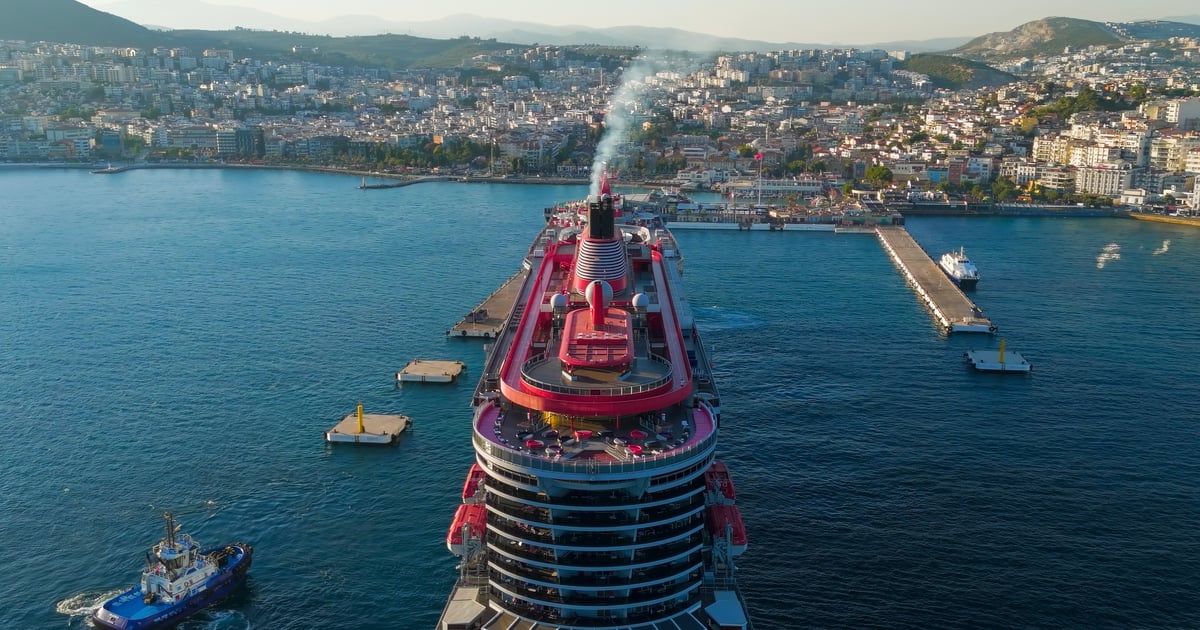

Last week, Virgin Voyages’ Scarlet Lady was refused entry to Turkey by local authorities. The offense? It had gay people on it.
The cruise was carrying 2,000 passengers as well as Broadway musical legend Patti LuPone, who had joined to entertain.
“A ship—a magnificent ship—full of gay men. And me. Denied entry to Turkey simply because of who is on board,” LuPone (2 Tony Awards, 8 nominations, diva) wrote on social media.
“I am furious, but I am sailing, as the ship will make other ports of call. I am ready to perform for all the wonderful men on this Atlantis [Events] cruise, who deserve so much better than this,” wrote LuPone.
The ship (pictured above in Turkey exactly a year before the slighted Atlantis cruise) had to go to Cairo and Crete instead of Turkey.
Being gay is not illegal in Turkey. No one on the cruise has been accused of wrongdoing or inappropriate public behavior. And Atlantis Events, which has been in business since 1991, has carried respectful groups to the same Turkish port 13 times in the past 25 years.
“When we pull into port, the ship looks like any other ship. It’s not like we’re not a gay pride rally, we’re not a march, we’re not an organization, we’re not a political statement in any way,” Rich Campbell of Atlantis told USA Today. “The cruise was advertised a year ago, it’s not new.”
Arthur Frommer and the Cayman Islands ban
In 1998, the Caribbean nation of Cayman Islands similarly banned a Norwegian Cruise Line ship chartered by a group catering to gay travelers.
No political activities were planned, and no illegal activity was associated with the passengers—it was just a typical cruise programmed with typical tourism activities. A local official, dishonestly claiming his action was based on “careful research,” banned them because of who they associate with privately.
At that time, Arthur Frommer, the founder of our travel guide books and of this website, wrote an eloquent complaint that appeared in newspapers nationwide and was amplified by headlines worldwide.
We think what Arthur said about that gay cruise ban bears repeating:
The Minister of Tourism of the Cayman Islands, a man named Thomas Jefferson (of all things), announced that gay people could not be expected to comport themselves according to the standards of the Caymans, and therefore denied permission to the cruise ship company to dock in the chief port of those islands.
We were immediately reminded of the shipload of German Jews who were denied permission to land in the United States in 1939, and denied permission to land elsewhere, and had to turn back to Nazi Germany, where all of them ultimately perished.
And while some of our readers may not think this to be an appropriate analogy, we think it is. We believe the Caymans’ decision presents a human rights issue, and one on which people of good will need to take a firm and public stand. … To deny the rights of travel to people because of their sexual orientation is a vile piece of discrimination. …
None of us should vacation in the Cayman Islands unless all our fellow citizens are permitted to vacation in the Cayman Islands.
Arthur’s words inspired a massive protest, including by many groups and countless travel agents.
Arthur’s protest was boosted by local uproar, too. Many individually owned hotels and tour operators throughout the Caribbean joined to say they did not support the false theology of a small number of benighted public officials.
The social pressure eventually worked to wear down the arrogance of the individual in power at the Cayman port.
The Cayman Islands never publicly retracted its ban, but behind the scenes Britain chastised the local government, travel agents refused to send clients there, and Mr. Jefferson was shown the door. By around 2005, gay groups were retesting the waters by returning, and there were no further incidents.
But Arthur, still fuming, had even more to say.
Several years ago, the Caymans denied landing rights on its main island to a boatload of law-abiding gays and vigorously defended the ban as consistent with the religious viewpoints of its population
Imagine the uproar if a Caribbean island had banned all Methodists from visiting—or if it had prohibited visits by white or Asian-Americans.
Though numerous journalists, including myself, later contacted the public-relations representatives of the Caymans to ask whether a change of government had brought about a change in this policy, we never—as best I know—got an answer.
Turkey’s 2000 gay cruise ban failed
In Turkey, homosexuality is not criminalized, so as with the Cayman Islands, there is no legal basis for the cruise ban.
What’s more, Turkey has done this before, with disastrous results—and at the very same port that barred both the Scarlet Lady and the First Lady of American musicals, Patti LuPone.
In 2000, police at Kuşadası decided to prevent more than 800 gay tourists on a cruise from visiting the Roman ruins at Ephesus.
But in that case, the Turkish tourism minister, who outranked the police, promptly apologized to the world press for the disgrace.
“I hope they will complete their trip without any problems,” Erkan Mumcu said at the time. “We cannot discriminate according to people’s sexual preference.”
Even without this new unforced error in 2026, the zealotry of Turkey President Recep Tayyip Erdogan is reducing his country’s standing in the world.
His re-conversion of the historic Hagia Sophia into a mosque, conducted against the forceful advice of global preservation experts, has undermined the structural integrity of the fragile 1,500-year-old building, which is now inching toward collapse.
With this cruise ban, Turkey is again bullying equality-minded people. Which is to say the vast majority of us.
Plus, it pissed off Patti, which rarely ends well.
Freedom-loving people are being assaulted on every front. Thirty years after this sort of thing resulted in heavy losses for the Cayman Islands, we keep allowing patronizing individuals to hijack our economic and peace interests with their small-minded personal hatreds.
Will travel consumers in 2026 prove to have the same standards that we defended when we fought this kind of bigotry in 1998?
