


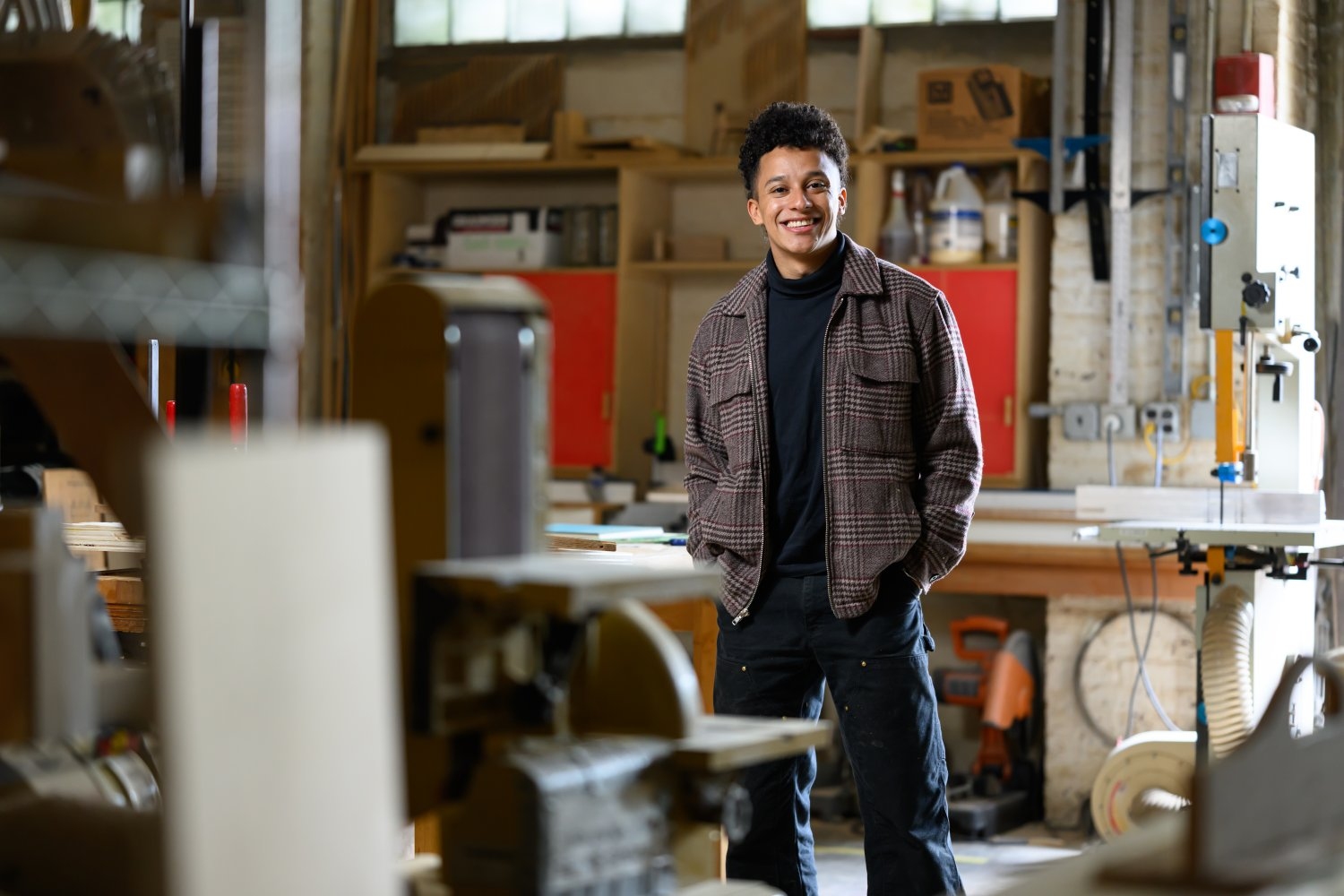
Some of designer C Jacob Payne’s projects present new, futuristic products — such as zero-gravity footwear for astronauts, and electronic-embedded ceramics — using technological tools and processes of digital fabrication, material innovation, and interactive interfaces. Other projects travel back in time to past centuries, considering the challenge of preserving and reconstructing Black architectural heritage.
Payne graduated from Yale University with a bachelor’s degree in architecture and environmental studies, and then worked briefly at architecture firms in New York and Los Angeles. He decided to pursue a professional degree in order to become a licensed architect and to try out different types of design. He began the MIT Master of Architecture (MArch) program in 2023, and is aiming to graduate in January 2027.
“I have especially valued the academic freedom to make my own path,” says Payne. “Although the MArch program requires certain classes each semester, I’ve been able to find a way to tailor the degree in a way that really reflects my interests.”
Payne says he appreciates how his experiences in the program have allowed him to work on design projects at a variety of scales — from the smaller scale in industrial and product design classes, to the larger scale in classes in the Department of Urban Studies and Planning. He is a collaborator at the Design Intelligence Lab and has served as a teaching assistant in MIT’s architecture wood shop, helping students to bring together digital design techniques with hands-on fabrication. Payne says he values the off-campus opportunities he has had, including working at a furniture and product design company in Barcelona through MISTI and spending a summer working at the experience design firm 2×4 in New York.
Rediscovering the architecture of the past
Through his graduate classes, Payne became especially interested in research into different types of vernacular architecture in America, especially in the American South. During his second semester, he took the class 4.182 (Brick x Brick: Drawing a Particular Survey), taught by Assistant Professor Carrie Norman, director of the architecture department’s undergraduate major and minor programs. As part of the curriculum, the class traveled to Tuskegee University to research the history and works of Robert R. Taylor, the first Black graduate of MIT (in 1892) and also the first licensed Black architect in America.
Following the class, Payne continued working on models and drawings reconstructing some important Tuskegee architecture. He created models of Taylor’s original 1896 Tuskegee University Chapel, lost to fire in 1957, and the subsequent chapel built in its place in 1969, designed by Paul Rudolph in collaboration with Tuskegee University. He also produced a set of speculative drawings reconstructing Taylor’s 1896 chapel, using the very sparse remaining archival materials (including a few photographs and one drawing), the standards of the Historic American Buildings Survey, and inferred details.
“A lot of the work was figuring out how we can better understand and reconstruct historic spaces with very limited information,” says Payne. “I think it’s important to not treat the past as something static or fixed — because there’s so much that we don’t know, that has been unexplored.”
Payne received the 2025-26 L. Dennis Shapiro (1955) Graduate Fellowship in the History of African American Experience of Technology. He is currently looking into different typologies of architecture that were in the American South, with a particular focus on “juke joints,” structures that came about during the Jim Crow era. These were intended as secret social spaces for Black people to congregate, dance, sing, and play blues music — at a time when they were often barred from many establishments. Since there is very little documentation still remaining to use in this research, Payne says, the challenge is identifying which current techniques of architecture and design can be used to better understand and visualize these spaces.
“As his advisor, I have watched Jacob develop a body of work that treats architectural representation as both record and repair, recovering lost and overlooked Black-built traditions as vital expressions of Black spatial agency,” says Norman. “Through drawings, models, and speculative reconstructions, he expands the tools of the discipline to engage histories of cultural identity and heritage.”
Incorporating AI to design for the future
While much of Payne’s research is rooted in the past, he is also interested in artificial intelligence and its implications for future innovations. Last spring, he took the class 4.154 (Space Architecture) and learned how to design for the particular challenges of working in space. Along with his team, he designed a footwear system for astronauts that could anchor to spacecraft structures with a mechanical, rotating sole, and inflatable bladders around the ankle for support.
In addition, Payne took a class about large language objects taught by associate professor of the practice Marcelo Coelho, director of the Design Intelligence Lab. “Designing products that integrate large language models involves thinking about how people can interact with AI in the physical world,” says Payne. “We are able create new experiences that challenge the ways that people think about how AI will look in the future.”
For the class, Payne and his team worked on a project using AI in the kitchen, developing a countertop device called the Kitchen Cosmo. A camera at the top scans the ingredients placed in front of it. The user can input information such as how many people will be eating the meal and how much time is available to prepare the meal, and the device prints out a recipe.
Payne also worked on a project with Coelho for the Venice Biennale: a lamp that used geopolymers — a more sustainable alternative to concrete or other castable materials. Because this ceramic material doesn’t need to be fired in a kiln to harden, it can have electronics embedded within it. Payne now continues to work on AI research and product design in the Design Intelligence Lab.
“Jacob is an exceptional designer who deeply embodies MIT’s ‘mens et manus’ [‘mind and hand’] ethos by approaching product and interaction design with an exciting combination of intellectual rigor and high-quality, hands-on making,” says Coelho. “He is equally comfortable thinking conceptually about the cultural implications of artificial intelligence and working on the technical and craft detailing needed to bring his ideas to life.”
