

mdisk/iStock via Getty Images
By Jim Iuorio
Prior to November 2022, artificial intelligence (AI) was something most people associated with futuristic movies. Then OpenAI released ChatGPT, and everything changed. AI was no longer an invisible algorithm quietly powering the world’s most sophisticated companies. Suddenly, the average person could use it to write code, compose poems, edit articles and much more.
The adoption was staggering. ChatGPT reached 100 million users in just two months, making it the fastest-growing consumer application in history at the time, and it has never looked back. Over the next three years, AI became the single most dominant investment theme on Wall Street, working its way into business models across every sector of the economy.
But is it a good thing? That seems to depend on who you ask.
The general consensus is that powerful emerging technology ultimately benefits society and raises our standard of living. The transition, however, can be rocky. There is a growing perception that AI may already be stifling traditional job growth, as companies slow hiring in anticipation of reducing their need for employees. While that has far-reaching implications across the economy, I want to focus on one area: lending rates and mortgages in particular.
A Housing Market Already Under Stress
The housing market has been a serious concern and a source of heated debate for the past five years. In 2021, the Federal Reserve began raising interest rates to combat sky-high inflation. In roughly one year, the 30-year fixed rate mortgage went from under 3% to well over 7%.
Raising rates to fight inflation is designed to address the problem from the demand side. The theory in housing seems fairly straightforward: if money is more expensive to borrow, buyers will be less aggressive in pursuing new homes.
But that is not quite what happened. Most housing analysts now conclude that raising mortgage rates so dramatically, after such a prolonged period of historic lows, effectively froze the supply of homes that would normally come to market. If someone is sitting on a 3% mortgage, there is little incentive to trade it in for a 7% one. Combined with a decrease in new builds, housing inventory dried up and prices rose even higher.
So Where Do Mortgage Rates Come From?
Before exploring how AI might affect mortgage rates, it helps to understand what drives them in the first place.
The average 30-year fixed mortgage is actually held for about 12 years. Because of that, mortgage rates closely track the U.S. 10-year Treasury yield, which is the nearest matching maturity. Historically, the spread between the 10-year yield and the 30-year fixed mortgage rate averages around 180 basis points. In plain terms, if the 10-year Treasury yield is sitting at 4%, one would expect the 30-year fixed rate to be somewhere around 5.8%.
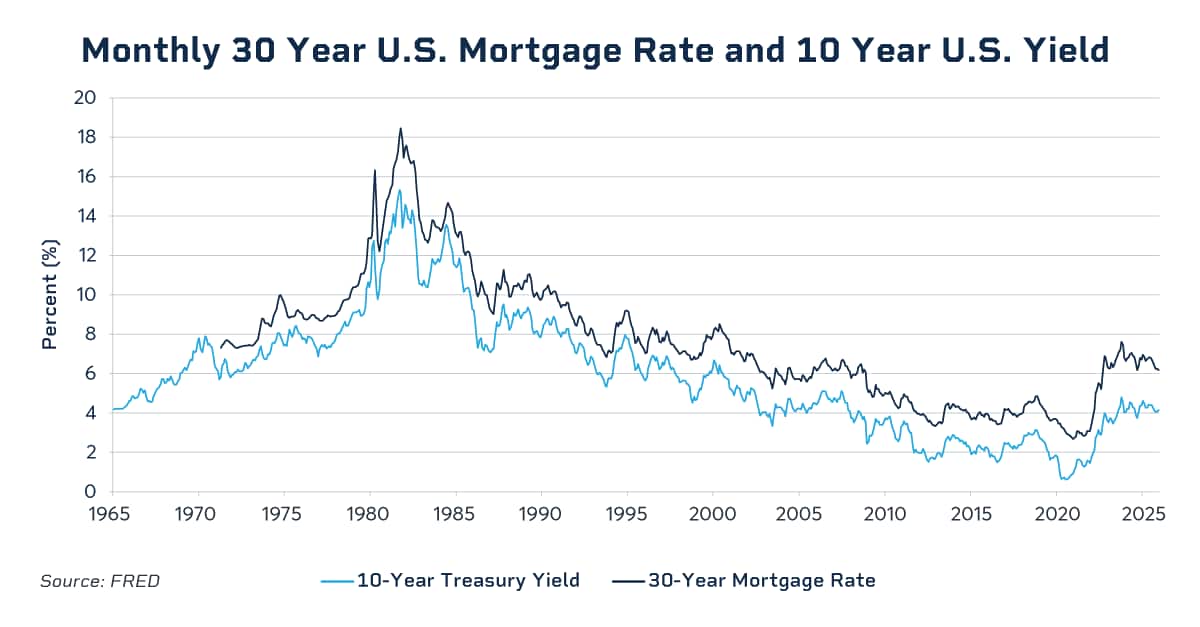
That spread exists for two reasons. First, a mortgage carries default risk that a U.S. Treasury bond simply does not. Second, there are real servicing and administrative costs baked into every mortgage. AI could potentially affect both the Treasury yield side of the equation and the factors that create the spread. Here are a few potential ways those scenarios might play out.
Scenario 1: AI Sparks Deflation, Rates Fall
If the biggest economic impact of AI turns out to be massive productivity gains spread across most sectors of the economy, the effect could be deflationary. We saw something similar play out in the 1990s with the internet. Many economists give Federal Reserve Chairman Paul Volcker full credit for reducing inflation in the early 1980s, but a compelling case can be made that the maturation of the internet was a significant deflationary force in its own right.
It is also worth noting that slower job growth, one of the more visible side effects of AI adoption, would likely further dampen consumer spending and add another layer of downward pressure on prices. Disinflation (where prices rise, but slowly) or outright deflation (where prices decline) makes owning long-duration bonds more attractive, which pushes yields lower. History also tells us that the Fed tends to cut short-term rates when disinflation becomes a concern, pulling yields lower across the entire curve. The end result of this scenario would likely be meaningfully lower mortgage rates.
Scenario 2: AI Fuels a Boom, Rates Rise
Alternatively, the AI revolution could ignite a massive domestic economic expansion. In that environment, investment money might flow out of the relative safety of U.S. Treasuries and into higher-returning opportunities in the market. That rotation could push bond prices down and yields up. If the economic boom also generates demand-driven inflation, it would only accelerate the selling pressure on bonds. In this scenario, mortgage rates could move higher.
Scenario 3: AI Compresses the Spread
This scenario gets less attention but may be the most interesting. Even if Treasury yields stay right where they are, AI could narrow the spread between the 10-year yield and the 30-year fixed mortgage rate.
It is possible that AI will improve risk assessment while simultaneously reducing the servicing and administrative costs embedded in the mortgage process. If one assumes that 30% to 50% of that 180 basis point spread is administrative in nature, cutting those costs in half with AI would not be a trivial result. Borrowers could see meaningfully lower rates even in a flat-rate environment, simply because the cost of originating and managing a mortgage comes down.
Where the Evidence Points
No one can say with certainty which of these scenarios will dominate, and it is entirely possible that elements of all three play out simultaneously. However, many analysts seem to believe the weight of evidence points toward lower rates.
For market participants looking to manage this uncertainty, Mortgage Rate futures offer a way to hedge mortgage servicing rights and pipeline risk that can be associated with a changing rate environment. The contract is based on the Optimal Blue Mortgage Market Index, which tracks real-time rate lock data from over one-third of U.S. residential mortgage originations.
The combination of AI-driven productivity gains, the deflationary pressure of a slower labor market and the prospect of leaner mortgage operations creates a compelling case that mortgage rates are more likely to fall than rise over the coming years. For prospective homebuyers who have been sitting on the sidelines waiting for relief, that may finally be the light at the end of a very long tunnel.
Original Post
