

Welcome to AI Decoded, Fast Company’s weekly newsletter that breaks down the most important news in the world of AI. I’m Mark Sullivan, a senior writer at Fast Company, covering emerging tech, AI, and tech policy.
This week, I’m focusing on Meta’s bid to deploy advanced commercial AI agents across its massive messaging network. I also look at Microsoft CEO Satya Nadella’s crafty defense of data center water usage, and at a dramatic shift in public sentiment against new data center projects.
Sign up to receive this newsletter every week via email here. And if you have comments on this issue and/or ideas for future ones, drop me a line at sullivan@fastcompany.com, and follow me on X @thesullivan.
A look at Meta’s new AI agents for businesses
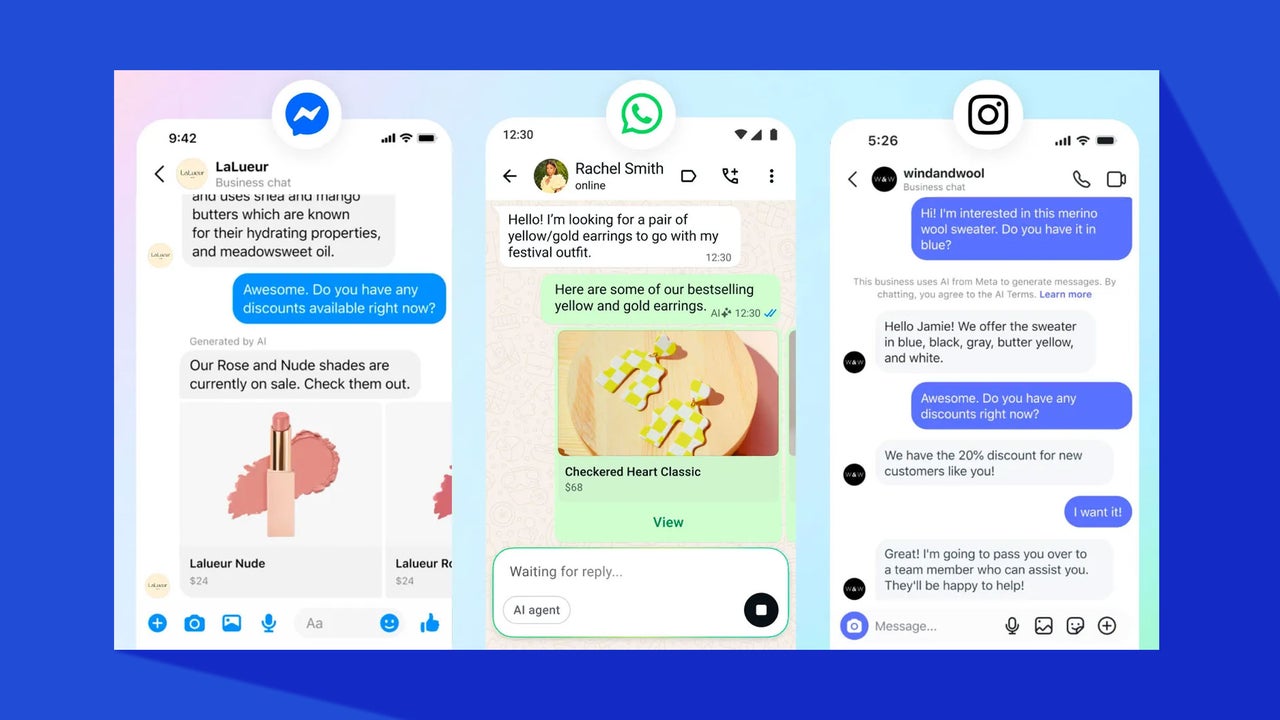
Meta said Wednesday that it’s going deeper into the business of selling artificial intelligence agents to companies of all sizes. The company announced new agents for businesses that will run on WhatsApp, Instagram, and Messenger. The agents can handle customer support requests, book calendar appointments, answer frequently asked questions, qualify leads, and escalate complicated queries to human operators. Over time, they will almost certainly evolve to complete more complex tasks on behalf of businesses.
Meta is also launching a Business Agent Platform that will let businesses build and manage custom AI agents. The platform connects to hundreds of non-Meta systems, including Shopify, Zendesk, and Shopee, where those agents can be deployed. The more responsibility and autonomy a business gives an agent, the greater the chance that agent gets stuck or makes mistakes on the customer’s behalf. Security exposure increases, too. Meta says the platform offers larger businesses enterprise-grade controls, guardrails, and measurement tools.
It’s easy to be cynical about Meta’s renewed forays into state-of-the-art AI models. Mark Zuckerberg has never met a new tech paradigm he didn’t want to lead. (Hello, metaverse.) Starting last summer, Meta rebuilt its AI research organization around a new (and very expensive group) of researchers called Meta Superintelligence Lab. The company may have the talent to compete with Google, OpenAI, and Anthropic, but the question has been, “To what end?” Does Meta need huge, cutting-edge AI models to power its core advertising business? That’s unclear. But it probably does need state-of-the-art models to power increasingly autonomous agents for businesses.
For Meta, selling AI agents to businesses may also make commercial sense. The company can use the vast reach of its social networks (where millions of businesses already have a presence) to find new customers for its agents. For some businesses, especially small ones, it may make sense to run AI agents on the same platforms where they run ads.
Many social network ads already contain a “click to contact” button that opens a messaging session between a consumer and a business, or perhaps a business’s agent. Meta has also been pushing businesses to treat messaging platforms like WhatsApp as support channels, as customers increasingly prefer texting to phone calls.
Whatever you think about the relative value of Meta’s social platforms, they’ve been a boon for many small businesses. Meta’s agents—if they work well and don’t alienate customers—may be a perfectly rational extension of the business side of social media.
Did Satya Nadella put the data center ‘water debate’ to rest? Not exactly
Microsoft’s CEO, Satya Nadella, tried to defuse the growing controversy over AI data center water consumption at Microsoft’s Build conference this week, claiming that modern data centers rely on highly efficient, closed-loop cooling systems that require minimal replenishment.
Nadella’s remarks gained traction among AI accelerationists on X after they were shared by the AI commentator Alex Volkov, who suggested Nadella had effectively put the “water debate” to rest.
Nadella said that once these closed-loop systems are initially filled, their annual water footprint drops significantly. To put the scale in context, Nadella said a modern data center’s total water usage over an entire year is roughly equivalent to that of a single restaurant. (The venture capitalist and Trump ally Marc Andreessen quipped: “And this is why we must also abolish restaurants.”)
Not so fast.
Industry analysts say Nadella is right when it comes to truly closed-loop data center cooling systems. Hyperscalers like Microsoft, Google, and AWS are aggressively shifting to advanced closed-loop and direct-to-chip liquid cooling for new frontier-model clusters. Microsoft said in 2024 that it would begin building only closed-loop systems that recycle water and use direct-to-chip cooling.
But a substantial number of the world’s operational data centers still rely on older evaporative cooling methods that can consume millions of gallons of water a day. Many hyperscale data centers built over the last decade use evaporative cooling towers, which continuously consume water (through evaporation) to dump heat. Google, for example, recently said that about two-thirds of its data centers still rely on evaporative cooling. This water is not reused indefinitely and must be replenished.
So Silicon Valley can’t truly absolve itself of water abuse until the thousands of data centers now supporting AI have converted to water-efficient cooling.
Survey: Public opinion has swung 49 points against data centers in just nine months
Public opposition to data centers is surging as the physical footprints of the AI boom mark the landscape, and local residents and politicians weigh the technological benefits against the economic and ecological costs. According to a new poll conducted by Embold Research, 71% of Americans now oppose having a data center built near their homes. This represents a dramatic 49-point swing in net opposition since September 2025, when the public was roughly evenly split.
The backlash crosses political and demographic lines, with opposition reaching 80% among young voters and 63% among Trump voters. The data reflects intensifying local resistance over power grid strain, water usage, and noise pollution. The friction is already impacting infrastructure rollouts, with public opposition scuttling at least 20 projects in the first quarter of 2026 alone.
More AI coverage from Fast Company:
- Trump’s AI order gives Washington a look at frontier models, but not much leverage
- Coursera now offers an AI-powered feed of short form educational content
- OpenAI CEO Sam Altman makes a lot of predictions. Here’s how they’ve fared so far
- Your AI-dar probably doesn’t work
Want exclusive reporting and trend analysis on technology, business innovation, future of work, and design? Sign up for Fast Company Premium.
