

At the age of 41, Cristiano Ronaldo is preparing for his sixth FIFA World Cup with Portugal.
Two years Ronaldo’s junior, Lionel Messi will turn 39 two days after Argentina’s second group-stage match against Austria.
Luka Modrić, Manuel Neuer and Edin Džeko are all famous 40-year-olds who will still be expected to feature prominently for their respective nations at this summer’s tournament in North America.
So it is not entirely inconceivable that Son Heung-Min will not still be around when the next World Cup comes around in four years’ time.
Nonetheless, given it is only fair to expect that the 33-year-old’s powers will not be the same then, it does beg the question if 2026 will be his last World Cup hurrah with South Korea.
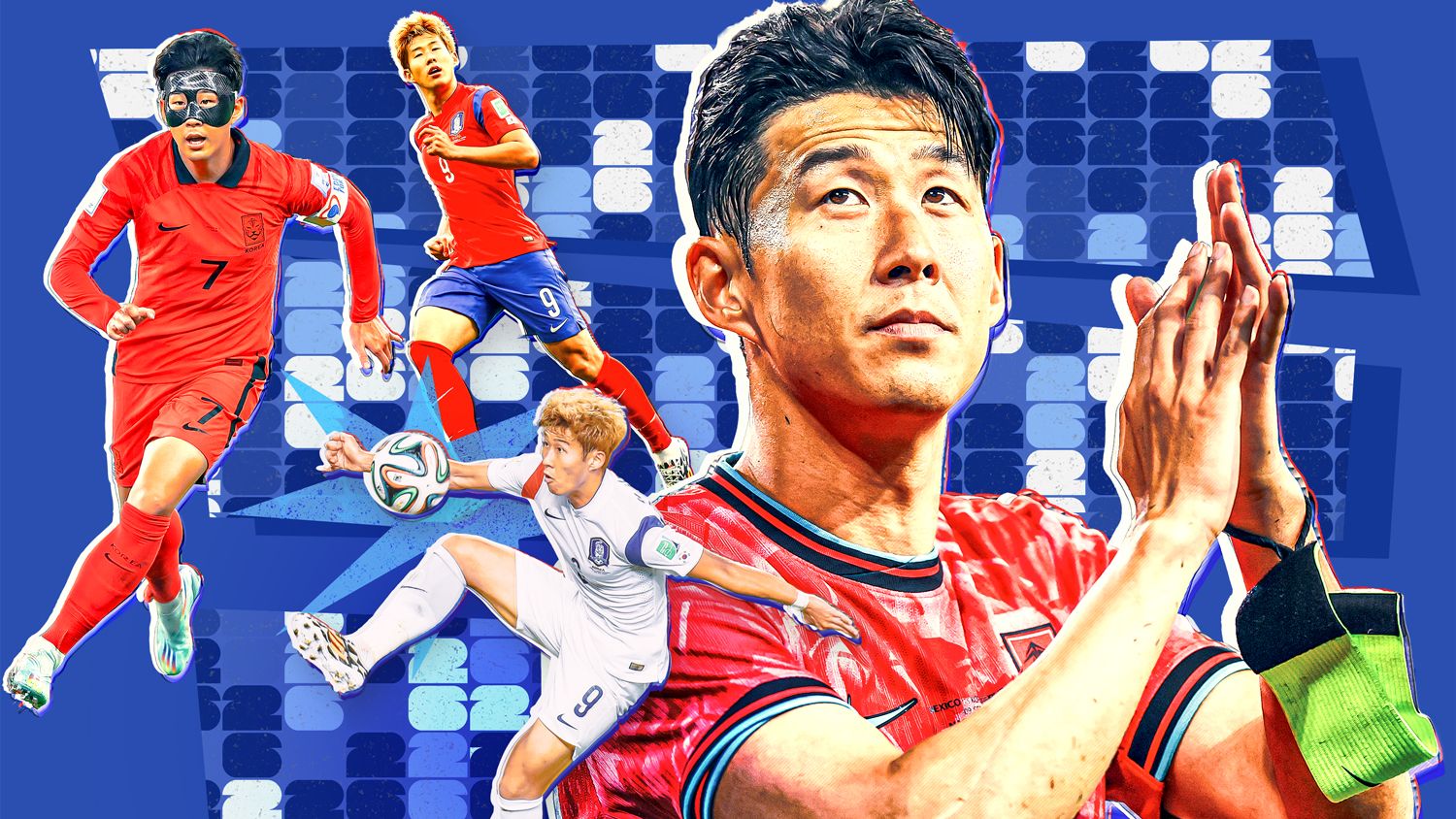
It was 12 years ago when Son first made his bow on world football’s biggest stage — almost unrecognizably with a golden mop of hair, and a No. 9 — and not his now-signature No. 7 — emblazoned on his chest and back.
In what proved to be South Korea’s worst performance at a World Cup since 1998, they picked up just one point from three matches in a fairly even group that included Belgium, Algeria and Russia.
At the time, Son has already moved from Hamburg — where he made his professional debut — to Bayer Leverkusen, and was slowly but surely emerging as one of the brightest prospects in Europe’s big five leagues. He already had 25 caps to his name as a 22-year-old.
But with others such as Koo Ja-Cheol, Ki Sung-Yueng and Park Chu-Young in the team, Son hadn’t yet had to shoulder the expectations an entire nation.
Son would put an inauspicious debut World Cup behind him to build on his blossoming career at Leverkusen. The following summer, he earned his big move to the Premier League with Tottenham Hotspur — and that is when he took the next step.
When the 2018 World Cup came around, Son was coming off back-to-back seasons where he had hit double-digit goals in the Premier League — with a total of 39 in all competition.
Opening defeats to Sweden and Mexico suggested it might be another tournament to forget for the South Koreans and, yet, they somehow entered their final group-stage game against Germany still with a mathematical chance of progressing.
Against all odds, they stunned the defending champions. After absorbing tremendous pressure throughout the 90 minutes, South Korea would score twice in injury-time to claim a shock 2-0 win — including a memorable sealer from Son when he ran half the length of the pitch to slot into an unguarded net after Neuer had ventured forward in a last-ditch attempt to help Germany find an equaliser.
Had Sweden lost to Mexico, instead of winning 3-0, in the other Group F decider, South Korea would actually have leapt off the foot of the table into second place — and sealed a spot in the knockout round.
Son later revealed that he wept at the final whistle because he thought they had indeed progressed. The real tears of sorrow followed shortly after upon realization that they had not.
But with two goals in three matches, Son had proven he belonged on the world stage. And, having captained the team against Germany in the absence of Ki, was now clearly South Korea’s main man for the years ahead — both in terms of a talisman and a leader.
Then came 2022.
When football all across the globe paused in the middle of the regular calendar for the first year-end World Cup, Son was in the middle of a club campaign that would ultimately see him become the first Asian to win the Premier League’s golden boot — which he would share with Mohamed Salah.
He had already featured in a UEFA Champions League final and was also part of the Spurs team that were runners-up in the Premier League in 2016-17.
By all accounts, Son was now a genuine world-class talent and one who — at the age of 30 — was arguably at the peak of his powers, although his availability had initially been in doubt due to multiple facial fractures suffered during a Tottenham game in November — which subsequently saw him don a protective mask for the entirety of the World Cup.
As they often do, South Korea did not make it easy for themselves.
An opening draw with Uruguay followed by a loss to Ghana meant they headed into their third game at the tournament once again needing a win against a global powerhouse: Portugal, on this occasion.
Things were looking bleak when Portugal took the lead after just five minutes and, although South Korea would equalise before the half-hour mark, their inability to add a second in the remainder of the 90 minutes meant they were still headed for the exit door.
Then, in the first minute of injury-time, history effectively repeated itself.
As South Korea cleared a Portugal corner, Son was once again charging forward on the counterattack — this time the one with the ball driving forward from deep inside his own half.
A 60-yard charge would finally be met with some resistance on the edge of the opposition area. Surrounded by three defenders, Son would this time emerge as the provider — somehow finding a channel to poke a through-pass for Hwang Hee-Chan to run onto and finish clinically.
For the first time since 2010, and after the heartbreak from four years earlier, South Korea had finally returned to the knockout stage of the World Cup.
The round of 16 would prove to be as far as they would go. A highly-anticipated glamor tie with Brazil was over by the time the South American giants took a four-goal lead inside 36 minutes, with a second-half Paik Seung-Ho effort providing the scantest of consolations from a 4-1 loss.
Nonetheless, Son had at least helped South Korea achieve something that eluded him since his international debut months after that 2010 World Cup campaign.
Son now heads into a fourth World Cup undeniably at a changing of seasons. If it isn’t the winter of his career yet, then it most definitely is late autumn.
Still, he remains South Korea’s most-influential player and — as he continues to show in the MLS with LAFC — one capable of producing that moment of magic which can singlehandly win matches.
The Taegeuk Warriors may lack depth but their strongest XI remains formidable enough, boasting the likes of Bayern Munich defender Kim Min-Jae, Paris Saint-Germain attacker Lee Kang-In, and other seasoned European campaigners such as Hwang In-Beom and Lee Jae-Sung of Feyenoord and Mainz respectively.
There should still be enough of a supporting cast to lend Son a helping hand, following a kind draw that has landed the South Koreans in a Group A where they have a genuine chance of progressing out of from ties against Czechia (June 11), co-hosts Mexico (June 18) and South Africa (June 24).
Even before this summer, Son’s World Cup story was already quite the tale — although there is at least one more chapter to write.
For all his exploits under football’s brightest lights, at times with an entire country’s expectations solely on his shoulders, Son deserves one final hurrah.
It may just come in 2026.
