

For the first time, a great power has moved to price transboundary climate-driven harms–massive wildfires–and extract compensation unilaterally. What was previously a development, insurance, or emissions-accounting issue is now a security and trade dispute between two G7 economies, setting a precedent that others may try to follow.
WASHINGTON, DC—Starting in mid-December 2025, southern Africa endured months of relentless rainfall. Floodwaters swallowed roads, bridges, clinics, and schools across Mozambique’s Gaza province, affecting more than 700,000 people and displacing more than 200,000. An estimated 300 deaths have been recorded, with waterborne diseases trailing in the floods’ wake. Within weeks, World Weather Attribution had delivered its verdict: climate change made the rainfall about 40% more intense.
The world’s donor community then did what it always does when climate disaster strikes Africa or another developing region. Blame was attributed to climate change, framed as an abstract collective failure with no single culprit. The victims were poor, but specific perpetrators could not be identified. Nobody billed anybody.
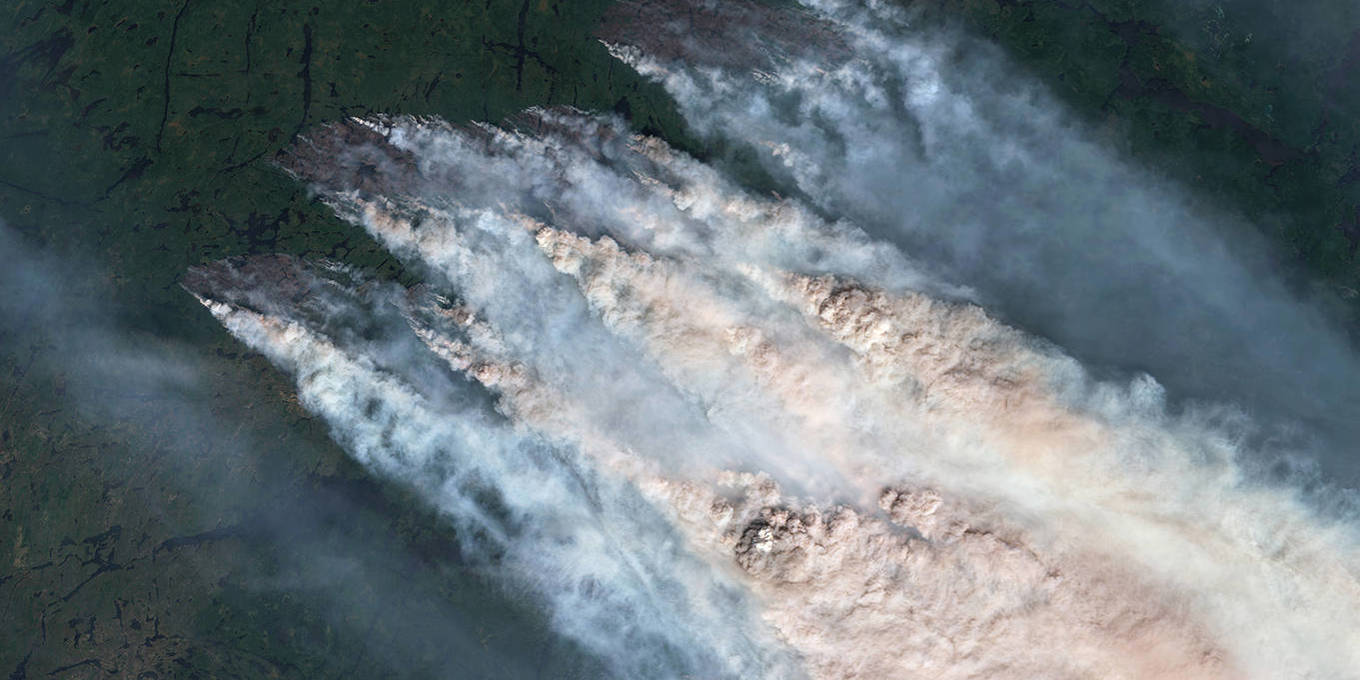
That era may now have ended, not in Maputo but in the haze over New Jersey. As smoke from hundreds of Canadian wildfires turned skies orange across much of the US, leading tens of millions of soccer fans to wonder if the world’s most-watched sporting event would be disrupted, President Donald Trump responded not with cooperation or mutual aid, but with a demand for accountability. America had been “unnecessarily invaded” by Canadian pollution, he declared. The Canadian government was willfully negligent in forest management and should therefore face higher tariffs.
The politics of climate change have crossed a critical threshold. For the first time, a great power has moved to demand a price for transboundary climate-driven harms and extract compensation unilaterally (in this case from a friend, neighbor, and ally). What was previously a development, insurance, or emissions-accounting issue is now a bilateral security and trade dispute between two G7 economies. We are witnessing the first international climate-security conflict.
The irony is thick. Canadian Prime Minister Mark Carney spent a decade as the world’s most influential financial voice on climate matters. As the first and most prominent central banker to warn of the “tragedy of the horizon,” he gave the financial industry permission to treat climate change as a source of financial risk—some of which are physical, and some of which follow from the broader economic transition.
As prime minister, however, Carney faces pressure from a domestic coalition demanding expanded oil and gas production, and from a US administration that is brandishing tariffs to demand more extraction, more pipelines, and greater use of the same fossil fuels that are contributing to the frequency and severity of wildfires. This episode shows that science will not adjudicate climate-related costs, which instead will be weaponized by whoever holds coercive power. The smoke is Canadian, the carbon is global, and the tariff is American. The pattern will be familiar to developing countries. Back in 2019, the G20 halted multilateral funding for oil and gas exploration in developing countries just because it could, ignoring the consequences for growth in developing countries.
The US-Canada dispute marks the opening of a new era, because physics guarantees more of the same. The January 2025 Los Angeles fires were already one of the costliest disasters ever recorded, but they were confined to one country. That will not always be the case. Smoke, floodwaters, and drought-driven migration respect no borders. India, Pakistan, and China all share Himalayan-fed rivers; six countries already contest control over the Mekong River’s flows; Senegal is absorbing ever more Saharan dust from Mauritania; and displaced peoples are constantly pressing on Europe.
Each represents a “smoke tariff” waiting to be levied. If the US can tariff Canadian smoke, shouldn’t Mozambique—a country battered by a problem it did nothing to cause—be able to make claims against the largest emitters? Small island states have already brought the issue to the International Court of Justice (ICJ). Can’t they now cite America’s conduct as proof that climate harm is an actionable interstate injury? If such damage is indeed real, quantifiable, and attributable, someone must pay.
In fact, the economics of a securitized, everyone-for-themselves climate response are ruinous. If Europe were to adopt a “fortress” position, it would be slower to decarbonize and would forgo roughly 14% of potential output by 2050. Insurers warn that fragmentation is already trapping capital behind borders, leading to regional risk pools that are too correlated to diversify and causing coverage to retreat from areas where risk is concentrated. Responding to climate damage with tariffs will accelerate these trends.
Rather than trying to improvise crisis by crisis, policymakers should focus on three priorities. The first is to treat climate resilience as a form of shared security. Carney is right to emphasize that fighting climate change is every country’s responsibility, but his message has fallen on deaf ears. Decades of joint US-Canada firefighting notwithstanding, tariffs now look like an easier way to assign responsibility. But investing a portion of tariff revenue jointly in fire management, watershed protection, and grid resilience would at least help to neutralize such policies’ potential for weaponization.
A second priority is to establish the means for adjudication before there can be further escalation. The world needs a common machinery grounded in science, not leverage for assessing transboundary climate harms. Perhaps AI can provide solutions. Who contributed what? Who failed to adapt? And who therefore owes whom? Small island states and the V20 have led this conversation and secured an ICJ advisory opinion and a United Nations loss-and-damage fund. These responses now must be strengthened. Trade rules should distinguish legitimate carbon levies from coercive climate protectionism.
The third priority is to prevent sovereignty claims from being pitted against decarbonization. Implicit in the US-Canada dispute is an assumption that climate costs must reflect someone’s negligence, rather than being a shared consequence of accumulated emissions. Such thinking inevitably lets the largest emitters convert the costs of their own inaction into leverage. The better alternative to border-tariff logic is resilient, efficient carbon markets that link emissions, market access, and climate-adaptation finance and investment coherently and predictably. Maybe the time has come for a real discussion on global compliance markets.
The smoke over New York and New Jersey ultimately cleared enough for Spain to win the World Cup, with both Trump and Carney watching from the stands. But the precedent has been set. Climate activists have long asked whether countries would cooperate to prevent harm. Now we must ask what governments will do as the harms mount. Will they find a better answer than billing each other at the border? The world’s first climate-security fight does not inspire confidence, but there is still time.
