

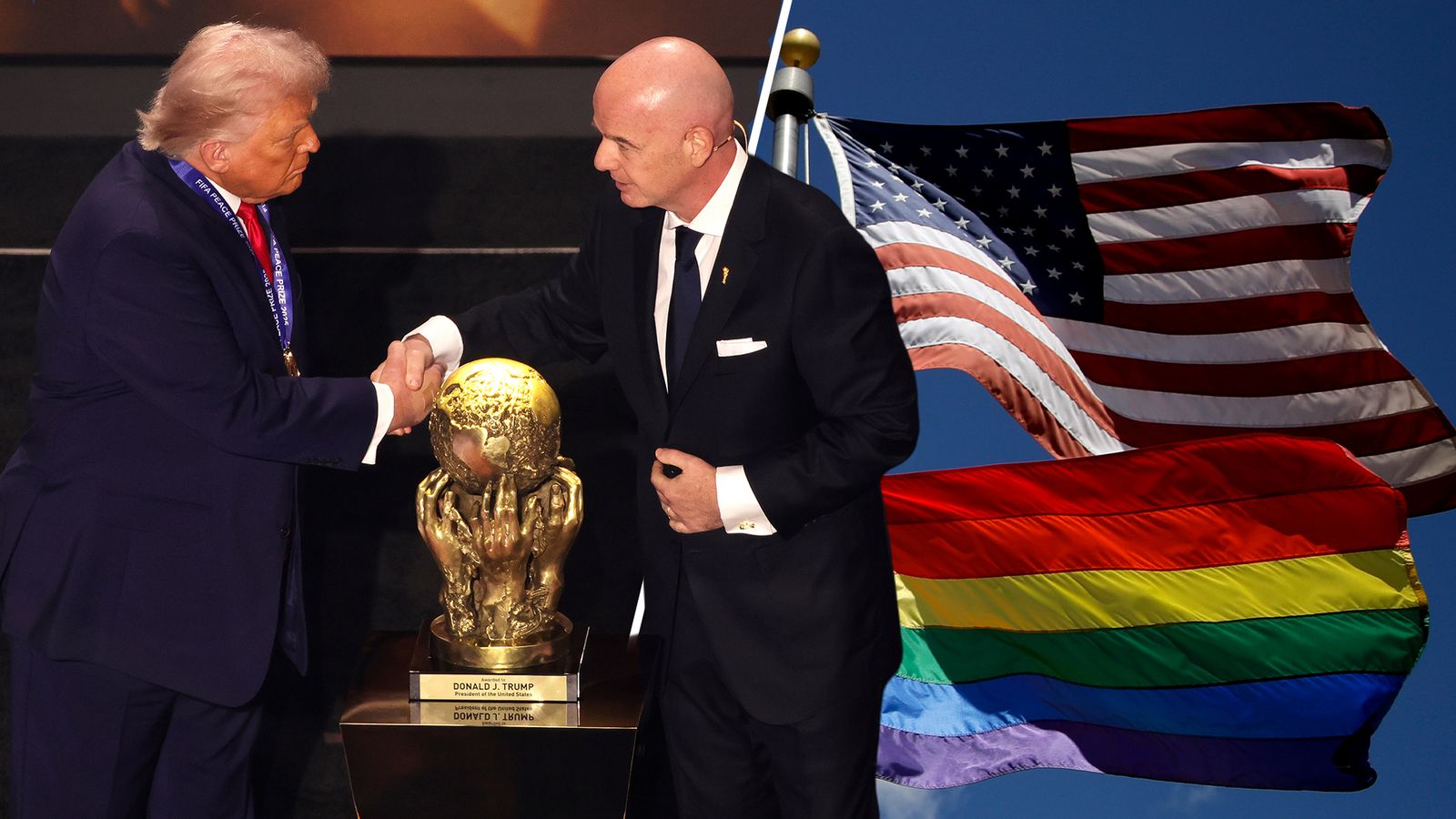
There’s a notable absence from this summer’s FIFA men’s World Cup that you might have missed.
England’s official LGBTQ supporters’ group, Three Lions Pride (3LP) announced in January that they would not have a visible presence at the tournament.
3LP, which has around 350 members and regularly attends matches, said in a statement that the “dangerous rollback of human rights” in the United States has caused significant concern for fans who were planning to attend the tournament.
The group said that they no longer believed the tournament would be a safe and inclusive environment.
“We very loudly raised our concerns about both Russia and Qatar as hosts, and it would be irresponsible of us to not raise our voices as loudly about the 2026 host,” 3LP said.
“As ever, our primary concern is about the safety of our members and queer fans worldwide under the principle that fans should be able to follow their team wherever they play without fear of abuse, violence, or arrest just for their existence.”
Here, Sky Sports News covers:
-
Why are LBGTQ fan groups not attending games in the United States?
-
What changes made by President Donald Trump’s administration have affected LGBTQ inclusion in the United States?
-
What has FIFA said about safety for LGBTQ fans, and will there be any improvements from the 2022 World Cup in Qatar?
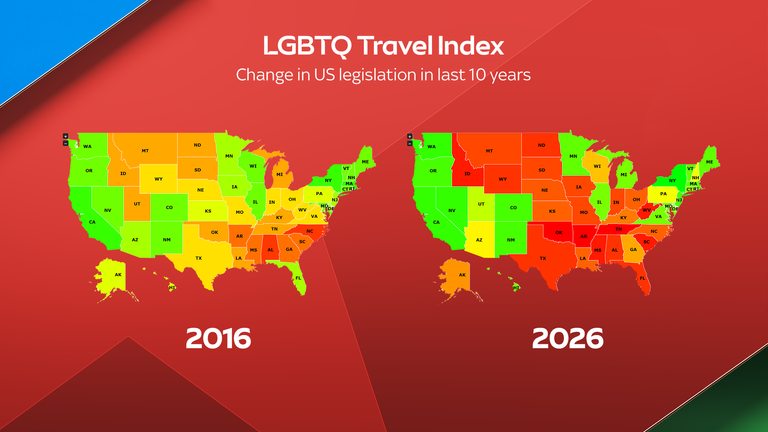
US map illustrating LGBTQ legislation changes in last 10 years, with green indicating states that are safer to be openly LGBTQ and red indicating states with more restrictions on things like access to healthcare, idenfication and school curriculums
Three Lions Pride said that they will continue to support LGBTQ England fans heading to the tournament but emphasised their concern, in particular for transgender fans who they say would be at a high risk of violence and discrimination.
United States President Donald Trump’s administration put executive orders into place in 2025 targeting transgender people, including federal restrictions on language, pronouns, healthcare, access to facilities such as bathrooms, military service, sports bans and identification requirements.
Since 3LP’s decision, other supporter groups have followed suit, and organisations such as Human Rights Watch have called on FIFA to do more to keep LGBTQ fans safe in the United States.
Minky Worden, director of global initiatives for Human Rights Watch, explained in an interview with Sky Sports News that the political climate in the US and FIFA’s organisation has made the event inaccessible to LGBTQ fans.
“It’s important for fans to know, if they are coming to the World Cup, they are going to have to protect themselves and not rely on FIFA to uphold their basic rights,” Worden said.
“This is the largest World Cup ever, the most lucrative for FIFA, and they certainly have the money to put in the protections if they want to.
“There are a lot of dangers, including that journalists, fans, players, and officials will have to travel across borders.
“We’ve already identified that the [US] border is where you can have trouble [entering the country], maybe based on your social media posts advancing LGBTQ rights.
“I think it’s dangerous that this is the first World Cup to include human rights criteria and a human rights framework, and yet those protections aren’t visible, and they aren’t named for LGBTQ people.”
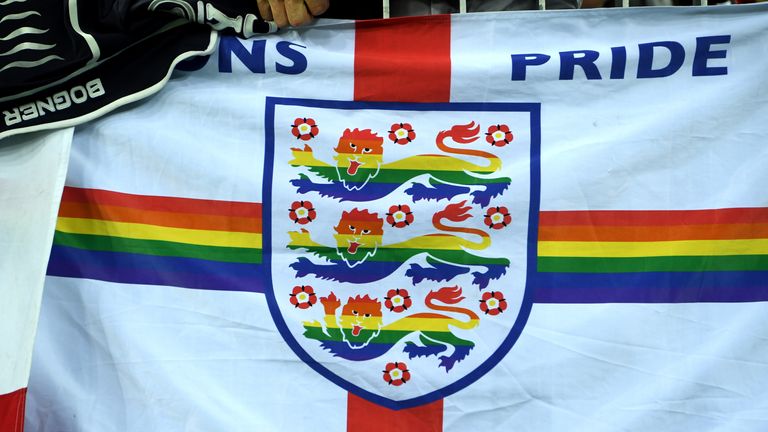
The last time Three Lions Pride had a visible presence at a men’s World Cup was in Russia, in 2018
When the United States, Canada and Mexico were announced as hosts for the 2026 FIFA Men’s World Cup, it was initially seen as a refreshing break for the LGBTQ community.
FIFA President Gianni Infantino has widely marketed the 2026 edition as the “biggest and most inclusive” World Cup to date.
However, as the tournament draws closer, more concerns continue to be raised about the safety of LGBTQ fans wishing to travel to the United States.
German group Queer Football Fanclub (QFF), which represents a network of LGBTQ fan groups primarily in Germany, supported 3LP’s decision not to attend the tournament and said they would do the same.
Sven Kistner, QFF spokesperson, told Sky Sports News: “We will not have an official QFF presence at the World Cup in the US.
“The Trump administration is putting more and more pressure on minorities and LGBTQI+ people […] and that makes it difficult to say ‘yes, we are willing to go there and willing to attend the games.'”
Kistner emphasised that it was policies and statements made by Trump’s administration that caused QFF to pull out of attending, not the culture in the United States.
“I think that the American people are generally quite open to our concerns and to living as you want to live, however the Trump administration is doing quite the opposite at the moment.
“It’s not about the American people, because all the people from the US I am talking to are really great people, nice people.
“I just hope that the situation changes for the people in the US, and especially for all the minorities in the US, not only LGBTQ, but other minorities as well.”
The cause for concern for LGBTQ fans
In the years that have followed since the 2026 host announcement, the US has seen a large number of rollbacks on inclusive laws and access to safe spaces for transgender people under Trump’s administration.
As of May 29, 2026, the American Civil Liberties Union (ACLU) was tracking 530 anti-LGBTQ bills in the US.
In the host states for World Cup games, the ACLU is tracking 110 anti-LGBTQ bills in state government, with 39 in Missouri alone.
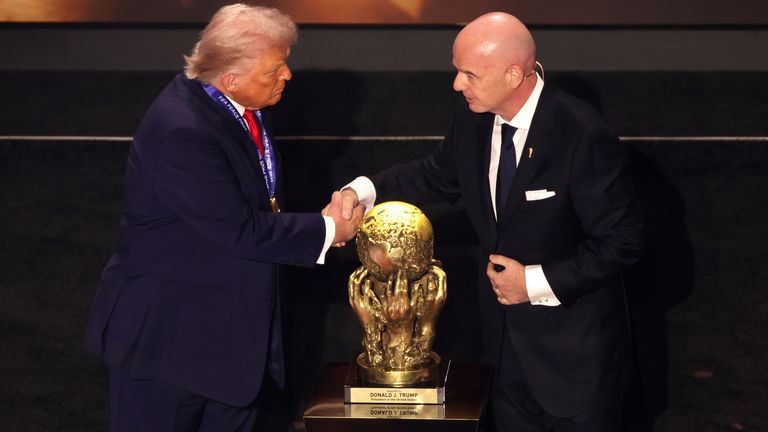
American President Donald Trump with FIFA President Gianni Infantino
Following an executive order from Trump in 2025, the US State Department finalised rules in March 2026 requiring visa applicants to list their sex assigned at birth on the application, meaning transgender fans wishing to travel to the US risk facing barrier to entry through denied applications.
This means any person who has changed their gender marker on their passport as a part of their transition, risks being denied a visa if the sex they were assigned with at birth differs from the gender listed on their passport.
If discrepancies are found between a person’s passport and their application, it could be deemed fraudulent, possibly leading to entry refusal, detention and permanent bans from the United States.
“This is a clear violation of LGBTQ rights, and there are no options to get around this,” Worden explained.
“Even if they somehow manage to get a visa to the United States at the border, they would have to say that they are their deadname in order to come in.
“This is an example of a new rule that is exclusive to the Trump administration.”
In Mexico, which will host 13 games across three cities, discrimination based on sexual orientation is prohibited under the federal constitution, however, violence against LGBTQ+ individuals remains a significant issue in some regions.
In recent friendlies ahead of the tournament, a homophobic chant used by fans in Mexico resurfaced, drawing concern about its use at the 2026 World Cup.
Canada, host of 13 games across two cities, has the most inclusive LGBTQ rights and cultural acceptance of the three countries, with federal legal protection against discrimination based on sexual orientation and gender identity/expression.
While this is a three-nation host tournament, the bulk of the games are in the USA, and Human Rights Watch released a reporters’ guide ahead of the tournament, outlining what they referred to as a “climate of fear” in the United States.
The report outlined that the LGBTQ community continues to be the target of abusive policies in the country.
The report includes the current political administration’s executive actions prohibiting government use of the term gender, restricting and withdrawing support for gender-affirming care for youth, and rollbacks on protections for transgender students.
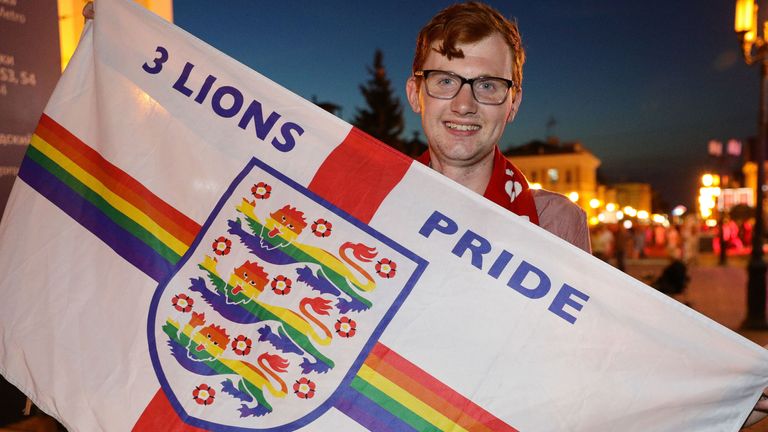
Jo White, co-founder of of Three Lions Pride
In addition, 19 states currently restrict classroom discussion of sexual orientation and gender identity and less than half of US states prohibit discrimination based on sexual orientation and gender identity.
World Cup host states Florida and Texas are two of the most restrictive. In 2022, Florida signed into law the widely dubbed “Don’t Say Gay” and “Don’t Say They” bill.
While this bill affects education on sexual identity, it also includes restrictions on using pronouns consistent with gender identity.
The United States often has different legislation state by state, meaning some states like California, which will host eight matches in Los Angeles, remains one of the most inclusive for LGBTQ people.
California has a number of laws that protect transgender, gender diverse, and intersex individuals in various settings, including at school, in employment, and in access to health care.
New York and New Jersey, which will host several matches including the World Cup final, are also among the most protective states for LGBTQ rights with robust anti-discrimination laws.
Will 2026 be different from previous tournaments?
Following criticism from Russia and Qatar, and a rise of abuse from fans around the world, FIFA introduced a zero-tolerance anti-discrimination framework in 2024.
This includes a procedure to halt matches during homophobic chants, monitor fan behaviour and social media, and work with partners to promote inclusivity. Critics however have questioned the inconsistent enforcement of the framework.
The 2025 Club World Cup, also hosted in the United States, was widely seen as a trial run for the 2026 tournament.
Prior to the Club World Cup, FIFA had announced a number of anti-discrimination and anti-racism activations for the event.
In June 2025, The Athletic reported that FIFA would be shelving these activations, removing signs planned for stadiums and video and social media campaigns. FIFA eventually reintroduced some anti-racism messaging, following criticism.
FIFA has said it has plans to reinstate some of the messaging for the 2026 World Cup, including the “No Racism” campaign and “Unite for Peace” initiatives.
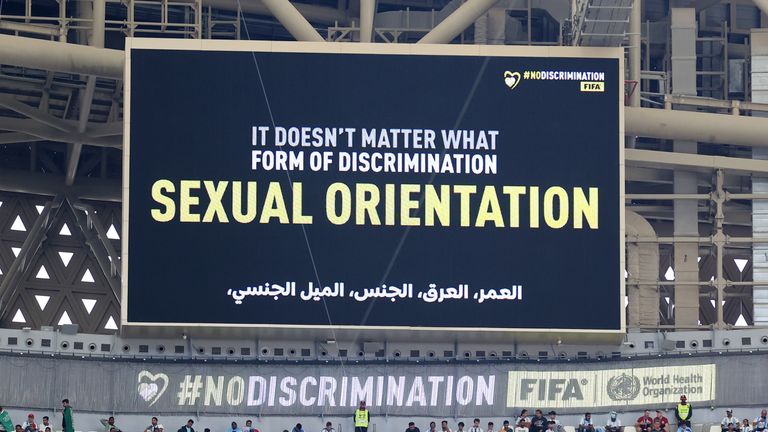
FIFA’s anti-discrimination messaging at a group stage match at the 2022 Qatar World Cup
“FIFA’s position is clear, everyone is welcome and football must remain a space where all people feel safe, respected and included,” a FIFA spokesperson explained to Sky Sports News when asked about what measures would be put in place to ensure the safety of LGBTQ fans at the World Cup.
“This commitment is underpinned by the FIFA Statutes, which expressly prohibit discrimination of any kind, and by FIFA’s Human Rights Policy.
“FIFA’s expectations for its tournaments are grounded in a core principle of inclusion for all and remains committed to working with all stakeholders to create an environment where every supporter can enjoy the tournament with confidence and dignity.”
FIFA explained they are committed to ensuring remedies for anyone who believes they may have been adversely affected in connection with FIFA tournaments or activities.
This includes raising concerns and incidents through FIFA’s independent grievance and reporting portal.
However, Worden says that FIFA are not following the statutes they have laid out.
“FIFA adopted the UN guiding principles on business and human rights 10 years ago.
“It means FIFA has to commit to using leverage within your system to advance human rights and prevent discrimination.
“It’s not consistent to pander to the Trump administration and at the same time tell LGBT fans, workers, players, officials and others that they’re safe. It’s an inconsistent policy, FIFA is not prepared to uphold its own rules.”
Kistner agreed, saying: “FIFA has it written that the host country must be open [to LGBTQ people], but they don’t stick to it.
“That makes it really difficult for a football supporter to believe what they are saying, they are not credible anymore.”
Sky Sports News understands that FIFA has collaborated with national LGBTQ rights groups, including but not limited to Athlete Ally, GLAAD, Pride House, and the Right To Be ahead of this summer’s tournament.
How is the LGBTQ community being supported at the World Cup?
There are ways in which the community is being celebrated in a more visible way than in Russia and Qatar.
Pride House announced they would be running a location in all 16 host cities across the US, Canada and Mexico, a stark contrast to Qatar where no official Pride House was established, and Russia where the establishment was shut down before the tournament.
The goal of the Pride House is to provide safe and welcoming environments for queer fans and allies during the World Cup, featuring watch parties, community events and providing resources.
The local organising committee in Seattle, announced that the game on Friday 26 June would be celebrated as the “Pride Match.”
“With hundreds of thousands of visitors and millions of viewers tuning into Seattle during Pride Weekend, we are presented with a unique opportunity to make a lasting impact,” the committee said in a post on the Seattle World Cup 2026 website.
The decision to dub the group stage match as the “Seattle Pride Match”, which falls on Seattle’s annual pride weekend, was made prior to the World Cup draw in December.
The match will now feature Egypt and Iran, two countries with some of strictest anti-LGBTQ laws in the world.
Seattle’s Pride Match Advisory Committee said the match will go ahead as planned, despite complaints from both countries.
“The Pride Match is a host city-led expression of Seattle and Washington State’s commitment to creating a welcoming and inclusive environment where everyone belongs: players, fans, residents and visitors alike,” the committee said in a statement.
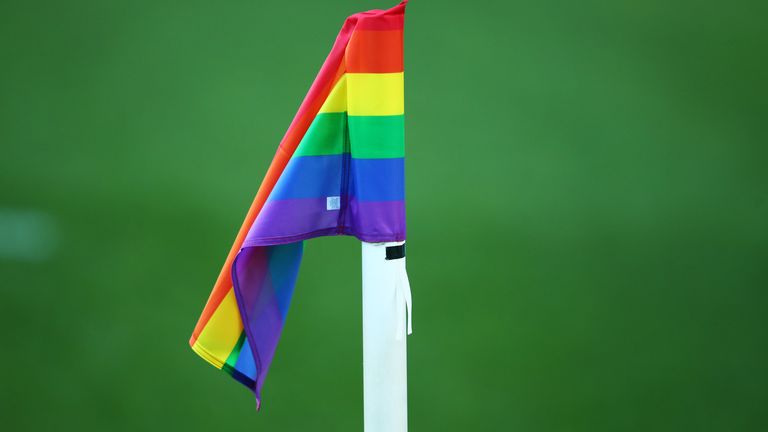
FIFA has said that pride flags will be allowed in stadiums at the 2026 World Cup
One thing is clear, as with the last two tournaments in Russia and Qatar, LGBTQ rights are an ever-present story line for the 2026 World Cup.
From North America, we head to another joint host in Spain, Portugal and Morocco for the 2030 edition before 2034 in Saudi Arabia.
In Saudi, same-sex sexual activity and non-conformant gender expression is strictly prohibited under Sharia law.
“The entire [bid] process did not embrace LGBT rights as one of the areas of protection,” Worden explained.
“That’s deeply problematic, because Saudi Arabia has national policies and laws that prevent LGBT people from existing. They certainly exist in Saudi Arabia.
“FIFA glossing over this and pretending it’s not a problem is a problem.”
It seems likely that FIFA will continue to host the World Cup in countries with laws and policies that Human Rights Watch says harms LGBTQ people and other minorities.
It is unrealistic to expect change in hosts that have already been announced, and if you look deep enough, there are challenges that need to be addressed in nearly every country.
However, stronger statements ahead of these tournaments would go a long way in pushing forward the inclusive game that FIFA says it wants.
“This is a tournament that had so much promise,” 3LP said in their statement.
“That hope, that optimism, is well and truly shattered. As a group, we are no longer surprised by hollow platitudes from FIFA nor are we shocked at having a major tournament that disregards the safety, security or wellbeing of fans.”
Sky Sports News reached out to the US Government for a comment but did not hear back by the time of publication.
