

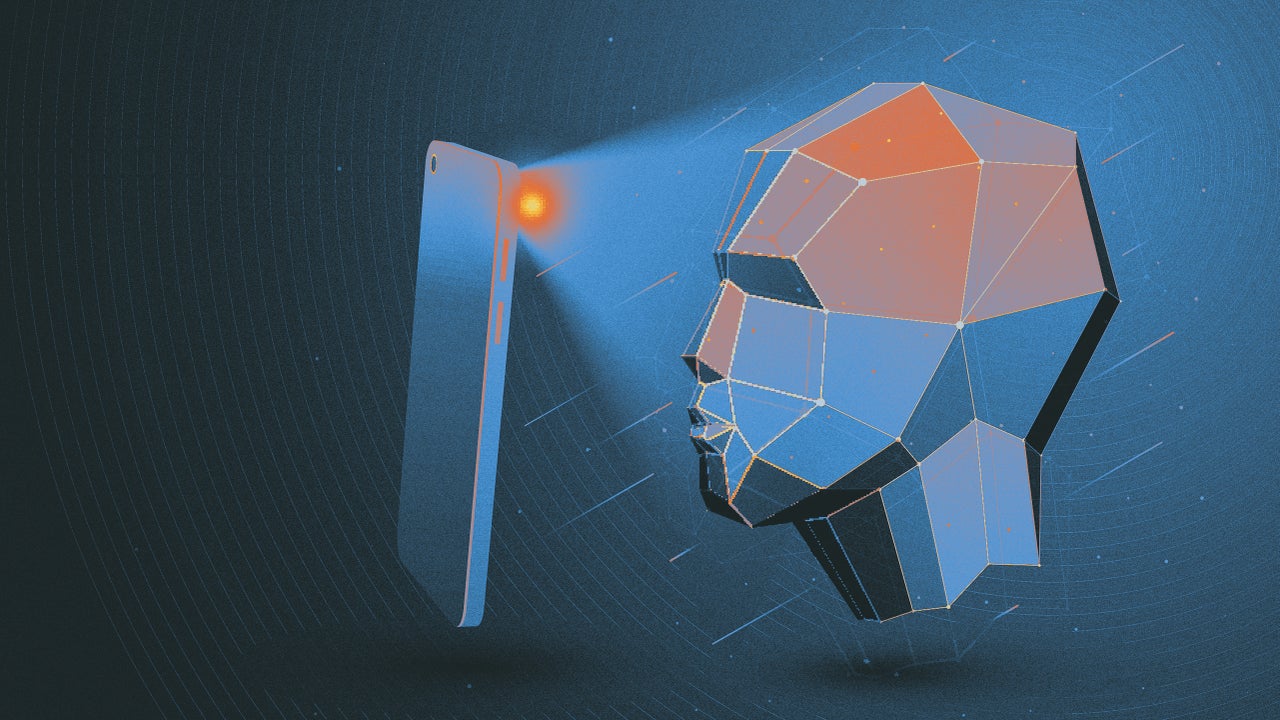
If you are fortunate enough to have a ticket to an event at Madison Square Garden in New York—say, an NBA Finals game—one aspect of your visit will be having your face scanned by a facial recognition system.
Major event venues are increasingly using the technology. Some, like the Garden, use it for surveillance purposes, and some, like Citizens Bank Park in Philadelphia and Oracle Park in San Francisco, to offer visitors optional ticketless admission.
Adoption of facial recognition technology is increasing, becoming more prevalent in daily life, from public buses to public buildings. The Transportation Security Administration has deployed the latest facial recognition technology at security checkpoints at numerous airports. The agency says the new system will be used in cities across the U.S. that are hosting FIFA World Cup 2026 soccer matches.
The growing use of facial recognition has broadened concerns about accuracy and bias. But in my research studying facial recognition technology in the Vision Lab at the University of Dayton, I’ve found that advanced deep learning models have made face recognition systems more accurate and reliable. The AI models, trained on hundreds of millions of face images, are more than 99% accurate in controlled environments—settings such as cellphones, airports, and border checkpoints.
Facial recognition basics
Facial recognition involves three steps: locate a face in an image or video frame, create a faceprint that catalogs salient features—including the shape of the face and landmark points such as eyes, nose and mouth—and record the texture of the skin. Then it compares the faceprint to those in a database, which may be inside a smartphone or at a bank or hospital, to verify a person’s identity or allow access.
In the physical world, these systems are faster and simpler than requiring people to show IDs. In the online world, they are easier than entering a login name and password. Facial recognition also significantly reduces the possibility of forgery or fraud when compared with ID cards or passwords.
Improvements in the technology have come from a variety of research projects. FaceNet, a deep learning model developed by Google, has upgraded recognition of faces that are partly covered or hidden in images. DeepFace, a landmark AI-powered facial recognition system developed by Facebook AI Research, achieves the same high level of verification shown by humans.
NeoFace, a highly accurate AI-powered algorithm developed by NEC, is built into Mobile Fortify, the mobile facial recognition system used by U.S. Immigration and Customs Enforcement to identify people.
Reducing false positives and negatives
Real-world conditions such as poor lighting, difficult viewing angles, extreme facial expressions, concealment by face masks or sunglasses, and poor image quality can still hamper performance, leading to faulty identification. False positives and false negatives are the two primary errors. False positives are when a person is incorrectly matched to a different person in a database. False negatives are when an individual is not found in a database, even though their image exists there.
False positives are more critical in security and safety applications. They can lead to wrongful accusations, discrimination, or detention. In 2025, a 50-year-old woman in Tennessee was arrested and put in jail for six months based on an AI-powered facial recognition system that incorrectly tied her to a North Dakota bank fraud investigation. False negatives may prompt authorities to deny services to people who qualify for them.
Accuracy can suffer if models are trained on data that does not reflect real-world demographics. A 2025 study showed that systems trained on public databases in which people with darker skin tones are lacking leads to lower recognition accuracy. This kind of unintentional bias in training data may lead to misidentification of women, people of color, and young and old people. One report found that facial recognition systems used by 42 U.S. government agencies falsely identified African American and Asian faces 10 to 100 times as often than white faces, in some cases leading to wrongful arrests.
Accuracy also deteriorates when people are wearing heavy makeup and for young children and old people because their landmark features tend to change more quickly than adults of other ages. Balancing datasets by collecting more representative images across age, gender, and ethnicity, and frequently updating databases, can improve accuracy and produce fairer results.
Adjusting images before they are sent for matching —for example, changing brightness levels—can improve accuracy, too. People squint their eyes when they are in dark or very bright light. Advanced processing software can mimic this human trait to improve the facial recognition system’s ability to extract facial features from the image.
A full face from partial data
Humans are good at identifying a person even if part of their face is covered by sunglasses or a face mask. The brain assigns more significance to the exposed details. If facial recognition programs can learn to do the same, that would reduce false positives and false negatives, including when cameras only capture part of a face.
Facial dynamics can help, too. It may be difficult for someone to recognize a middle school friend they haven’t seen for many years, but if the old friend smiles, that change in expression can immediately improve recall.
Researchers are developing a facial recognition method for doing this, known as volumetric directional patterning. It captures the subtle movements of facial muscles, as well as eyelid blinks, in consecutive frames of a video. It tracks how facial landmarks shift over time, as well as the context in which a face is being observed, which can improve recognition accuracy.
Researchers are also creating more accurate AI-powered three-dimensional systems that can capture the precise geometry of a face, including features such as contours of the eye socket, nose and chin. This kind of work could lead to antispoofing techniques that prevent facial recognition systems from falling for fake faces that are generated by computers and their human operators.
Fewer mistaken identities
Setting aside questions of privacy and cybersecurity and lingering issues of bias, one thing is clear: Facial recognition technology is improving. And that promises fewer errors—and fewer of the serious consequences that come with them.
Vijayan Asari is a professor of electrical and computer engineering at the University of Dayton.
This article is republished from The Conversation under a Creative Commons license. Read the original article.
