

When University of Pennsylvania student Crystal Yang was in high school, she and her friends were avid players of the trendy online game Wordle. One of Yang’s friends, however, is blind and was unable to join in.
That inspired Yang, while still a high school student, to work with researchers at Texas A&M University looking at conversational audio interface possibilities for the game. Soon, she founded a nonprofit called Audemy that has developed more than 50 audio-powered games accessible to blind and visually impaired players. The organization is now also at work on an accessible gaming console that will incorporate audio and tactile features and can function without Wi-Fi.
AI has been important to much of Yang’s work, from coding to management. Over the years, AI has helped her learn to conduct user research and write a formal paper, plug in new game ideas to an existing template, and even use computer-aided design tools and evaluate potential components as Audemy prototypes the console.
“It’s been a very helpful tool throughout, allowing me to champion the issues I’m passionate about, as well as continue using it to multiply my capabilities,” Yang says.
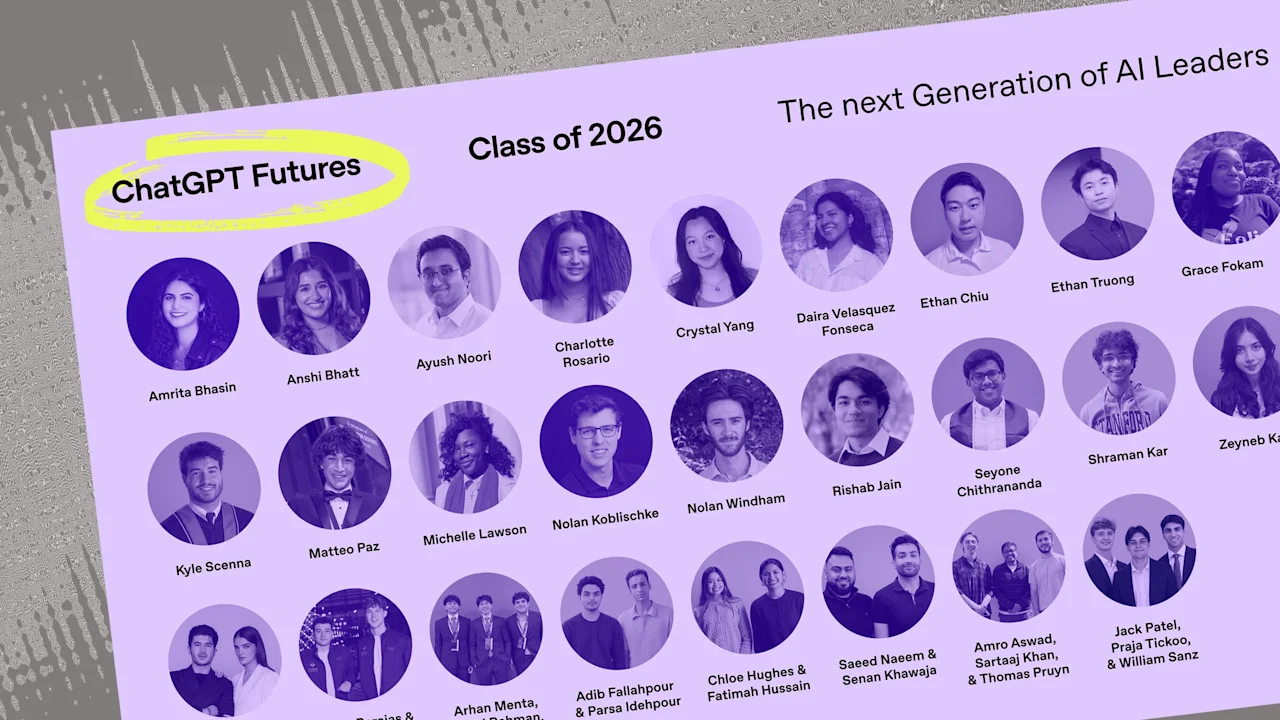
Yang is one of 26 students and other young people recently awarded a $10,000 grant by OpenAI as part of a program called ChatGPT Futures, designed to showcase how a rising generation is using the technology for good. As OpenAI notes, the graduating class of 2026 is the first cohort of university students to have ChatGPT, which debuted to the public in fall 2022, available throughout nearly their entire college experience.
“What we’ve seen is that these students are using AI to build things that many wouldn’t have previously thought were possible,” says Leah Belsky, head of education at OpenAI.
Other honorees of the program are using AI to build space robots to relieve astronauts of routine tasks; develop novel ways to spot disaster survivors through walls and debris using Wi-Fi signals; help older people avoid online scams; and let Latin American street vendors track their finances. Several are working on AI applications in science and medicine, including predicting the functions of proteins in the body; connecting people with local mental health resources; and optimizing drug production.
Ayush Noori, who holds bachelor’s and master’s degrees from Harvard University and is now pursuing a doctorate as a Rhodes Scholar at the University of Oxford, recently worked to develop a graph AI model called Proton that generates hypotheses around neurological disease. Noori says his work is motivated in part by his experiene caring for his late grandmother, who had a rare neurodegenerative disease.
Already Proton has shown promise in suggesting candidate drugs for bipolar disorder and Alzheimer’s disease—results validated, respectively, by experiments on lab-grown brain tissue and an analysis of health records.
“My mission is to develop AI systems that transform the understanding, diagnosis, and treatment of neurological disease and other currently unsolved medical conditions,” says Noori, who has training in both neuroscience and computer science.
Belsky says she’s seen firsthand how AI tools like OpenAI’s ChatGPT and, more recently, its coding tool Codex can enable students to pursue ambitious tasks and projects, whether that involves building websites and apps or creating new businesses and nonprofits.
“AI is giving them confidence,” she says. “It’s giving them agency, and it’s giving them a sense that they can actually learn and do things that they didn’t previously think were possible.”
OpenAI solicited entries for the program in March, calling for applications from students and recent graduates in the U.S. and Canada ages 18 to 25 who “leverage AI to expand their capacity” and “demonstrate agency” through their work, while holding “a bold, thoughtful vision for the future.”
“Building a Future for Education”
The ChatGPT Futures awards come as critics increasingly worry that overreliance on AI can hamper rather than help education, with students becoming overly reliant on the technology rather than learning new skills on their own, avoiding the sometimes tedious, iterative processes that are critical to learning. And, of course, educators on both the K-12 and college levels have warned of students using AI to cheat on assignments, skipping opportunities for learning and engendering mistrust between students and faculty.
But Belsky says that as she’s visited campuses she’s seen more examples of students using AI to pursue new initiatives. In some cases, she says, AI can help expand access to experiences previously limited to students involved in hacker spaces, entrepreneurial classes, and other facilities that haven’t been broadly available.
“Our hope is to work with the entire education ecosystem to start building a future for education, where schools and universities can intentionally work to unlock this type of agency for all students,” Belsky says.
To be sure, AI hasn’t replaced the role of human collaboration in either education or entrepreneurship. Yang, for instance, is now managing a team of volunteer developers contributing to Audemy games—though AI has helped with the recruitment and onboarding process—and Noori’s papers on Proton and other AI health topics are the product of a lengthy list of human collaborators. Yang and Noori, along with a number of others being awarded, continue to pursue their formal education.
The ChatGPT Futures honorees are set to visit OpenAI in June, where they’ll meet with employees, share their projects, and receive their awards, Belsky says.
“We haven’t put a restriction on what they do with these awards,” she says. “But my hope is that they spend part of their efforts both advancing their projects and engaging others and inspiring them to build [projects] the way they have.”
